MAINTENANCE AND SERVICING
Charging the Battery
CAUTION
• Ventilate the area where batterie s are
being charged.
• Do NOT charge a frozen battery. Warm to 60°F
(16°C) before charging.
• Do NOT connect or disconnect live circuits. To
prevent sparks, turn off charger and connect
positive cable first. PROTECT YOUR EYES.
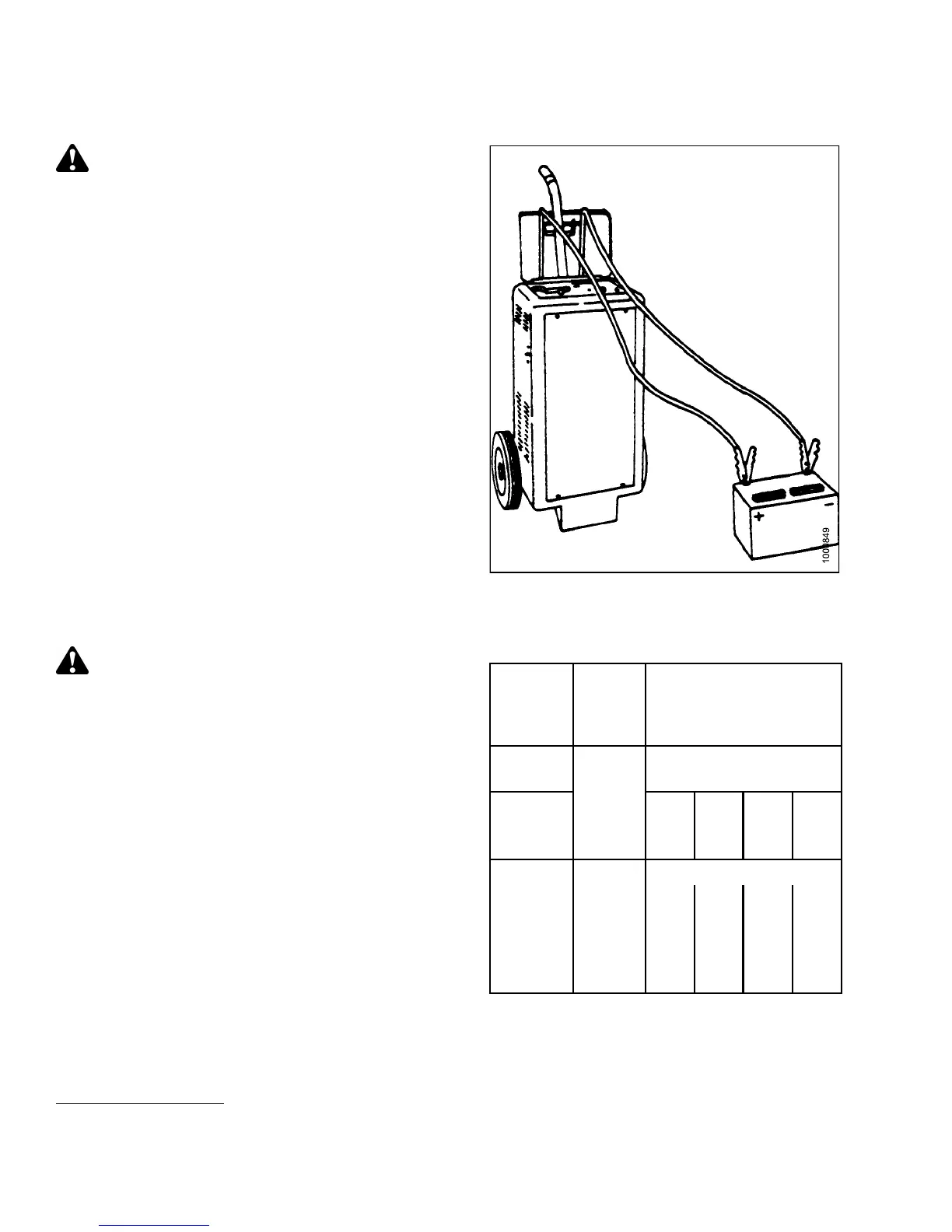
• If charging battery in windrower, disconnect
POSITIVE battery cable before connecting charger
cable, then connect ground cable last, away
from battery.
• Stop or cut back charging rate if battery feels hot,
or is venting electrolyte. Battery temperature m ust
NOT exceed 125°F (52°C).
• The maximum charge rate in amperes should be
NO MORE than 1/3 of the battery’s reserve capacity
minute rating. If the terminal voltage exceeds 16.0
volts while charging, reduce the charge rate.
• Continue charging and reduce the rate as needed
until a two hour period results in no increase in
voltage or decrease in current.
Figure 5.119: Charging Battery
WARNING
• Gel and AGM (Absor
bed Glass Mat) batteries
require a voltag
e-limited charger. Charging a G el
or AGM battery on
a typical shop charger—even
one time—may gre
atly shorten its life .
• If the electroly
te is accessible, verify that plates
are covered bef
ore beginning to charge. At the
end of charge, a
dd distilled water as needed
to bring levels
to the proper height. If water is
added, charge f
or an additional 30 minutes to
mix. If electr
olyte levels are low, but battery is not
accessible, r
emove b a ttery from servi ce.
Table5.1VoltageChart
Voltage
State of
Charge
(%)
Approximate Battery
Charging Time
29
to Full
Charge at 80°F/27°C.
(Minutes)
Standard
Battery
Maximum Rate at
(Amps)
12 Volts 50 30 20 10
12.6 100
— FULL CHARGE —
12.4 75 20 35 48 90
12.2 50 45
75
95 180
12.0 25 65 115 145 280
11.8 0 85 150 195 37 0
29. Charging time depends upon battery capacity, condition, age, temperature, and efficiency of charger.
147649 370 Revision A


 To Next Page