OPERATION
4.4.2 H ead er Float
The header floa
t feature allows the header to closely follow ground contours and respond quickly to sudden
changes or obs
tacles. The float setting is ideal when the cutterbar is on the ground with minimal bouncing,
scooping, or p
ushing so il.
IMPORTAN T:
• Set header float as light as possible—without excessive bouncing—to avoid frequent breakage of knife
components, scooping soil, or soil build-up at the cutterbar in w et conditions.
• Avoid excessive bouncing (resulting is a ragged cut) by operating at a slower ground speed when the float setting
is light.
• Readjust the float when adding or removing optional attachments that affect the weight of the header.
• Refer to your header operator’s manual for setting float and adjustment guidelines.
Float Oper
ating Guidelines
When working with the cutterbar on the ground:
• Set center-link to mid-range position (05.0 on cab display module [CDM]). Refer to 4.4.5 Adjusting Header Angle,
page 203.
• Minimize scooping rocks by adjusting the header skid shoes downward to raise guards when operating at the
flattest header angle.
• Adjust header height or adjust header angle to minimize pushing soil.
When working with the cutterbar off the ground (draper header only):
• Set center-link to mid-range position (05.0 on CDM). Refer to 4.4.5 Adjusting Header Angle, page 203.
• Balance the amount of header weight carried by the float and stabilizer whee ls. Refer to your draper header
operator’s manual.
• Use the CDM controls to automatically maintain cutting height. Refer to 4.4.6 Cutting Height, page 206.
Checking Float
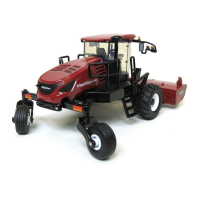
M-Series windrowers are equipped with primary (coarse) and secondary (fine) float adjustment systems. The primary
or coarse adjustment uses drawbolts to change the tension on the springs in the lift linkages. The secondary or fine
adjustment uses hydraulic cylinders to change the spring tension.
147649 195 Revision A


 To Next Page