Monitoring
214
Instructions for use Zeus Infinity Empowered SW 2.n
Beat and rhythm classification
The beat classification refers to the analysis of indi-
vidual beats.
All detected beats are analyzed by Zeus IE for the
heart rate calculation; however, questionable beats
are excluded from arrhythmia detection.
The rhythm classification refers to the analysis of
beat sequences.
Zeus IE compares the sequence of the last eight
beats with the saved beat sequences. If two or
more events are detected at the same time,
Zeus IE reports an alarm for the event with the
highest priority.
Automatic learning and relearning
If the ECG cables are connected to the patient,
Zeus IE starts a learning phase in the following sit-
uations:
– After switching on Zeus IE
– When leaving the system standby mode
– After switching on arrhythmia detection
– When changing the lead in the ECG channels
ECG-HF (ECG1) or ECG-ST (ECG2) while
processing one or two ECG signals
ECG – ST monitoring
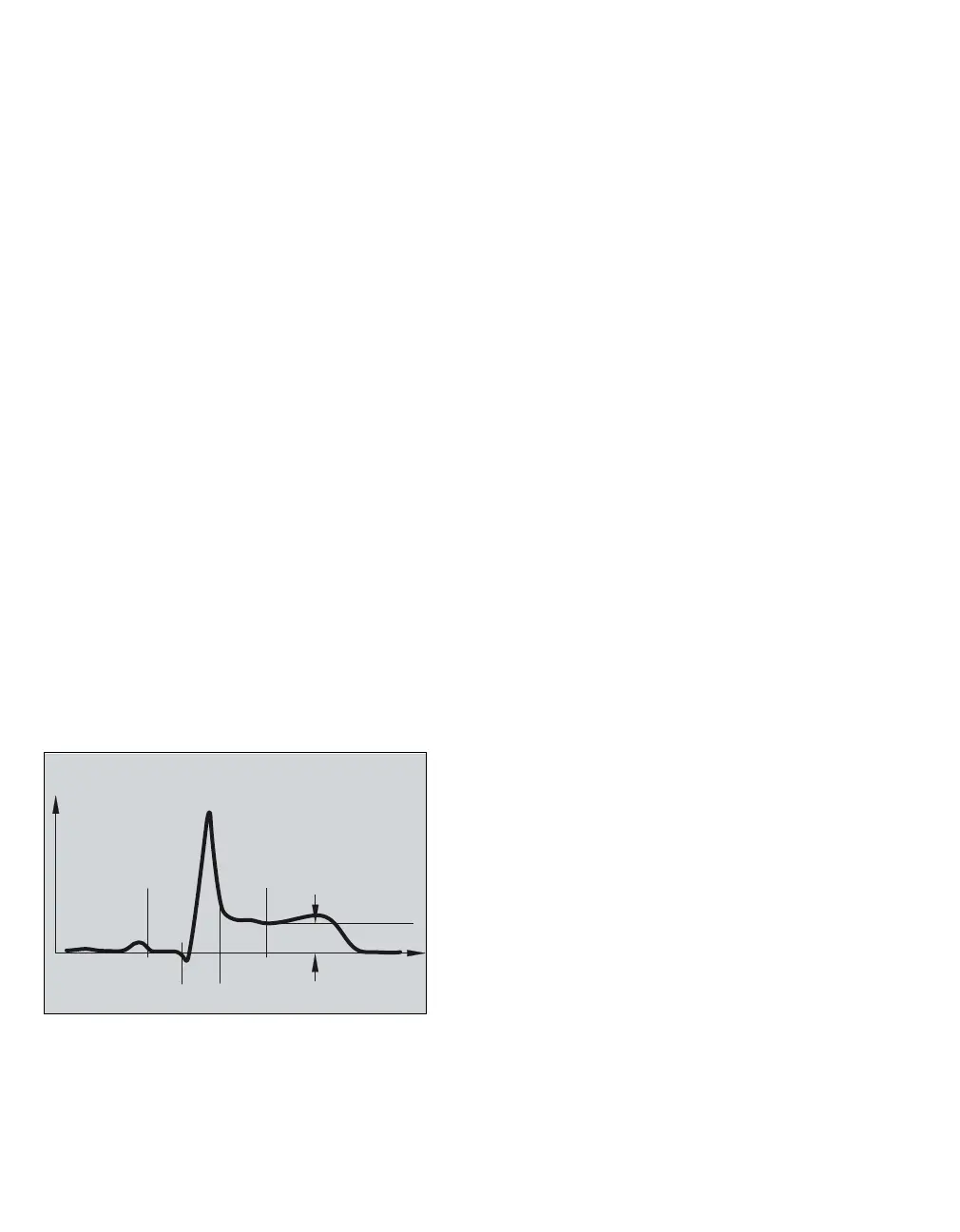
Zeus IE can detect and display deviations in the ST
segment of the QRS complex relating to an isoelec-
tric baseline.
This is done by measuring voltage values and com-
paring them at two measurement points, the isoe-
lectric point and ST measurement point. The isoe-
lectric point defines the zero voltage (no electrical
activity = 0 mm) and appears on the horizontal time
axis as basic setting 28 ms before the beginning of
the QRS complex. The ST measurement point ap-
pears in the ST segment between the end of the
QRS complex (J point) and the T segment as basic
setting 80 ms after the end of the QRS complex.
247
Voltage
[mV]
Isoelectric
measuring point
ST measuring point
ST level
Time [s]
QRS start QRS end
ST deviation



 To Next Page