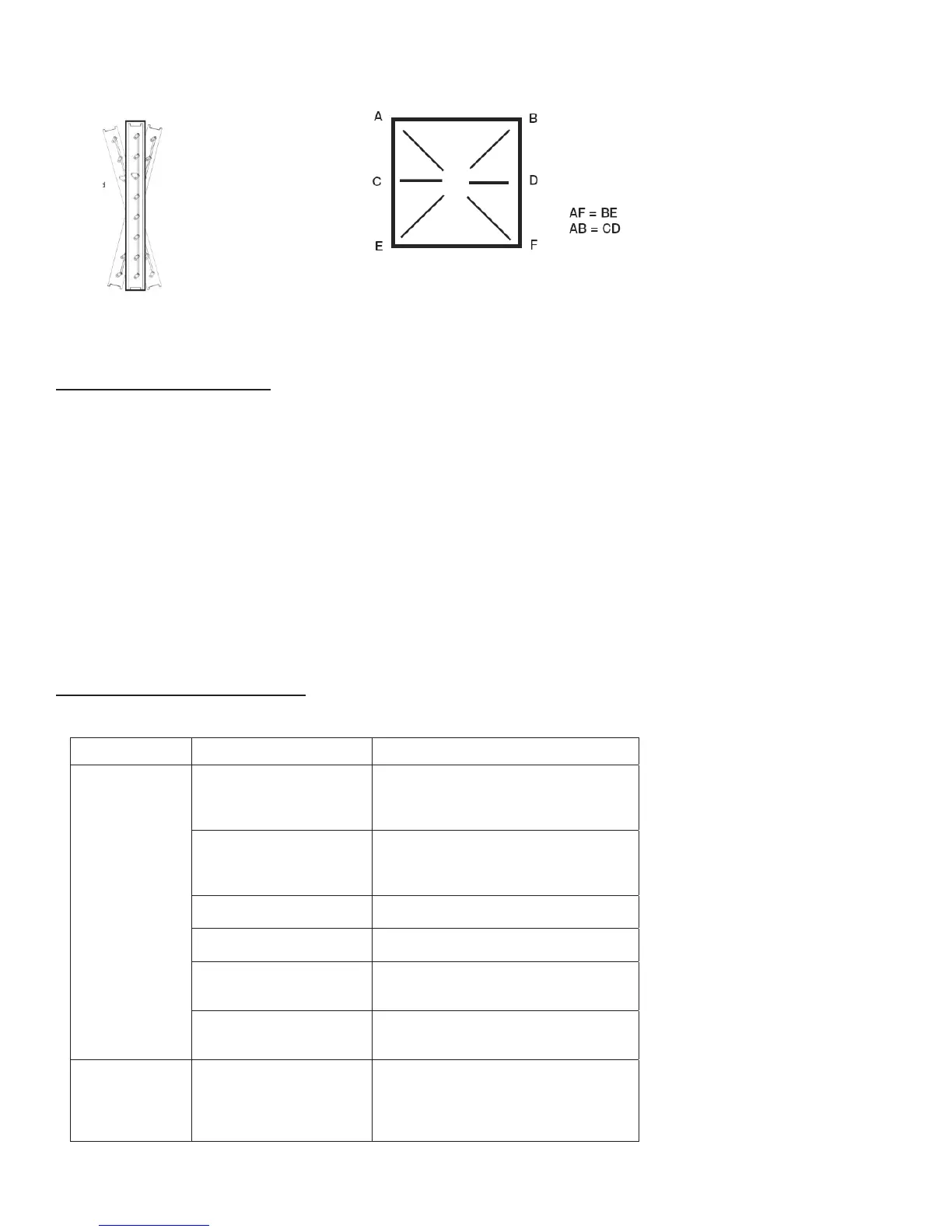
7. Individual damper sections, as well as entire multiple section assemblies must be completely square and free from racking, twisting,
or bending. Measure diagonally from upper corners to opposite lower corners of each section (see drawing below).
Do not twist
or bow. Mount
damper plumb
in the opening.
8. Damper blades, axles, and linkage must operate without binding. Before system operation, cycle dampers after installation to assure
proper operation. On multiple section assemblies, all sections should open and close simultaneously.
Damper Maintenance:
Alumavent control dampers are designed to operate trouble free under normal operation. Dampers are to be installed square and
straight so as to prevent binding during operation. The following annual damper maintenance suggestions will help to insure proper
damper operation and increase the life expectancy of the damper.
Foreign Matter: Over the course of time, dirt and grime may collect on damper surfaces. The damper surfaces should
be cleaned with a non oil-based mild solvent/cleaner to prevent hindrance to airflow.
Moving Parts: Make sure that parts such as linkage, bearings, blades, etc. that are intended to move freely can do so.
Lubricating these components helps prevent possible rusting and unnecessary friction increase. Use
only a moli-spray oil or similar graphite based dry lubricant, as regular lubricating oil will attract dirt.
Bearings: Synthetic, oil impregnated, and ball bearings (without grease fittings) do not require lubrication.
Ball bearings with grease fittings require only minimal grease.
Closure: Remove foreign materials that may be interfering with blade closure or effective sealing of the blades with
each other or with the frame.
Operation: While operating the damper through its full cycle, check to see that the blades open and close properly.
If there is a problem, check for loose linkage, especially at the actuator. Tighten linkage where required.
Damper Trouble Shooting:
The following is a cause and correction list for common concerns regarding damper operation:
Page 3 of 4
Symptom
Possible Cause Corrective Action
Damper does
not fully open
and/or fully
close
Frame is racked/out-of-
square
bind on jamb seals
Adjust frame so that it is s
plumb within the duct/opening
power, adjust and tighten
linkage
Defective actuator
Locate screws and remove or relocate
wall or floor
Damper installed too far into wall. Move
out
Clean with a non oil-based
mild solvent/cleaner
Actuator runs
hot or makes a
humming noise
Actuator prohibited from
reaching end of stroke
Disconnect linkage from
jackshaft, open damper, power actuator
to
end of spring, tighten linkage. Verify
amperage draw.



 To Next Page