PowerPC e500 Core Family Reference Manual, Rev. 1
2-30 Freescale Semiconductor
Register Model
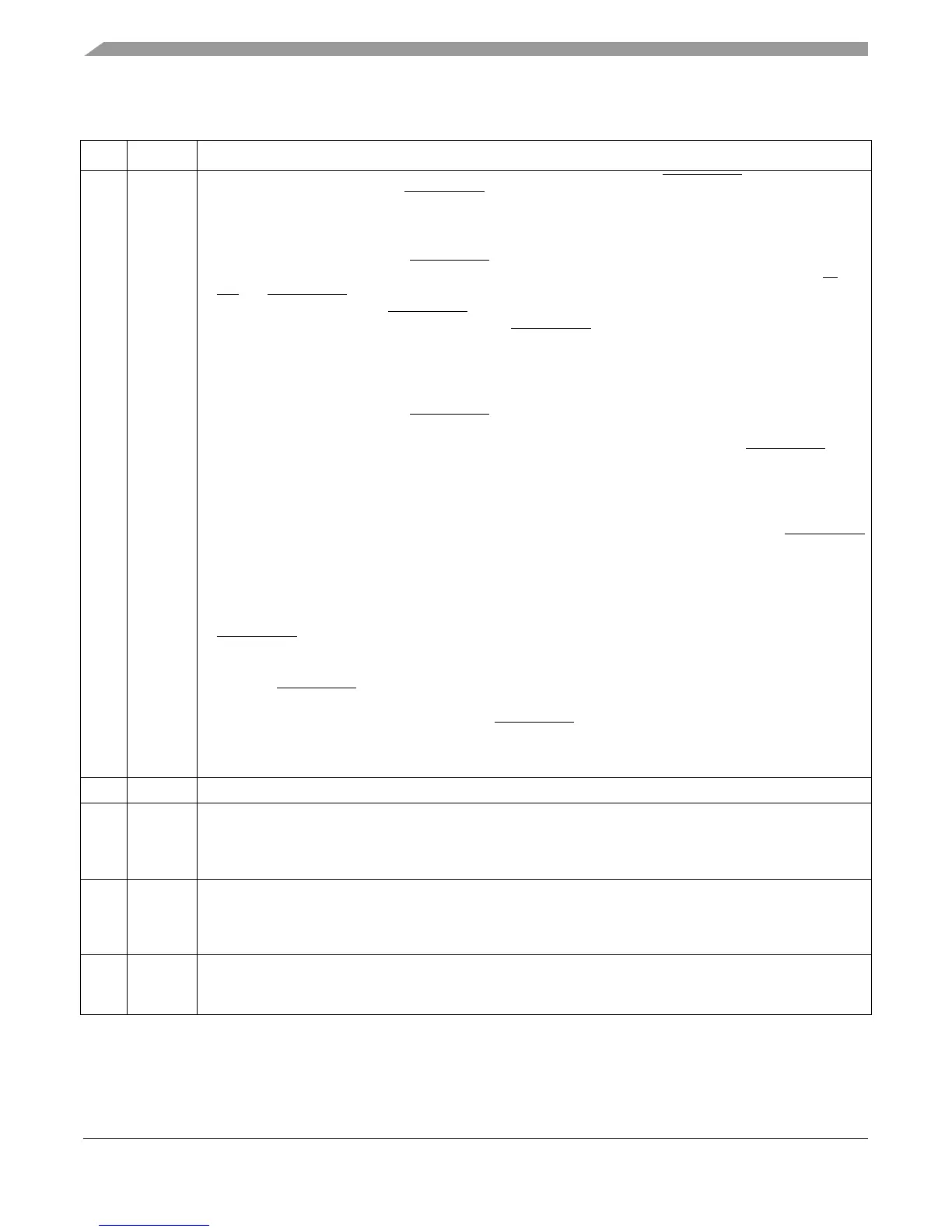
46 RFXE Read fault exception enable. With MSR[ME], controls whether assertion of
core_fault_in
causes a machine
check interrupt. The assertion of
core_fault_in
can result from an L2 multibit ECC error. It can also occur for
a system error if logic on the integrated device signals a fault for a transaction initiated by the core (for
example, a master abort of a PCI transaction). See Section 13.8, “Proper Reporting of Bus Faults,” for
more information.
0 Normal operation. Assertion of
core_fault_in
does not cause a machine check. In normal operation RFXE
should be left clear and an interrupt should be reported by the integrated device (possibly through
int
or
cint
) for
core_fault_in
conditions. If RFXE = 0, it is important that the integrated device be configured to
generate an interrupt when
core_fault_in
is asserted.
1 A machine check can occur due to assertion of
core_fault_in
.
If MSR[ME] = 1 and a fault is signaled, a machine check interrupt occurs.
If MSR[ME] = 0 and a fault is signaled, a checkstop occurs.
Caveat for the e500v1.
CCB transactions that result in
core_fault_in
being asserted may contain bad data. On the e500v1, such
transactions may complete and the core could continue executing with bad data. Note that even if the
peripheral blocks are set up to signal an interrupt to the core for all possible causes of
core_fault_in
, there
is some delay between the completion of the CCB transaction (with potentially bad data) and the
processing of the peripheral block interrupt.Therefore, for the e500v1, if software requires that code
execution stop immediately when a bus fault occurs, RFXE must be set to 1 so that at a minimum, a
machine check exception is taken immediately and processing does not continue with potentially bad data.
However, setting RFXE when a peripheral block is configured to also signal an interrupt for a
core_fault_in
case results in both a machine check interrupt (if MSR[ME] = 0) and potentially an external interrupt
occuring when a bus fault is detected by that peripheral.þIn this case, the machine check interrupt handler
can re-enable external interrupts and wait for the interrupt from the peripheral block, and handle the
condition, before returning from the machine check exception, therefore protecting the system from using
potentially bad data. Note that on the e500v2, the core never completes a CCB transaction for which
core_fault_in is
asserted, so the above precautions regarding execution with bad data do not apply.
RFXE should always be 0 for normal operation for the e500v2; it should be set only if it is necessary that the
assertion of
core_fault_in
generate a machine check or a checkstop because peripherals are not properly
configured to report bus faults. This would typically occur only during software or firmware development.
Note that the L2 cache detects any assertion of
core_fault_in
and ensures that the L2 cache is not corrupted
when data is dropped for this type of transaction.
Machine check generation for bus parity errors is not affected by this bit.
47 — Reserved, should be cleared.
48 R1DPE R1 data bus parity enable. The R1 and R2 data buses are described in Chapter 13, “Core Complex Bus
(CCB).”
0 R1 data bus parity checking disabled
1 R1 data bus parity checking enabled
49 R2DPE R2 data bus parity enable. The R1 and R2 data buses are described in Chapter 13, “Core Complex Bus
(CCB).”
0 R2 data bus parity checking disabled
1 R2 data bus parity checking enabled
50 ASTME Address bus streaming mode enable
0 Address bus streaming mode disabled
1 Address bus streaming mode enabled
Table 2-15. HID1 Field Descriptions (continued)
Bits Name Description



 To Next Page