PowerPC e500 Core Family Reference Manual, Rev. 1
11-12 Freescale Semiconductor
L1 Caches
The instruction cache is loaded only as a result of instruction fetching or by an Instruction Cache
Block Touch and Lock Set (icbtls) instruction. It is not snooped for general coherency with other
caches; however, it is snooped when the Instruction Cache Block Invalidate (icbi) instruction is
executed by this processor or any other processor in the system. Instruction cache coherency must
be maintained by software and is supported by a fast hardware flash invalidation capability as
described in Section 11.5, “L1 Data Cache Flushing.” Also, the flushing of self-modifying code
from the data cache is described in Section 3.3.1.2.1, “Self-Modifying Code.”
11.3.3 Snoop Signaling
Cache coherency is maintained automatically by hardware through snooping the CCB. A bus
transaction is enabled for snooping by setting the coherency-required bit (M) in the TLBs
(WIMGE = 0bxx1xx). The M bit state is sent with the address on the internal global signal (gbl
).
If gbl
is asserted, the CCB transaction should be snooped by other bus masters.
To determine the action to take due to a snoop, the cache coherency protocol uses transfer type
(ttx) encodings, which are transmitted on the CCB with the address. See Section 13.2, “Signal
Summary.” These encodings indicate whether a transaction is a read or write and whether a
reading bus master has an intent to modify the cache line. The core complex uses these encodings
as a CCB master to signal its intent to other snooping caches.
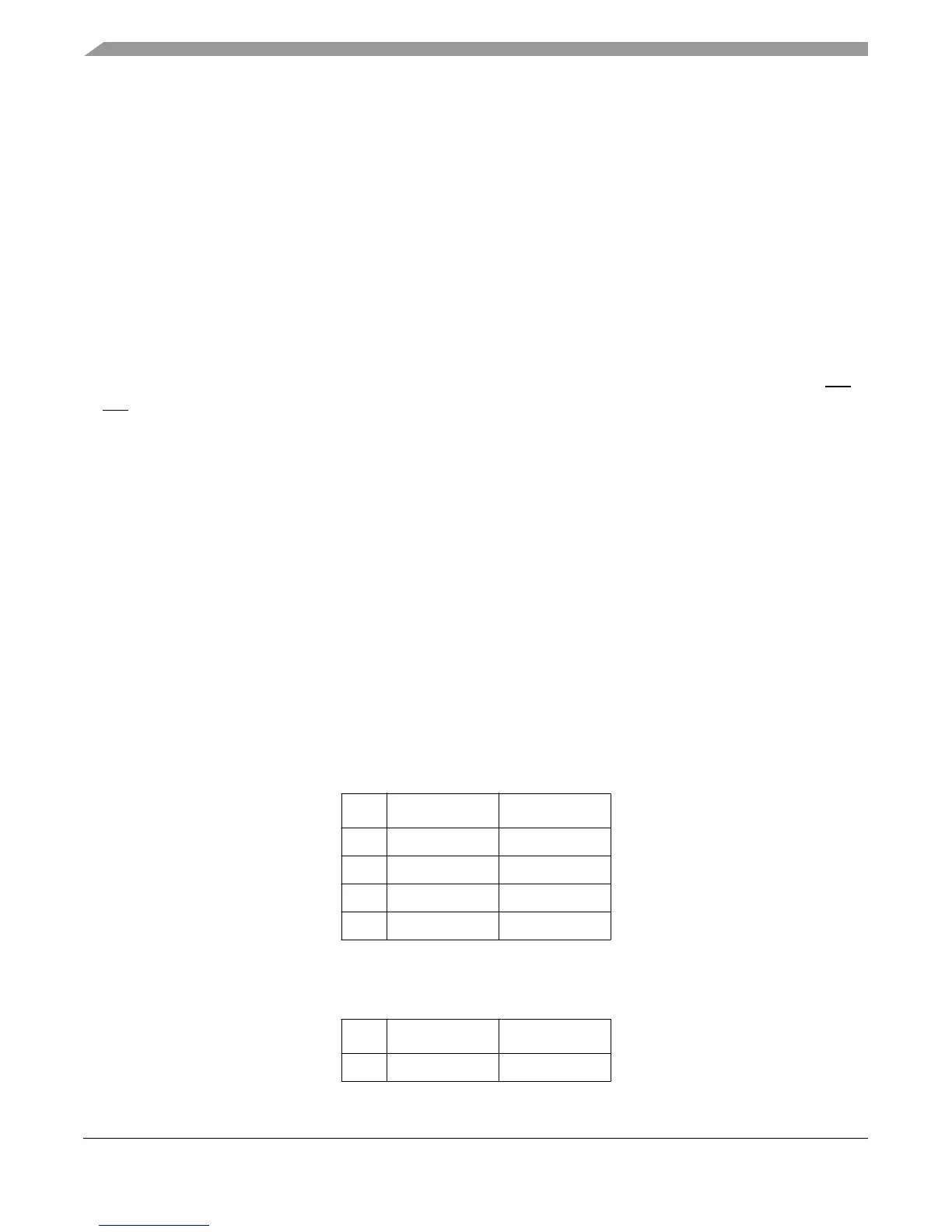
Clean, flush, and kill are three basic snoops that affect the L1 data cache. Table 11-4 describes the
state changes caused by these snoops.
The instruction cache is not snooped, except in the case of the ikill, so coherency must be
maintained by software. However, the core complex does support a fast instruction cache
invalidation capability as described in Section 11.4.3, “L1 Instruction and Data Cache Flash
Invalidation.” Also, Section 3.3.1.2.1, “Self-Modifying Code,” describes flushing of
self-modifying code.
Table 11-5 describes state changes caused by the ikill snoop.
Table 11-4. Data Cache Snoop Coherency State Transitions
Event Initial State Final State
clean M, E, or S S
clean I I
flush Any I
kill Any I
Table 11-5. Instruction Cache Snoop Coherency State Transitions
Event Initial State Final State
ikill V or I I



 To Next Page