PowerPC e500 Core Family Reference Manual, Rev. 1
5-6 Freescale Semiconductor
Interrupts and Exceptions
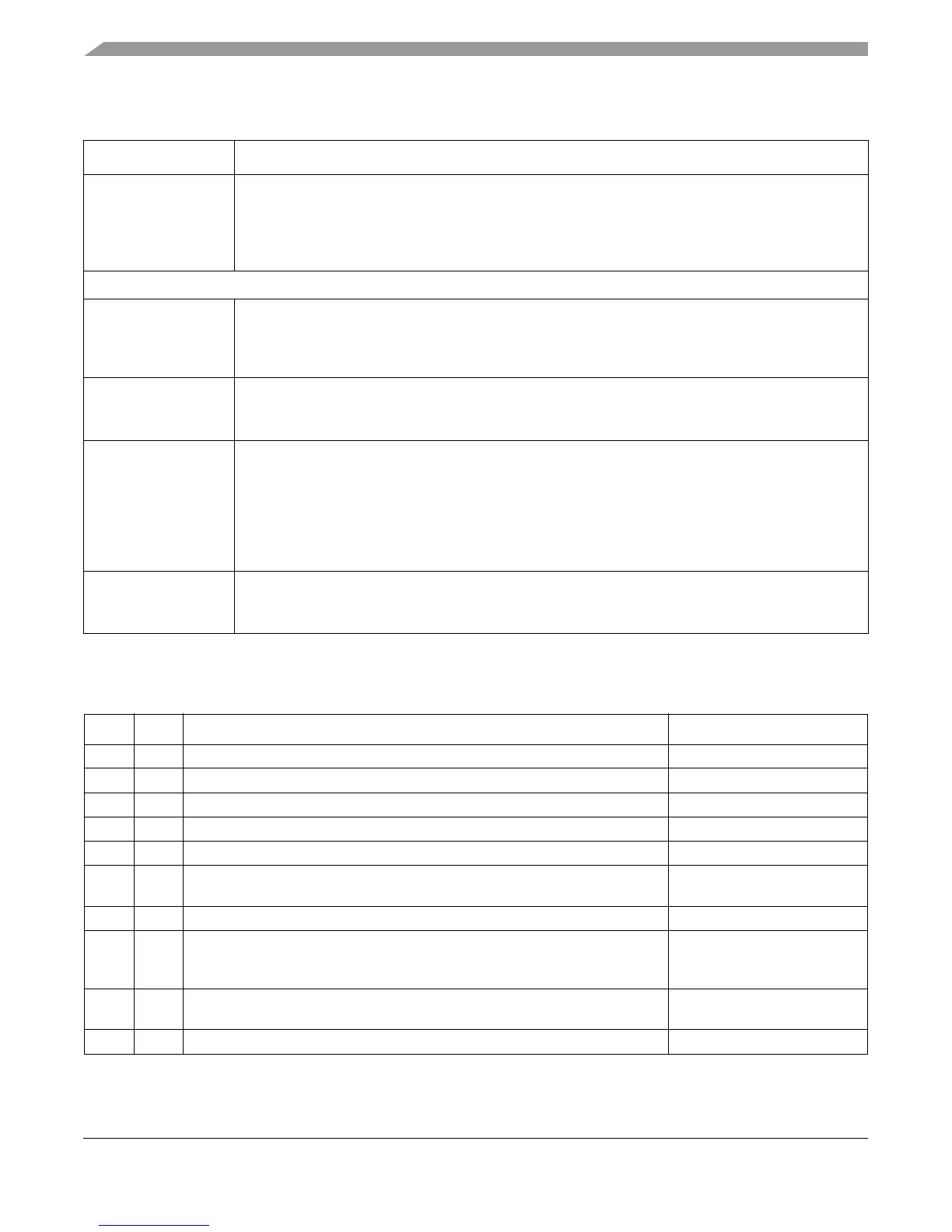
Table 5-3 shows ESR bit definitions.
Machine state register
(MSR)
MSR[38] is defined as the vector available bit (SPE). It functions as follows:
0 For the e500v2, if software attempts to execute an instruction that tries to access the upper word of
a 64-bit GPR, an SPE APU unavailable interrupt is taken. For the e500v1, the interrupt is also taken
if an attempt is made to execute an embedded SPFP scalar instruction.
1 Software can execute any embedded floating-point or SPE instructions.
EIS-Specific Interrupt Registers
Machine check
save/restore register 0
(MCSRR0)
When a machine check interrupt is taken, MCSRR0 is set to the current or next instruction address.
When rfmci is executed, instruction execution continues at the address in MCSRR0. In general,
MCSRR0 contains the address of the instruction that caused the machine check interrupt, or the
address of the instruction to return to after a machine check interrupt is serviced.
Machine check
save/restore register 1
(MCSRR1)
When a machine check interrupt is taken, MSR contents are placed into MCSRR1. When rfmci is
executed, MCSRR1 contents are restored to MSR. MCSRR1 bits that correspond to reserved MSR bits
are also reserved. Note that an MSR bit that is reserved may be altered by rfmci.
Machine check
syndrome register
(MCSR)
When a machine check interrupt is taken, the MCSR is updated to differentiate between machine check
conditions. Table 5-4 lists e500 bit assignments. The MCSR also indicates whether a machine check
condition is recoverable. ABIST status is logged in MCSR[48–54]. These read-only bits do not initiate
machine check (or any other interrupt). An ABIST bit being set indicates an error being detected in the
corresponding module.
Note that processors that do not implement the machine check APU use the Book E–defined ESR for
this purpose.
Machine check address
register (MCAR)
When a machine check interrupt is taken, MCAR is updated with the address of the data associated
with the machine check. Note that if a machine check interrupt is caused by a signal, the MCAR
contents are not meaningful. See Section 2.7.2.3, “Machine Check Address Register (MCAR).”
Table 5-3. Exception Syndrome Register (ESR) Definition
Bits Name Syndrome Interrupt Types
32–35 — Allocated —
36 PIL Illegal instruction exception Program
37 PPR Privileged instruction exception Program
38 PTR Trap exception Program
39 — Reserved, should be cleared. —
40 ST Store operation Alignment, data storage, data
TLB error
41 — Reserved, should be cleared. —
42 DLK Cache locking. Settings are implementation-dependent. On the e500, DLK is
set when a DSI occurs because dcbtls, dcbtstls, or dcblc is executed in user
mode and MSR[UCLE] = 0.
Data storage
43 ILK (EIS) Set when a DSI occurs because icbtl or icblc is executed in user mode
(MSR[PR] = 1) and MSR[UCLE] = 0
Data storage
44–45 — Reserved, should be cleared.
1
—
Table 5-2. Interrupt Registers Defined by the PowerPC Architecture (continued)
Register Description



 To Next Page