System Initialization
3-6 Élan™SC520 Microcontroller User’s Manual
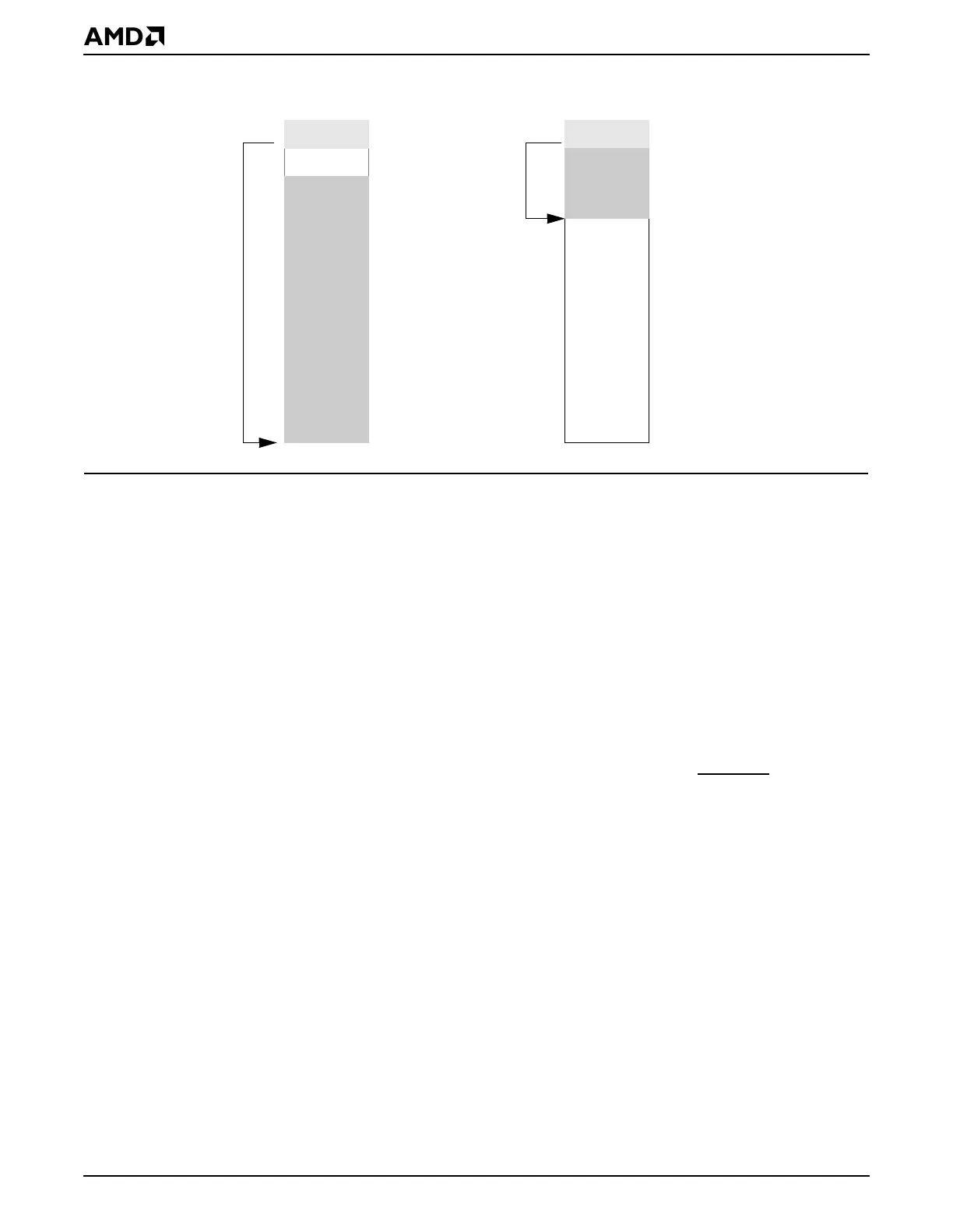
Figure 3-1 Initial Near Jump Example
The reset vector Near Jump is not required to jump to F000:0000. It can jump anywhere
into the reset segment. For example, if the reset handler code is only 16 Kbytes in size, it
could jump to F000:C000, leaving more room on the boot ROM device for other code. This
allows the reset handler to be placed right up against the reset vector, thus using the space
in the boot ROM device more efficiently.
Note: For debugging using AMDebug technology, not only should this first Jump instruction
be a Near Jump, it should be a Jump Near Indirect instruction, which is opcode FF/4. In-
circuit emulation and debug software that uses the internal trace cache searches for this
opcode to aid in determining when the reset event occurred.
As much or as little of the system initialization code can take place in the reset handler
while the system is executing from the reset segment (i.e., before the first Far Jump
instruction). For example, a native embedded system using a 32-bit only RTOS will merely
setup the protected mode data structures, switch to protected mode, and jump directly into
system boot code (the boot ROM device is the device selected by BOOTCS
).
In contrast, a system with a PC-style BIOS would initialize the SDRAM controller, shadow
the BIOS to SDRAM, and then jump to the BIOS.
3.2 CONFIGURING THE SDRAM CONTROLLER
After a system reset, the SDRAM controller configuration registers are reset to their default
states. All the SDRAM controller banks and SDRAM refresh are disabled by default. For
details on how to enable the SDRAM controller and the SDRAM configuration, see
“Initialization” on page 10-29.
Note that the ÉlanSC520 microcontroller can be reset in a manner that preserves the
operation of the SDRAM controller. This condition can be detected and handled properly
by the SDRAM initialization code.
If the Error Correction Code (ECC) logic for SDRAM is enabled, ECC operation requires
that SDRAM and its associated ECC memory be initialized. This is accomplished by the
boot code, which must write to every location in SDRAM. This process initializes the ECC
SDRAM to reflect the proper error-checking codes. If this procedure is not performed, false
F000:FFF0
F000:FFFF
F000:0000
Near
Jump
Reset Vector
Reset
Handler
F000:C000



 To Next Page