SHOP MANUAL
Engine
Ch 1 page 122
Crankshaft damper
The power impulses from the connecting rods give rise to torsional oscillation in the crankshaft. These oscillations
are severest at certain engine speeds which vary with the design of the engine, how it is loaded, etc.
Torsional oscillation is characterised as follows:
The flywheel (at the “rear” end of the crankshaft) rotates at an almost constant speed throughout each revolution
of the crankshaft. Relative to the flywheel, the rotational speed of the front end of the crankshaft will increase and
decrease several times during each revolution.
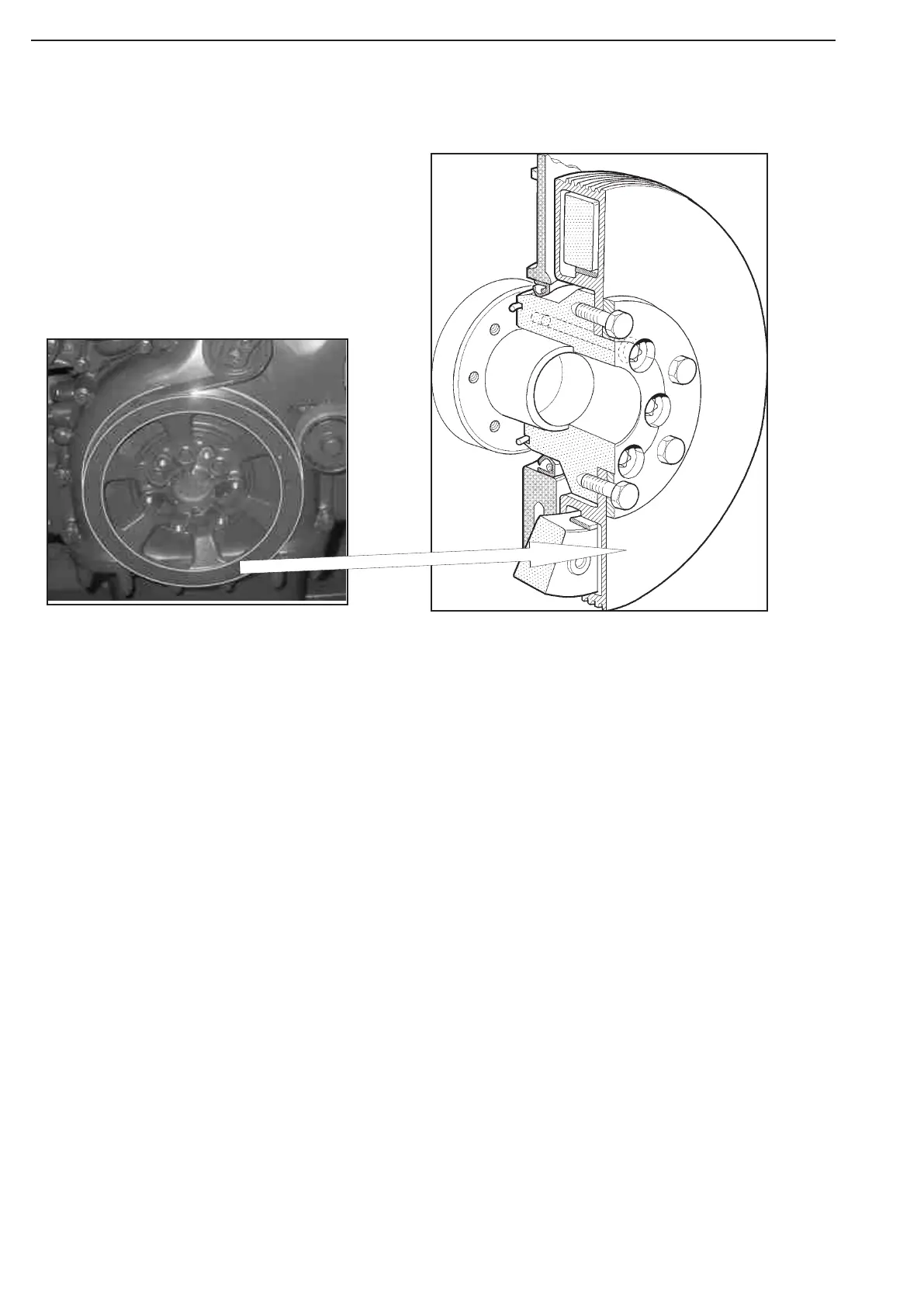
To reduce the amplitude of the oscillation, a crankshaft damper is attached to the front end of the crankshaft.
A ring of steel is incorporated in the circular and completely enclosed housing of the crankshaft damper. The
housing is bolted onto the crankshaft.
There is a heavy oil between the housing and ring which damps the relative movement between the two. The
oscillation at the front of the crankshaft is damped by the ring striving to rotate with even speed.
The crankshaft damper has numerous belt grooves for a “Multigroove V-belt”.
Figure 235
Figure 236



 To Next Page