SHOP MANUAL
DRIVE LINE
Ch 3 page 44 Ch 3 page 45
DRIVE LINE
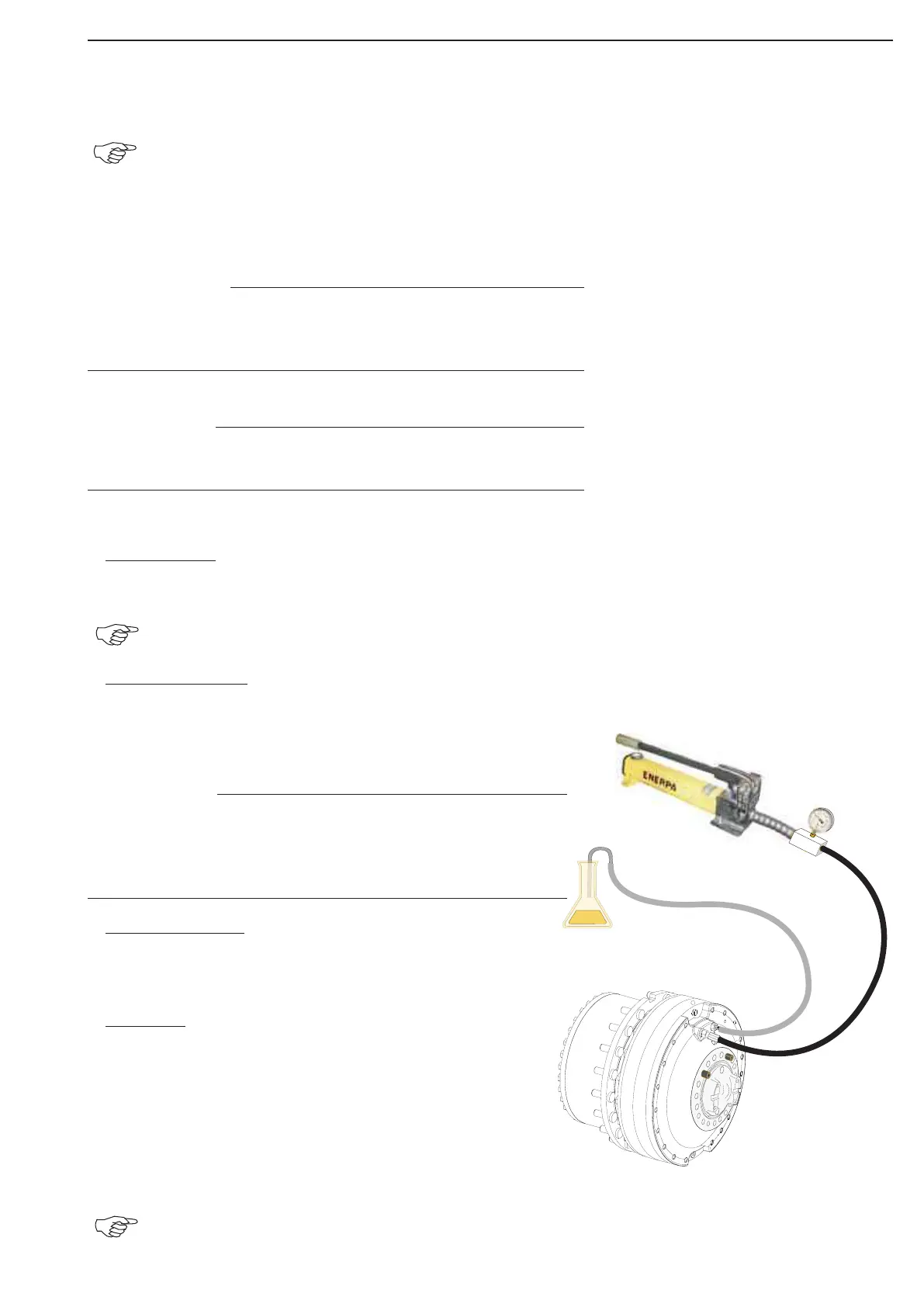
Prior to start the test, ventilate the brake hydraulics
completely!
1. Open the bleeder.
2. Actuate the HP-pump slowly until oil gets out of the bleeder.
3. Close the bleeder again.
4. Pressurize the HP-Pump slowly with p > 10 bar and
keep the pressure for some seconds.
5. Loosen shut-off valve on the HP-pump.
6. Open the bleeder again.
7. Actuate the HP-pump slowly until oil gets out of the bleeder.
ATTENTION:
Repeat the procedure (Point 3 ... 7) until (at Point 7)
from starting of the actuation no more air comes out of
the bleeder.
Then pressurize the brake temporarily
(5x) with p = 100 bar max.!
High-pressure test:
Increase test pressure up to p = 100 –10 bar and close
connection to the HP-pump by means the of shut-off valve.
During a 5 min. testing time a pressure drop of max. 2 %
(2 bar) is allowed!
If maximum pressure of 100 bar is exceeded, here will be an
excessive piston adjustment and a repeated disassembly
of brake or of the adjusting is required to reset the gripping
rings to the adjusting dimension.
Low-pressure test:
Reduce test pressure to p = 5 bar and close the shut-off valve
again.
During a 5 min. testing time a pressure drop is not allowed!
Test media
Motor oils SAE 10-W corresponding with,
MIL-L 2104 C, MIL-L 46152,
API-CC, CD, SC, SD, SE,
ATF-Oils Type A, Suffic A Dexron
of II D.
(S) HP-Pump 514661
(S) Mini measuring hub 514670
(S) Bleeding equipment 514659
Prior to putting the axle into operation, fill in oil
acc. to the lubrication instructions!
Leakage test of brake hydraulics
NOTE
The brake piston extends and the cylinder chamber lls up with
oil. The air accumulates in the upper section of the cyl. cham-
ber.
NOTE
The retracting piston presses the air out of the upper section of
the cylinder into the brake line.
NOTE
Figure 121


 To Next Page