Engine
SHOP MANUAL
Ch 1 page 159
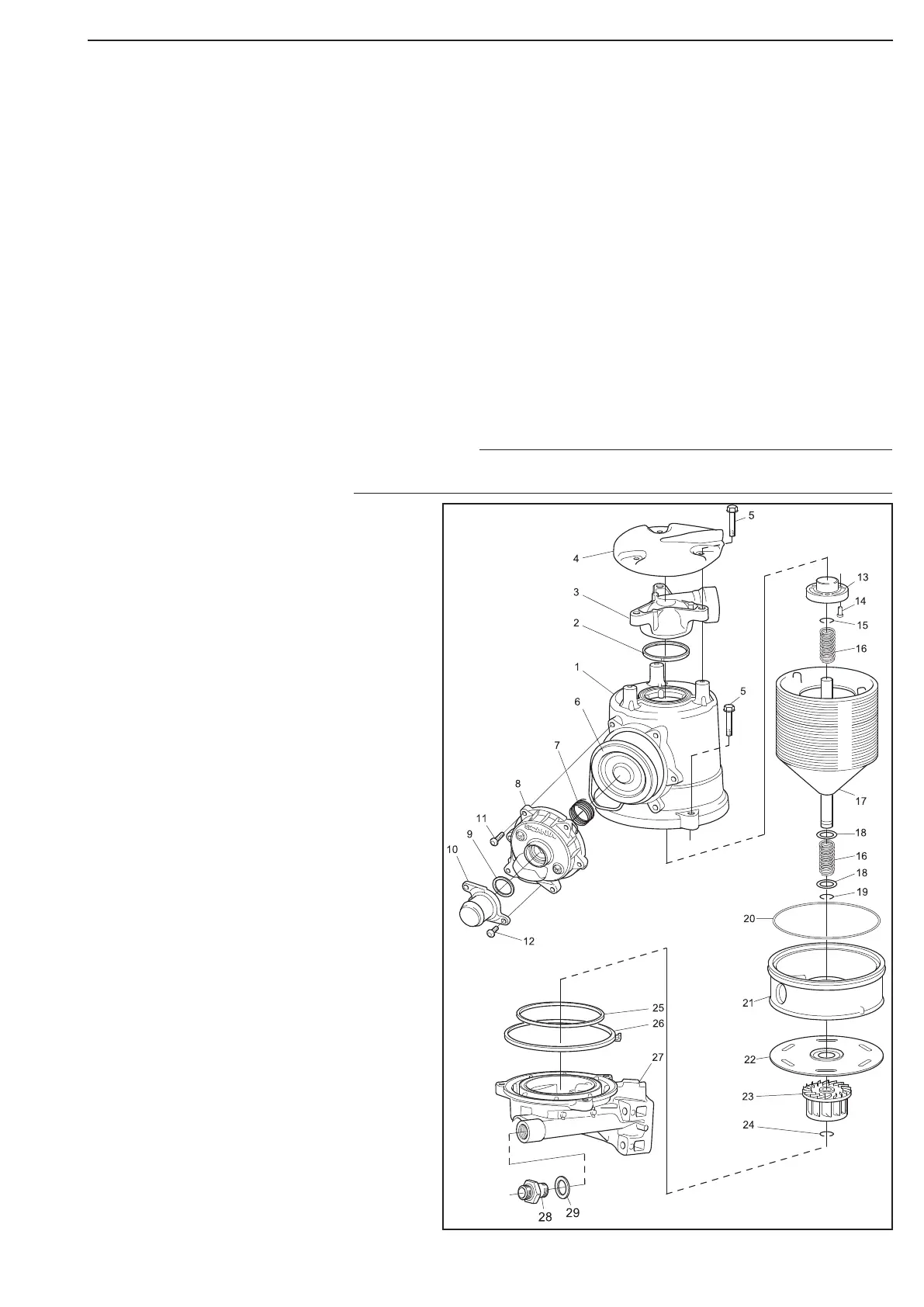
Oil mist separator exploded view
1 Oil mist separator housing
(different version for closed
crankcase ventilation)
2 O-ring
3 Nipple
4 Heat shield
5 Screw
6 Diaphragm (not used on oil mist
separator for closed crankcase
ventilation)
7 Diaphragm spring (not used on
oil mist separator for closed
crankcase ventilation)
8 Cover (different version for
closed crankcase ventilation)
9 O-ring
10 Nipple (not used on oil mist
separator for closed crankcase
ventilation)
11 Screw
12 Screw (not used on oil mist
separator for closed crankcase
ventilation)
13 Upper bearing retainer
14 Screw
15 Retaining ring
16 Spring
17 Separator
18 Washer
19 Retaining ring
20 O-ring
21 Insert
22 Lower bearing retainer
23 Turbine
24 Retaining ring
25 O-ring
26 O-ring
27 Turbine housing
28 Washer
29 Straight nipple
The oil mist separator is driven by oil from the lubrication system. The oil flows into the oil mist separator and is
sprayed onto the turbine located on the rotor shaft. The oil then flows out and back to the oil sump.
The rotor consists of a number of tapered plastic plates which are located on top of one another. There is a
space for the crankcase gases and oil particles between each plate.
The crankcase gases and oil particles flow into the oil mist separator through the union in the top of the oil mist
separator housing. The oil particles stick to the rotating plates and the centrifugal force causes the oil particles
to be thrown against the wall of the oil mist separator housing. The oil which has been separated from the
crankcase gases runs down along the walls of the oil mist separator housing and then flows out of the oil mist
separator via the centrifugal oil cleaner to the oil sump. The centrifugal oil cleaner contains an oil trap. The oil
trap is there so that oil from the oil sump is not drawn in the wrong direction.
The cleaned crankcase gases flow out of the oil mist separator via a diaphragm which acts as a pressure regu-
lator. When the vacuum downstream of the oil mist separator is too great, the diaphragm will close the opening
until the pressure has risen again.
The oil mist separator does not normally need to be dismantled for cleaning.
Remove the oil mist separator from the engine before it is dismantled.
NOTE
Figure 312



 To Next Page