SHOP MANUAL
SHOP MANUAL
LUBRICATION SYSTEM
Ch 4 Page 12 Ch 4 Page 13
LUBRICATION SYSTEM
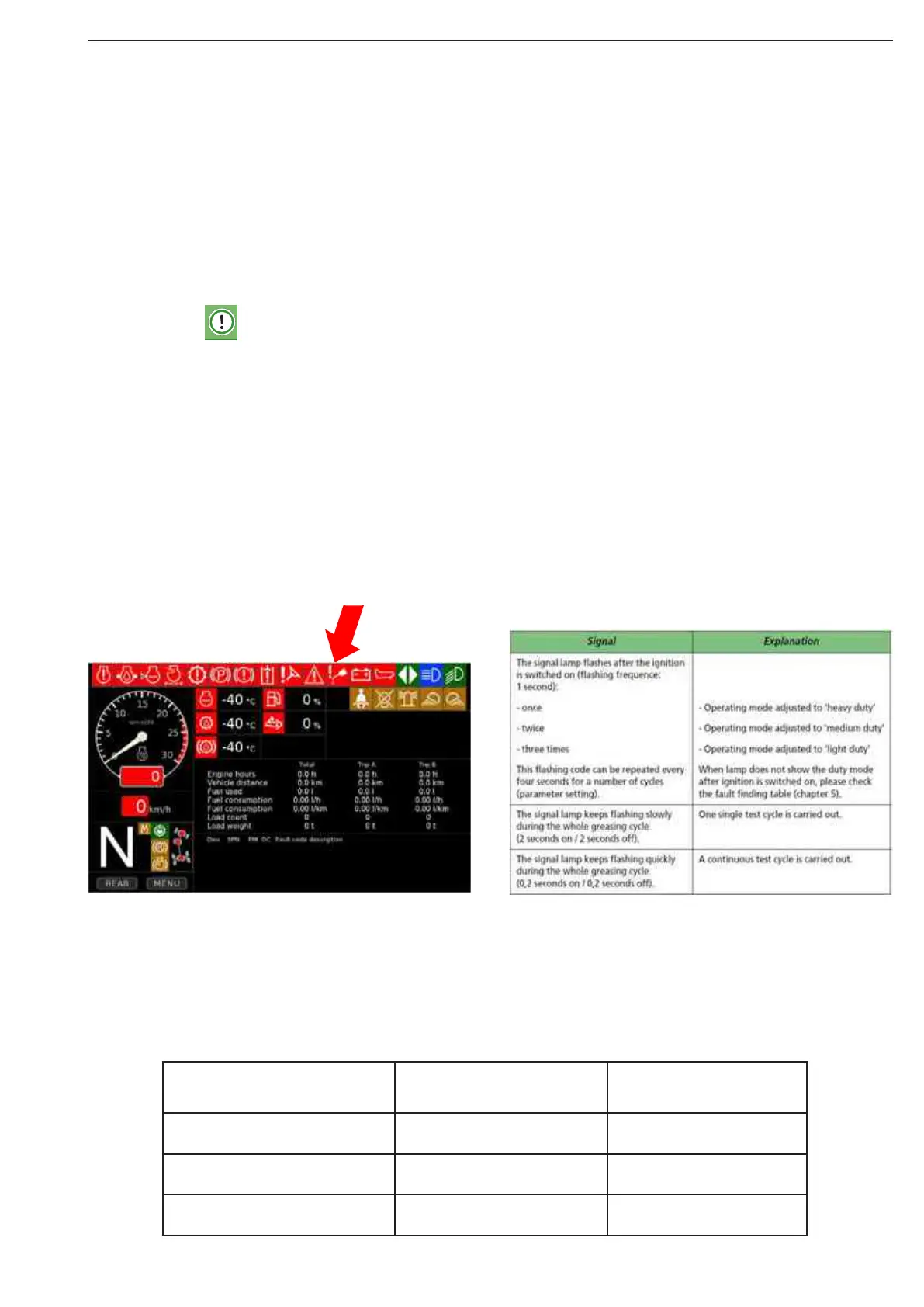
The warning light is mounted on the LCD display.
This warning light shows the status of the greasing system and the malfunction reports by means flash codes.
In the chart, an overview of normal signals is given. Malfunction signals can be find on the fault table.
Warning signal
It is the utmost importance that the correct grease is used in the Twin greasing system (Ref O&M Manual).
Please consut your grease supplier or Groenneveld when a different grease is to be used.
The Twin grease system is developed for use with grease up to NLGI-class 2.
Which NLGI-class has to be used, mainly depends on the temperature in which the greasing system has to
operate:
The continuous-test cycle
With a continuous-test cycle extra grease can quickly be added to the greasing points or the grease system can
be bled.
Proceed as follows to carry out a continuous-test cycle:
1. Turn on the contact switch.
2. Push the test push-button on the pump for at least 6 seconds.
The system will start a pumping phase. After pumping phase A, pressure retaining phase A and pressure
decrease phase A are ended, pumping phase B is started immediately, then again A, then B, etc. The pause
phases are skipped entirely every time.
ATTENTION:
It is also possible to skip the pressure retaining phase and pressure decrease phase during the continuous-
test cycles, by activating the “enable fast multiple test” option with a diagnosis unit. Please be aware that when
activated at low temperatures, the output of the metering units in the end of the system might get reduced to 0,
due to these missing phases.
3. Turn off the ignition switch to end the continuous-test cycle.
When the ignition switch is turned on again the program will always begin with the pause phase of the pumping
phase that has just been interrupted.
Lowest operating
temperature
Highest operating
temperature
Use NLGI class
-20ºC (-4ºF) +70ºC (+160ºF) 2
< -20ºC (-4ºF) +70ºC (+160ºF)
Synthec 2
< -20ºC (-4ºF) 0ºC (+32ºF) 0 / 1
Figure 19
Figure 18


 To Next Page