SHOP MANUAL
Engine
Ch 1 page 138
Each compression stroke ”brakes” the crankshaft and each com-
bustion stroke attempts to increase the speed of rotation of the
crankshaft.
The pistons and connecting rods change their direction of travel
twice during each rotation of the crankshaft. This exposes the
crankshaft to numerous power pulses during each revolution.
The material is of major importance for the useful life of the crank-
shaft. Its design and surface treat ment also help to extend its life
- for instance, the surface quality of the shaft journals is an impor-
tant factor in providing protection against fatigue failure.
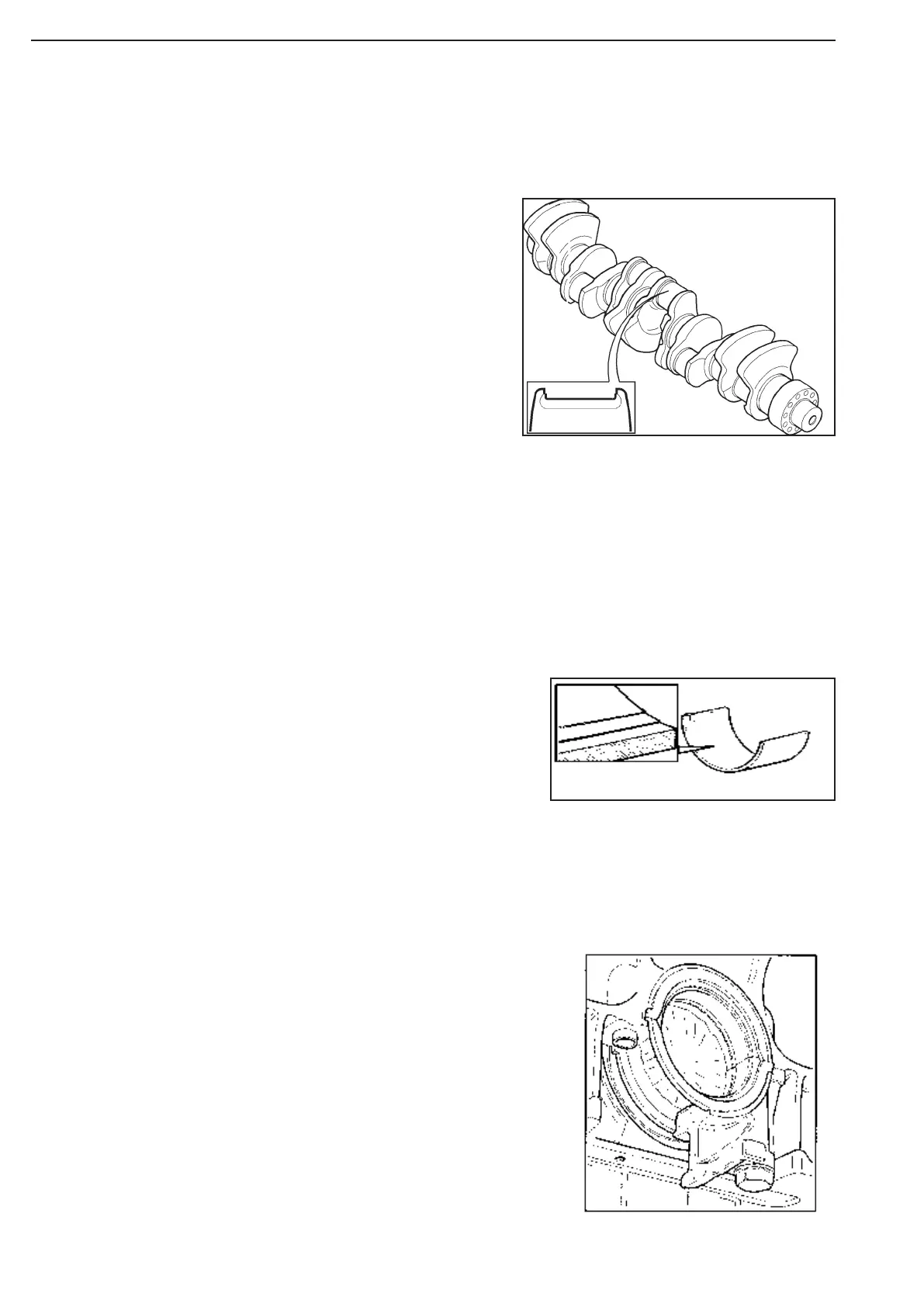
The bearing surfaces on the crankshaft are hard ened to a depth
which allows them to be ground several times.
Only the bearing surfaces are hardened as it is important to retain
the toughness of the material in other parts.
Crankshaft
The bearing shells of the main and big-end bear ings consist of
three layers. An outer layer or backing of steel, an interlayer of
lead-bronze and, nearest the crankshaft, an overlay consisting
of a mixture of lead and indium or lead, tin and cop per. The in-
nermost layer is usually worn away during the course of engine
utilization.
Thrust washers are used for endways location of the crankshaft
at the rear main bearing. These thrust washers are available in
different thick nesses so that the crankshaft can be adjusted to
the correct clearance. The thrust washers have the same types
of layer as the big-end bearing shells.
Figure 274
Figure 275
Figure 276



 To Next Page