SHOP MANUAL
DRIVE LINE
Ch 3 page 70 Ch 3 page 71
DRIVE LINE
Measure Disc Thickness
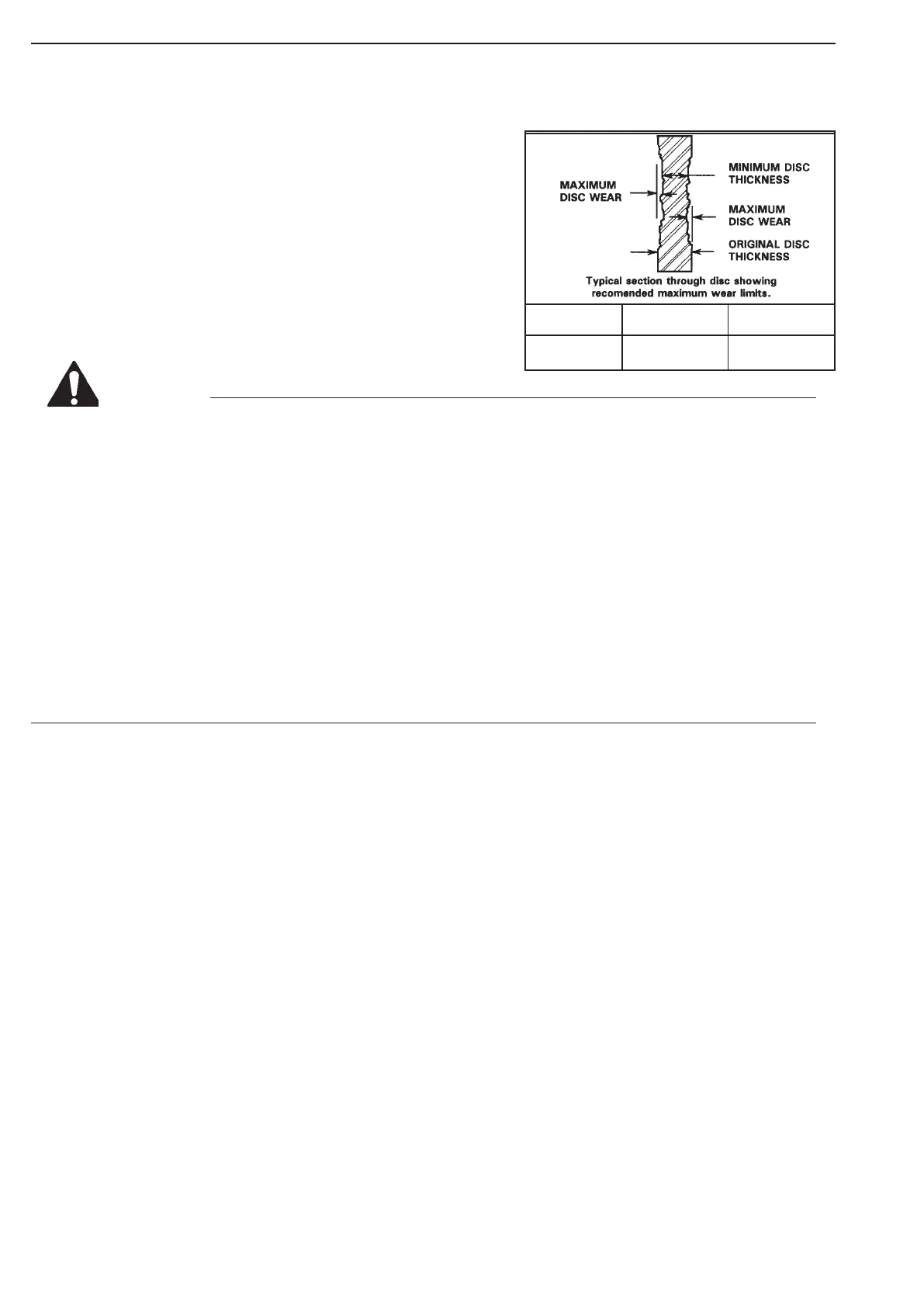
Measure the thickness of the disc when you reline the brakes.
The disc must be at least 0.866-inches (22.0 mm).
Figure 186.
If the disc thickness is outside specification, replace the disc.
Caliper Assembly
The caliper and saddle assembly are not serviceable.
Replace the brake assembly when a caliper is worn or damaged.
Cleaning
Cleaning Ground or Polished Metal Parts
• Use a cleaning solvent to clean ground or polished parts or surfaces.
Kerosene or diesel fuel oil can be used for this purpose.
NEVER USE GASOLINE.
• Be careful not to damage ground surfaces.
• DO NOT clean ground or polished parts in a hot solution tank, water, steam or alkaline solution.
Cleaning Metal Parts With Rough Finishes
• Parts with a rough finish can be cleaned with cleaning solvent or in a hot solution tank
with a weak alkaline solution.
• Parts must remain in hot solution tanks until completely cleaned and heated.
• Parts must be washed with water until the alkaline solution is removed
• Use a wire brush to clean the threads of fasteners and fittings.
Cleaning Non-Metal Parts
• Use soap and water to clean non-metal parts.
• Scrape away build-ups of mud and dirt on the linings. Replace all linings contaminated with or grease.
Drying Cleaned Parts
• Dry the parts immediately after cleaning and washing.
• Dry the parts with soft clean paper or rags.
Corrosion Protection
Apply rust inhibiting fluid to the cleaned and dried parts that are not damaged and are to be
immediately assembled. Do NOT apply fluid to the brake linings or the disc.
If you plan to store the brake parts, apply a special corrosion preventative material to all
surfaces. Do NOT apply this material to brake linings or the disc.
Store the parts inside special paper or other material that prevents corrosion.
O R IG IN A L D IS C M A X I M U M D IS C M IN IM U M D IS C
T HIC K N E S S W E A R T H IC K N E S S
1. 0 0 -in c h 0 . 0 6 7 -inc h 0 . 8 6 6 -i n c h
(2 5 . 4 m m ) (1 .7 m m ) (2 2 . 0 m m )
To prevent serious eye injury, always wear proper protection
when you perform vehicle maintenance or service.
Solvent cleaners can be ammable, poisonous and cause burns.
Examples of solvent cleaners are carbon tetrachloride,
emulsion-type cleaners and petroleum-based cleaners.
To avoid serious personal injury when you use solvent cleaners,
you must carefully follow the manufacturer’s product instructions
and these procedures:
• Wear proper protection.
• Wear clothing that protects your skin.
• Work in a well-ventilated area.
• Do not use gasoline or solvents that contain gasoline. Gasoline can explode.
• You must use hot solution tanks or alkaline solutions correctly.
Follow the instructions carefully.
WARNING
Figure 186


 To Next Page