SHOP MANUAL
DRIVE LINE
Ch 3 page 74 Ch 3 page 75
DRIVE LINE
Although the wheels have different distances to roll when negotiat-
ing bend and thereby different rotation speed, exactly the same
drive torque has to be transmitted to both sides.
This torque distribution takes place in the differential gear.
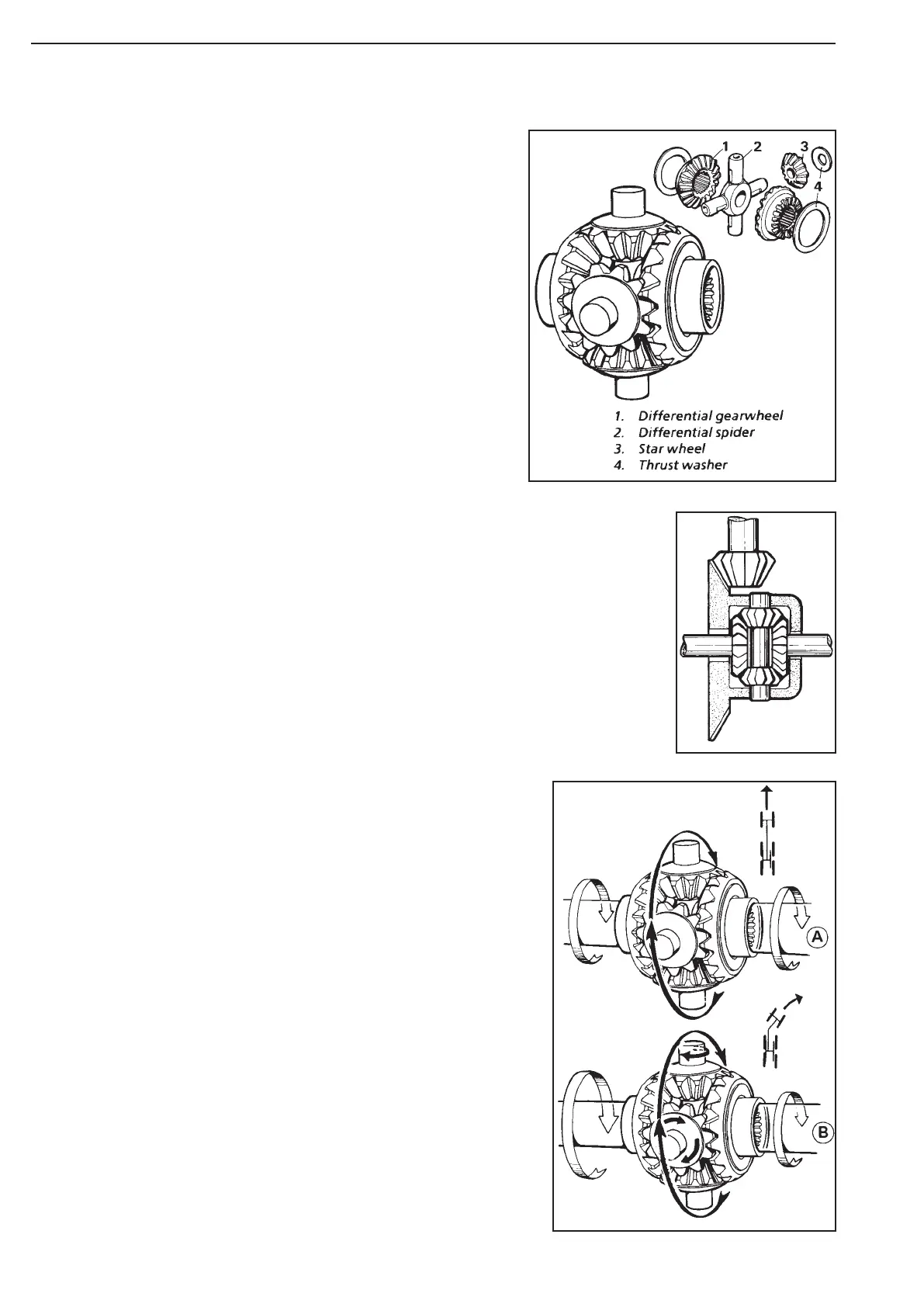
The differential gear consists of four taper gear wheels, star
wheels, that run on a differential spider.
The star wheels are in constant mesh with two opposed differential
gear wheels, each attached to a half shaft.
The differential gear sits in the differential casing to which the
crown wheel is attached.
When the truck travels straight ahead and the rotation speed of the
drive wheels is the same, the star wheels on the differential spider
do not turn, and only function as a driver between crownwheel and
half shafts.
When the dump truck travels round a bend, the inner drive wheels
will roll a shorter distance than the outer ones. Because of the
drive wheels then having different rotation speeds, this also ap-
plies to the differential gear wheels on the half shafts. The star
wheels will then turn.
Because of the compound speed of the drive wheels being con-
stant, the outer drive wheel will turn much faster in relation to the
crown wheel, as the inner drive wheel will turn slower.
In extreme cases, when one drive wheel side is stationary and
the other one spins, the spinning wheels turns twice as fast as the
crown wheel.
If a drive wheel side does not have sufficient grip and starts spin-
ning, the dump truck comes to standstill. The grip of the spinning
wheels determine the amount of torque.
This torque becomes decisive in regards to the drive power of both
sides because the differential gear will always distribut the torque
equally to both sides.
Figure 194
Figure 193
Figure 192


 To Next Page