SHOP MANUAL
Ch 6 page 72
ELECTRICAL SYSTEM
Engine charge air pressure
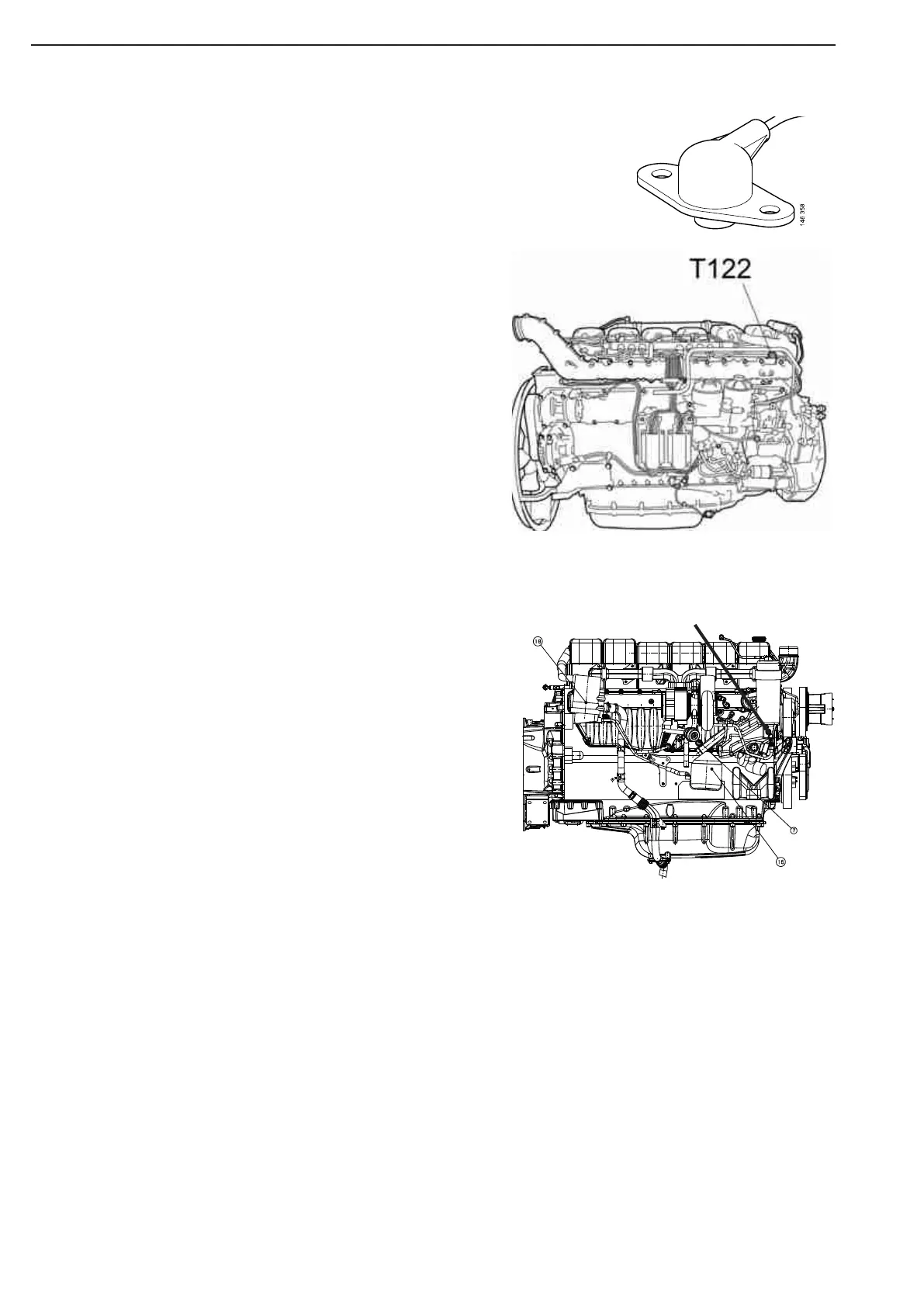
T122, Charge air pressure sensor
Function:
The charge air pressure sensor detects the absolute pressure
in the intake manifold, i.e. the atmospheric pressure plus the
positive pressure provided by the turbocharger.
The signal from the sensor is directly proportional to the charge
air pressure. A high pressure gives a high voltage and vice
versa.
The engine control unit uses the information from the charge
air pressure sensor to control the relationship between the in-
take air and EGR gases going to the engine. Depending on the
factors that requested the acceleration, engine speed, engine
acceleration and charge air temperature, the engine control
unit will expect a certain charge air pressure. Should there be
a fault in the signal, the engine control unit will work to a preset
pressure value. At the same time, the engine torque will be
limited and a fault code will be generated.
T5, Oil pressure sensor
Function
The engine control unit reads the voltage from the sensor.
In the case of some faults, e.g. when the signal voltage from the
sensor has been outside a certain range, the oil pressure gauge
will show 0 bar even though the oil pressure is higher than this.
The oil pressure lamp will not light up until the oil pressure has
moved outside the permitted pressure range.
The engine control unit expects a certain oil pressure depending
on the engine speed. Below 1000 rpm, the oil pressure should
be at a certain level. Over 1000 rpm the oil pressure should be at
a higher level in order to provide sufficient oil pressure for piston
cooling, etc. If the oil pressure is below the permitted value, the
oil pressure lamp will light up. The oil pressure lamp therefore
lights up at different pressure levels depending on the engine
speed.
Purpose
The pressure sensor is a capacitive sensor and measures the
absolute pressure.
Measurement range is 0.5-9 bar (A).
Engine oil pressure sensor
T5
Figure 58
Figure 57



 To Next Page