GENERAL INSTRUCTIONS
SHOP MANUAL
Ch 0 page 41
Handling of bearings
• Keep the bearings and their surroundings clean. Every dust
and dirt particle, even though they are invisibly small can
affect bearings. Always take sufficient care to protect
bearings against dust and dirt.
• Handle bearings with the utmost care. Because of the high
precision structure and the increased hardness which is
provided by heat-treatment to improve wear resistance,
bearings require special care to handle them. Shock due to
careless handling of bearings will cause dents to form
on the inner and outer races or break the bearings.
• Avoid excessive heating. The hardness of bearings will be
lowered at temperatures higher than 120°C, this may cause
considerably reduced life of the bearings.
• Use the proper jigs for handling the bearings. Under no
circumstances should any other jig be used as a substitute
for the proper one.
• Take necessary rust-preventive means.
• Keep the work where bearings are to be handled clean.
Also, do not unpack a bearing package
until just before the installation of the bearing.
• Be carefull not to drive an outer race onto an inner race by
tapping the outer race, and vice versa. Such unreasonable
handling will cause dents to form on the sliding surfaces
between the races, and the bearing will be damaged early in
its life.
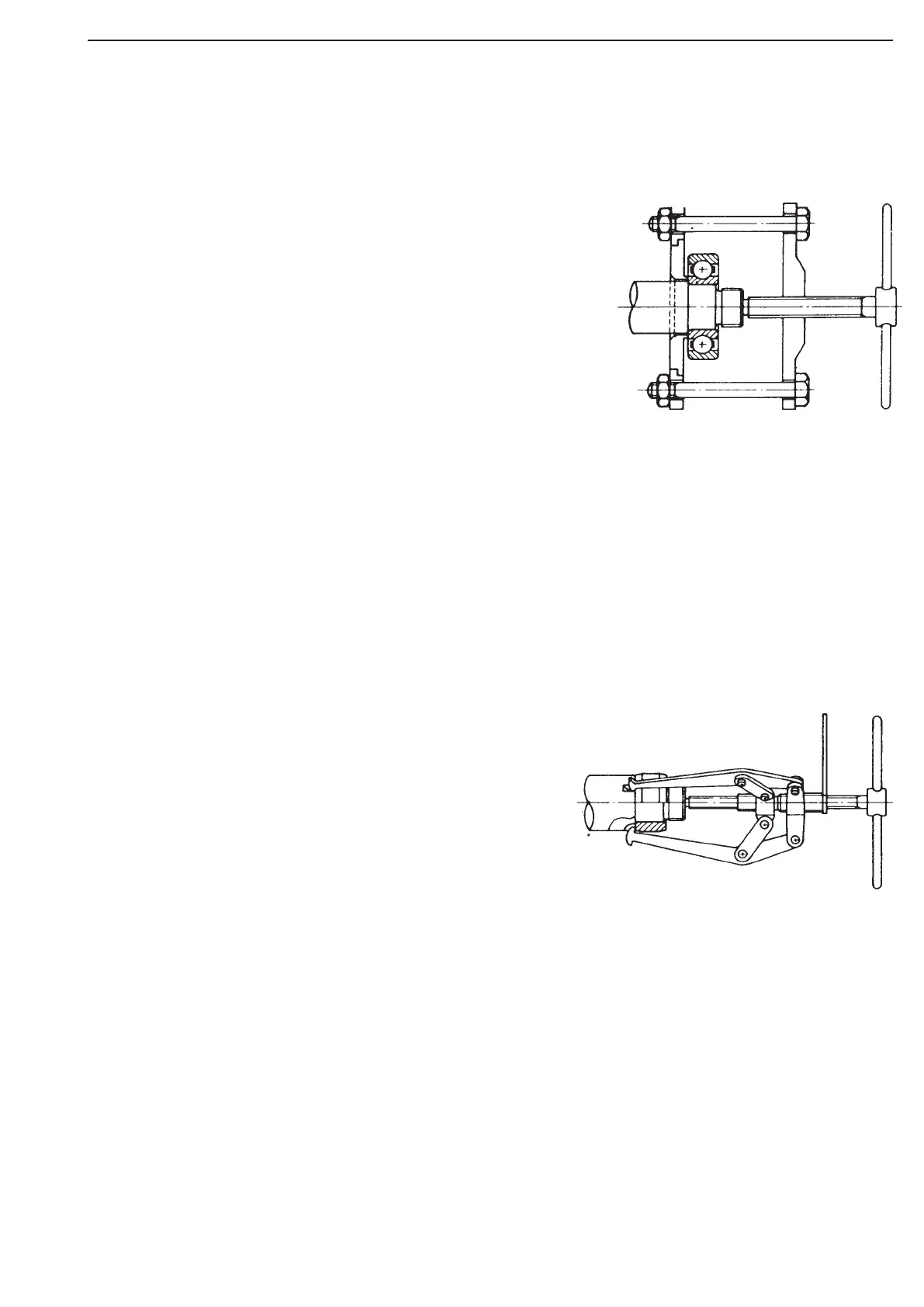
• Be careful not to force a bearing for removal. The use of a
proper removing jig shown below is recommended.
• To wash bearings, neutral and anhydride solvents such as
light oil and kerosene may be used. Two vessels filled with
washing oil should be provided; one for washing dirty
bearings and the other for rinsing. Rapidly shake a soiled
bearing in the washing oil to remove dirt. Rotating bearing
races, instead of shaking the bearing in the washing oil,
should be avoided because bearing races may be damaged
by foreign particles such between the races. It is also
necessary to keep washing oil clean by filtering it from time
to time.


 To Next Page