MPC5604B/C Microcontroller Reference Manual, Rev. 8
Freescale Semiconductor 367
Reading the IBDR will return the last byte received while the I
2
C is configured in either master receive or
slave receive modes. The IBDR does not reflect every byte that is transmitted on the I
2
C bus, nor can
software verify that a byte has been written to the IBDR correctly by reading it back.
In master transmit mode, the first byte of data written to IBDR following assertion of MS/SL is used for
the address transfer and should comprise the calling address (in position D7–D1) concatenated with the
required R/W bit (in position D0).
20.3.7 I
2
C Bus Interrupt Config Register (IBIC)
20.4 Functional description
20.4.1 I-Bus protocol
The I
2
C Bus system uses a Serial Data line (SDA) and a Serial Clock Line (SCL) for data transfer. All
devices connected to it must have open drain or open collector outputs. A logical AND function is
exercised on both lines with external pull-up resistors. The value of these resistors is system dependent.
Normally, a standard communication is composed of four parts: START signal, slave address transmission,
data transfer and STOP signal. They are described briefly in the following sections and illustrated in
Figure 20-10.
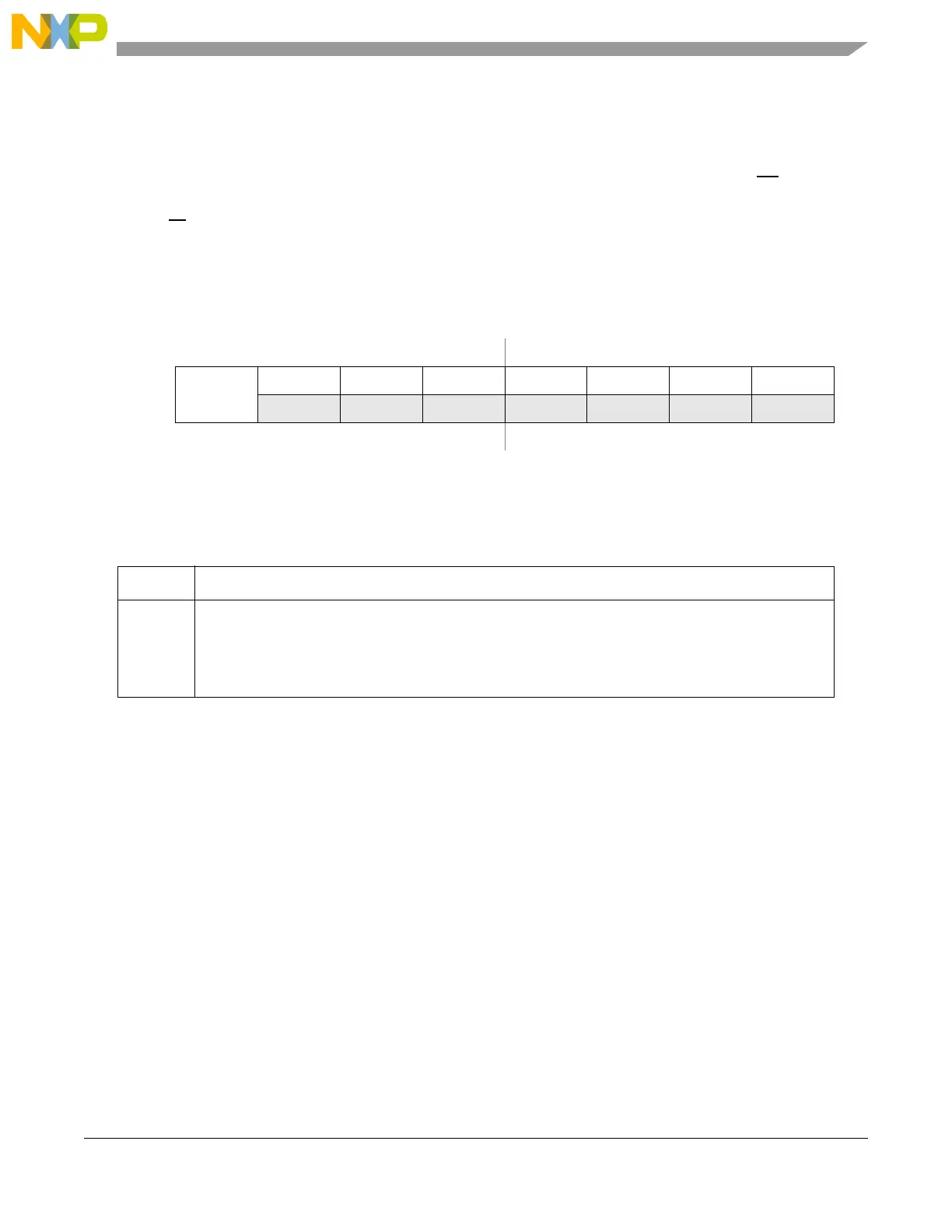
Offset 0x5 Access: Read/write any time
76543210
RBIIE
1
1
This bit cannot be set in reset state, when I2C is in slave mode. It can be set to 1 only when I2C is in Master mode.
This information is missing from the spec.
0000000
W
Reset00000000
Figure 20-9. I
2
C Bus Interrupt Config Register (IBIC)
Table 20-10. IBIC field descriptions
Field Description
BIIE Bus Idle Interrupt Enable bit. This config bit can be used to enable the generation of an interrupt once
the I
2
C bus becomes idle. Once this bit is set, an IBB high-low transition will set the IBIF bit. This feature
can be used to signal to the CPU the completion of a STOP on the I
2
C bus.
1 Bus Idle Interrupts enabled
0 Bus Idle Interrupts disabled



 To Next Page