Final Check Metering : Loudness and Peak Metering
13 - 308
<MSL>1.53237224</MSL> Maximum long-term loudness AKA Max S
</Surround_5.1> End of results for the surround tracks
</FinalCheck_Metering> End of file
Loudness and Peak Metering
ITU-R 1770-1
This is the new recommendation of the ITU (International Telecommunication Union) about Peak and Loudness
measurement. It specifies the requirements for the audio meters employed to measure programme loudness,
and/or to indicate true-peak level to assist in the avoidance of overload of digital audio signals.
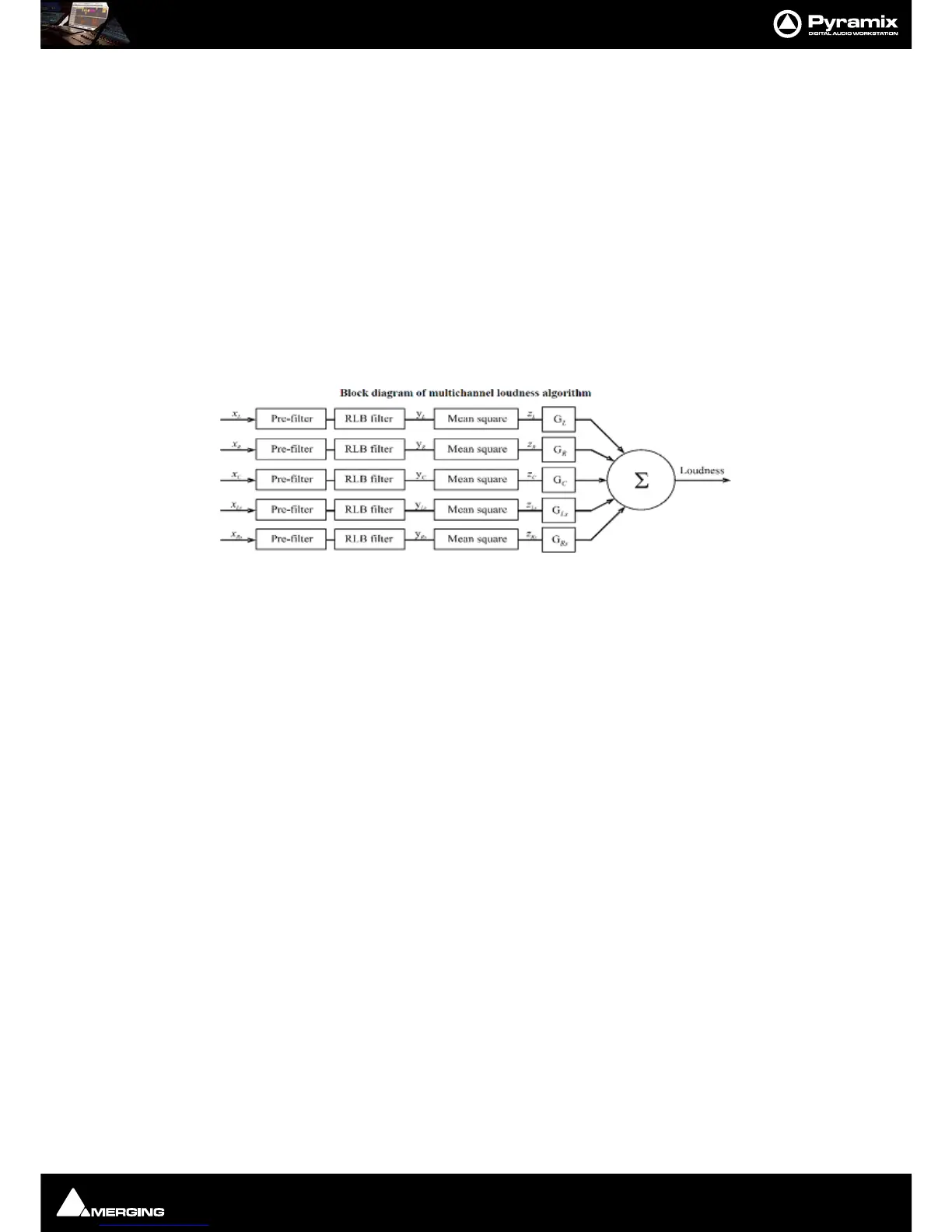
Loudness Algorithm
The goal of the loudness measurement is to give a numerical expression of the overall loudness that the listener
feels. It is expressed in LUFS. The block diagram below shows inputs for five main channels.
The pre-filtering accounts for the acoustic effects of the head. The RLB-filter is a LEQ (Loudness equivalent) fre-
quency-weighting curve that delivers much more precise results than previous LEQ-curves. The G-factors account
for different weighting of different channels.
LUFS
Loudness Unit Full Scale is the unit used for Loudness measurement. To match the ITU recommendation, a mix
shall have an overall Loudness of -23 LUFS. This unit is dB-like, in the sense that a variation of 1 dB in a mix will pro-
duce a variation of 1LUFS in its loudness as well.
For calibration: a full scale sine wave on one non-surround channel shall read -3.01 LUFS.
LKFS
LKFS (Loudness K-Weighting Full Scale) is the old name for the Loudness unit, which is now called LUFS instead, as
recommended by the ITU. These two units are strictly the same, though.
Dolby Dialnorm™
LUFS are the same unit as the Dolby Dialnorm™ unit, and you will therefore get the same results as long as Dolby's
automatic speech detection is disabled.
LEQ(A) ?
LEQ(A) is not supported. With the new Loudness algorithm described above, old-fashioned LEQ-curves are now
widely obsolete, and are therefore not included in this plug-in.
True Peak Detector
Unlike traditional digital peak detectors that merely check if the input samples are close to digital full scale, a True
Peak Detector first performs an oversampling operation. This means that it is able to detect peaks that would
occur between samples, possibly with an amplitude larger than 0dBFS (which traditional digital peak detectors
cannot detect). With heavily compressed audio material it is not uncommon for a True Peak Detector to show val-
ues up to +3 dBFS (or even worse) while a standard digital peak detector would only show + 0 dBFS.



 To Next Page