Fig.
5-3
GEN
lamp
Fig.
5-4
Fig.
5-5
5
5-8.
ALTERNATOR AND REGULATOR
5-8-1.
Precautions
on
Service
When servicing lhe charging system, observe lhe
fol-
lowing precautions.
If
not
followed, the result will be
in serious damage
of
the
system.
1. Do
not
short across
or
ground
any
of
the
terminals
on
the
alternator.
2.
When installing
the
battery,
always make sure
that
the
negative post
of
the
battery
is attached securely
to
the
negative cable.
3.
Never reverse
battery
cables, even
for
an instant,
as
the
reverse polarity current flow will damage the
diodes
in
the
alternator.
4. When charging the
battery
with a fast charger,
dis-
connect
the
positive cable
at
the
battery.
5.
Check
the
drive
belt
tension and adjust
it
to
specifi-
cation
if
necessary.
5-8-2.
Ch
ecking Charging System
on
Car
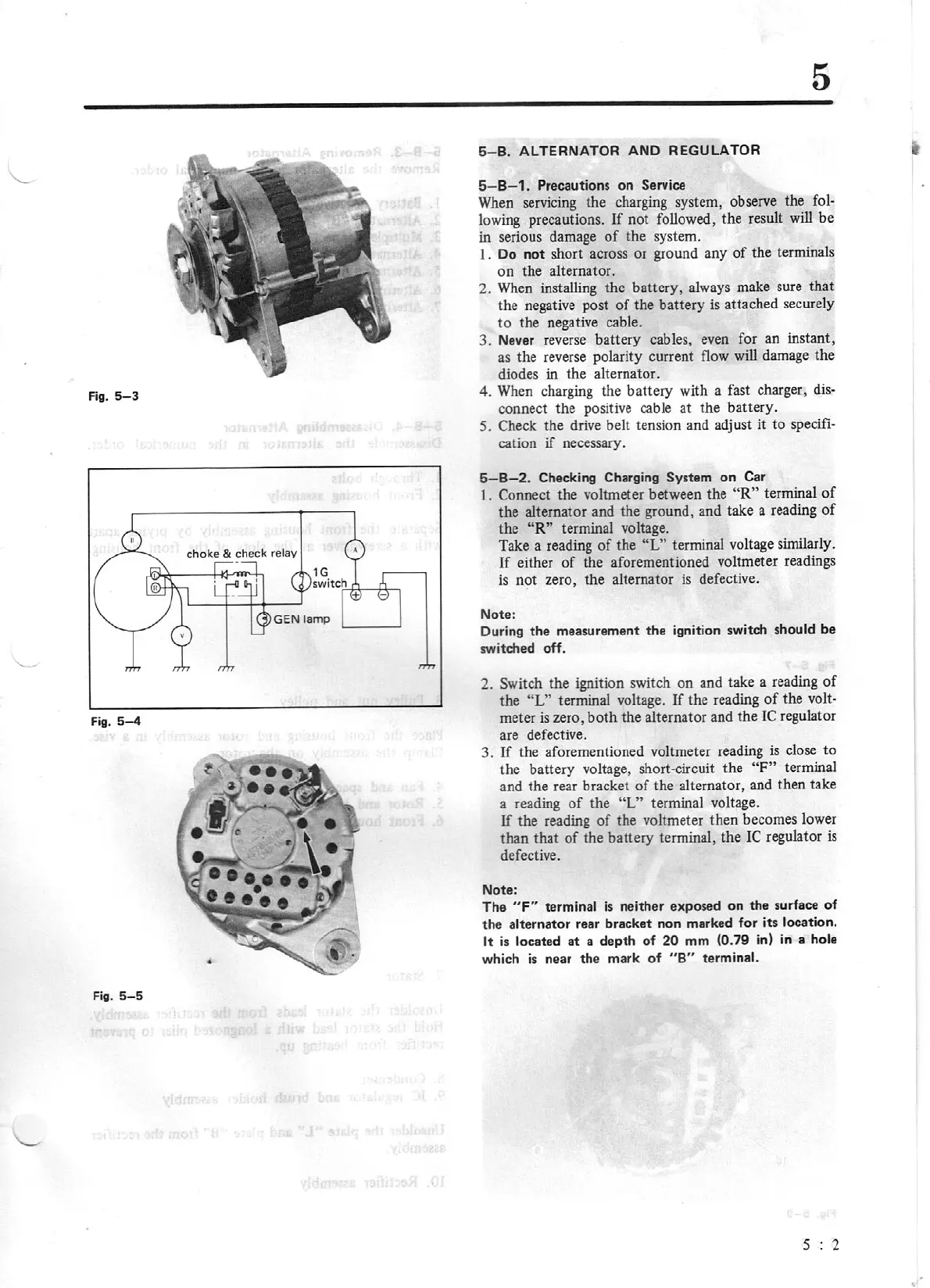
1.
Connect
the voltmeter between
the
"R"
terminal
of
the
alternator and
the
ground,
and
take a reading
of
the
"R"
terminal voltage.
Take a reading
of
the
"L"
terminal volta
ge
similarly.
If
either
of
lhe aforementioned voltmeter readings
is
not
zero,
the
alternator is defective.
Note:
During
the
measurement
the
ignition switch
should
be
switched
off
.
2.
Switch
the
ignition switch
on
and take a reading
of
the
"L"
terminal voltage.
If
the
reading
of
the
volt-
meter
is
zero,
both
the
alternator
and
the
IC
regulator
are defective.
3.
If
the
aforementioned voltmeter reading is close
to
the
battery
voltage, short-circuit
the
"F"
terminal
and
the
rear bracket
of
the alternator,
and
then
take
a reading
of
the
"L"
terminal voltage.
If
the
reading
of
the
voltmeter then becomes lower
than
that
of
the
battery
terminal,
the
IC
regulator is
defective.
Note:
The
"F
" terminal
is neither exposed
on
the surface
of
the
alternator
rear bracket
non
marked
for
its location.
It
is
located
at
a
depth
of
20
mm
(0.
79
in) in a hole
which
is
near the mark
of
"8"
ter
minal.
5
2



 To Next Page