11
Fig,
11-39
Fig.
11-40
Fig. 11 -
41
Fig.
11-42
11
:
11
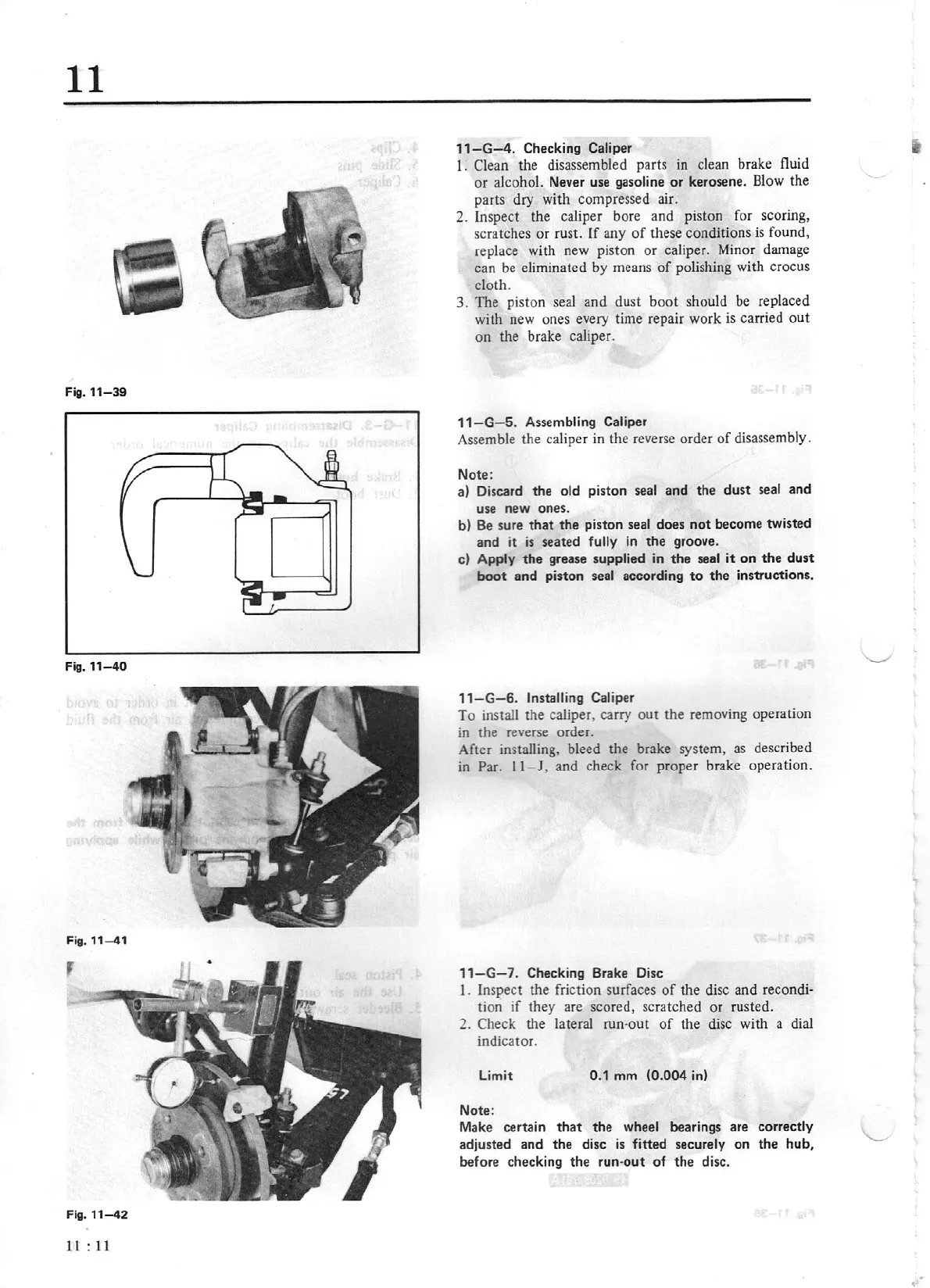
11-G-4.
Checking Caliper
I. Clean the disassembled
parts
in
clean brake
fluid
or
alcohol. Never use gasoline
or
kerosene. Blow the
parts dry with compressed air.
2.
Inspect the caliper bore and piston for scoring,
scratches
or
rust.
If
any
of
these conditions is found,
replace with new piston
or
caliper. Minor damage
can be eliminated
by
means
of
poUshing with crocus
cloth.
3.
The piston
seal
and dust
boot
should be replaced
with new ones every time repair wo
rk
is
car
ri
ed
out
on
the brake caliper.
11
- G-
5.
Assembling Caliper
Assemble the caliper in the reverse order
of
disassembly.
N
ote:
a) Discard the
old
piston seal and the
dust
seal and
use new ones.
b)
Be
su
re
that
the
piston seal does
not
become twisted
and
it
is seated
fully in
the
groove.
cl Apply
the
grease supplied in
the
seal
it
on
the
dust
boot
and
piston seal according
to
the
instructions.
11
-G-6.
I
nstatling Caliper
To
install
the
caliper, carry
out
the removing operation
in the reverse order.
After installing, bleed the brake system, as described
in Par.
11
J,
and check for
proper
brake operation.
11-G-7.
Checking Brake Disc
I.
Inspect the friction surfaces
of
the disc and
recondi-
tion
if
they
are scored, scratched
or
ru
s
ted
.
2.
Check
the lateral
run·out
of
the disc
with
a dial
indicator.
limit
0.1 mm
(0.004
in)
Note:
Make certain
that
the
wheel
bearings are correctly
adjusted
and
the disc
is
fitted securely
on
the hub,
before checking the run-
out
of
the
disc.


 To Next Page