LEDs 135
imc CANSAS Users Manual - Doc. Version 1.9 - 05.12.2014© 2014 imc Meßsysteme GmbH
4.6 LEDs
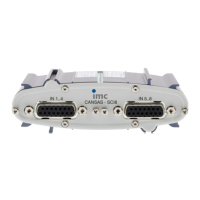
The imc CANSAS-module is equipped with one or more LED depending on the module. It is located to the
right above the external power supply jack. It can shine red or green, or their combination yellow.
The manufactory default codes are described in chapter "Measurement technique" .
The LED can be under the user's control. The red and the green parts can each be set up just as virtual
channels are. If both colors shine at once, it appears yellow. Making settings for the two color
components can be accomplished using the imc CANSAS operating software via the Module Tree's entry
"CAN-bus Interface" under "Without CAN-bus message". On the corresponding dialog pages, you can
parameterize each of the color components in the same way as virtual channels.
An LED's control signal takes digital data format (1 (TRUE) corresponds to LED on and 0 (FALSE) to LED
off). Any function whose result is in digital data format can be outputted by an LED. Here we will devote
particular attention to the functions "Digital Constants" and "LED-Flash":
The function "Digital Constants" lets you generate digital functions. The constant's value is to be specified
as either 0 (FALSE) or 1 (TRUE). When the constant is set to 1 (TRUE), the selected color component of
the LED shines, otherwise is doesn't.
The "LED-Flash"-function makes the LED blink. For this purpose, the user must specify a pulse interval
and how many pulses the LED is to shine and how many pulses it is to stay off. If "Flash" is set in the input
box "Condition", the LED flashes the set color at the set pulse rate (see also "LED-Flash " in the
Functions Reference).
To conserve computational capacity, functions with compressed input data are calculated with a time lag
(see below under Sampling Rates ). At pulse rates of 100 ms and higher, this phenomenon can be
observed directly in yellow flashes (the red and green components flash on and off at an offset).
Therefore it is recommended not to specify yellow flashes at higher rates than 50 ms.
The bridge amplifier module's two additional LEDs are also yellow. The red and green color components
of these LEDs, however, are not separately programmable. Using the special bridge amplifier function
"Output status on LED", info on the bridge amplifier's status can be output to these LEDs (see also
"Output status on LED " in the function reference).
The LED card for these modules is status-oriented, i.e. there are no longer 1 or 2 LEDs, but only one (or
more) module states. For each of the states listed, it is possible to set the LED and the flashing pattern by
which it is indicated. For the description of the blinking code see imc µ-CANSAS and imc µ-CANSAS-HUB4
.
220
161
141
169
223


 To Next Page