Special module-specific characteristics 139
imc CANSAS Users Manual - Doc. Version 1.9 - 05.12.2014© 2014 imc Meßsysteme GmbH
4.7.2 Output modules
The output modules are DAC8, PWM8, DO16R and DO8R. These modules receive their data in messages
via the CAN-bus. The CAN-messages can contain either analog or digital data. The channel data are
extracted from the CAN-messages and then output on the process side either directly or after prior
processing. Such prior processing is accomplished with the help of virtual channels; for instance, such a
channel can contain the results of low-pass filtering applied to channel data received via CAN-bus.
Depending on the module type, either analog data (in the case of the analog output module) or digital
data (in the case of the digital output module) can be outputted.
If data are to be read in to the output module, the bits and Bytes to be read in must be assigned to
channels. To do this, use the Drag & Drop technique to position the Module Tree entries of channels in
messages. Virtual channels as well as physical outputs can be positioned in the messages. The channels
assigned to a message are automatically set on the function "Read-in CAN channel". In the message
mapping dialog, a message's bit and Byte assignments, the number and order of bits, and the numerical
format of the channel data to be extracted can be set. For analog data, the minimum and maximum
values can additionally be set. Virtual channels can be processed in any way desired and then outputted.
4.7.2.1 DAC8
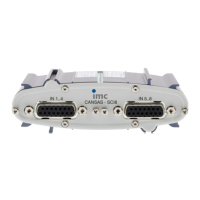
Analog output module DAC8
At the 8 analog outputs, voltages in the range from -10 V to +10 V can be outputted. Channels read in
from the CAN-bus and having this scaling, or virtual channels created with this scaling can be outputted
directly. Otherwise the channels are automatically re-scaled, which results in a loss of precision. If for
instance a 16-bit channel with an input range of -1 V ... +1 V is read in from the CAN-bus and is to be
outputted, the values which are read in are automatically transformed into the value range -10 V ... +10
V. Of the values -32767 to +32767 on the CAN-bus, only the values -3276 to +3276 can be used for the
D-A converter's output after scaling. This is because the range 1 V to +1 V is to be analog output. And if a
channel with the input range 20 V..+20 V is transmitted by CAN-bus, the values outside of the range +10
V to -10 V are truncated.
For some special functions, the results are re-scaled because of the integer arithmetic. Thus, the addition
of two channels scaled to ± 10 V results in a channel with an input range of ± 20 V. If this result is to be
analog output, it is automatically re-scaled to ± 10 V.
The additional functions "Rectangle function", "Triangle", and "Sine" are available to this module under
the group heading "Signal generator functions".
Sample application: A physical input channel is to be read in from the CAN-bus, subjected to low-pass
filtering and outputted at the Analog Output 1. To do this, a virtual channel must first be created and
positioned in a CAN-message using the Drag & Drop technique. In the message mapping dialog for this
virtual channel, the position of the bits to be extracted in the message and the data type can be set. Then
the low-pass filter function must be set in the function setting dialog for Analog Output 1, the virtual
channel created must be set as the function's parameter channel and the other parameters must also be
specified.
The module also can output currents in the range 0 mA to 20 mA. If the module is switched to current
supply mode, its output is still scaled as -10 V...+10 V. All positive voltages from 0 V to +10 V are mapped
to 0 mA..20 mA. No negative voltages can be mapped, since the current supply can only provide current
in one direction.


 To Next Page