394 Properties of the Modules
imc CANSAS Users Manual - Doc. Version 1.9 - 05.12.2014© 2014 imc Meßsysteme GmbH
6.19.2.2 Parameterizing the FAST-channels
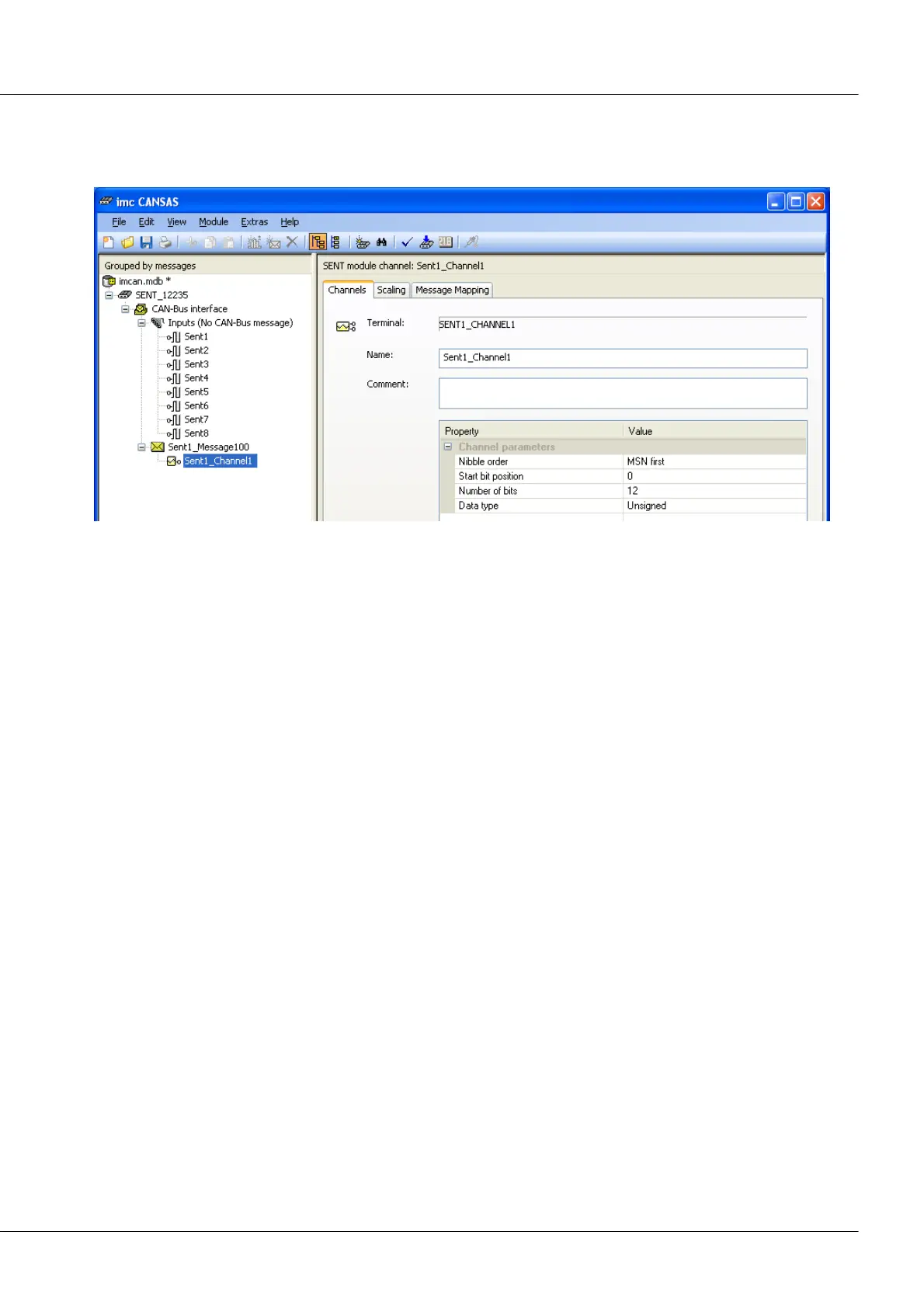
From each SENT-input (= connected SENT-sensor), it is possible to extract FAST-channels to be
transmitted on the CAN-bus.
The FAST-channel is formed by extracting a number from a SENT-message’s data nibbles, which is then
put into a CAN-message.
Nibble order
The order in which the nibbles are arranged, which together form a number.
MSN first: most significant nibble first. The nibble with the highest value is transmitted before the
nibbles of lower value.
LSN first: least significant nibble first: The nibble with the lowest value is transmitted before the
nibbles of higher value.
See the examples further below.
Start bit position
The bit position from which onward the number’s first bit is transmitted. All 6 data nibbles are
imagined as ordered in succession, resulting in a sequence of 6*4 = 24 bits. A nibble’s highest-value bit
is considered the nibble’s first bit. The first among the 24 bits has bit position 0, the last has bit
position 23.
Thus, the data nibble’s most significant bit has bit position 0, that of the 2
nd
data nibble the bit
position 4. And the first data nibble’s least significant bit has bit position 3, that of the 2
nd
data nibble
the bit position 7.
See the examples further below.
Number of bits
The number in the SENT-message is this many bits wide. With CANSAS, the amount can be between 1
and 16 (theoretically up to 24).
See the examples further below.
Data type
What is the number’s data type?
Signed: signed integer in two’s complement. E.g. for 8-bit width, the value range -128 ..127
Unsigned: unsigned integer. for example: for 8-bit width, the value range 0..255


 To Next Page