298 Properties of the Modules
imc CANSAS Users Manual - Doc. Version 1.9 - 05.12.2014© 2014 imc Meßsysteme GmbH
6.7.2 Voltage measurement
Voltage: ±10 V to ±5 mV in 9 different ranges
The input impedance is 20 M . (1 M when switched off)
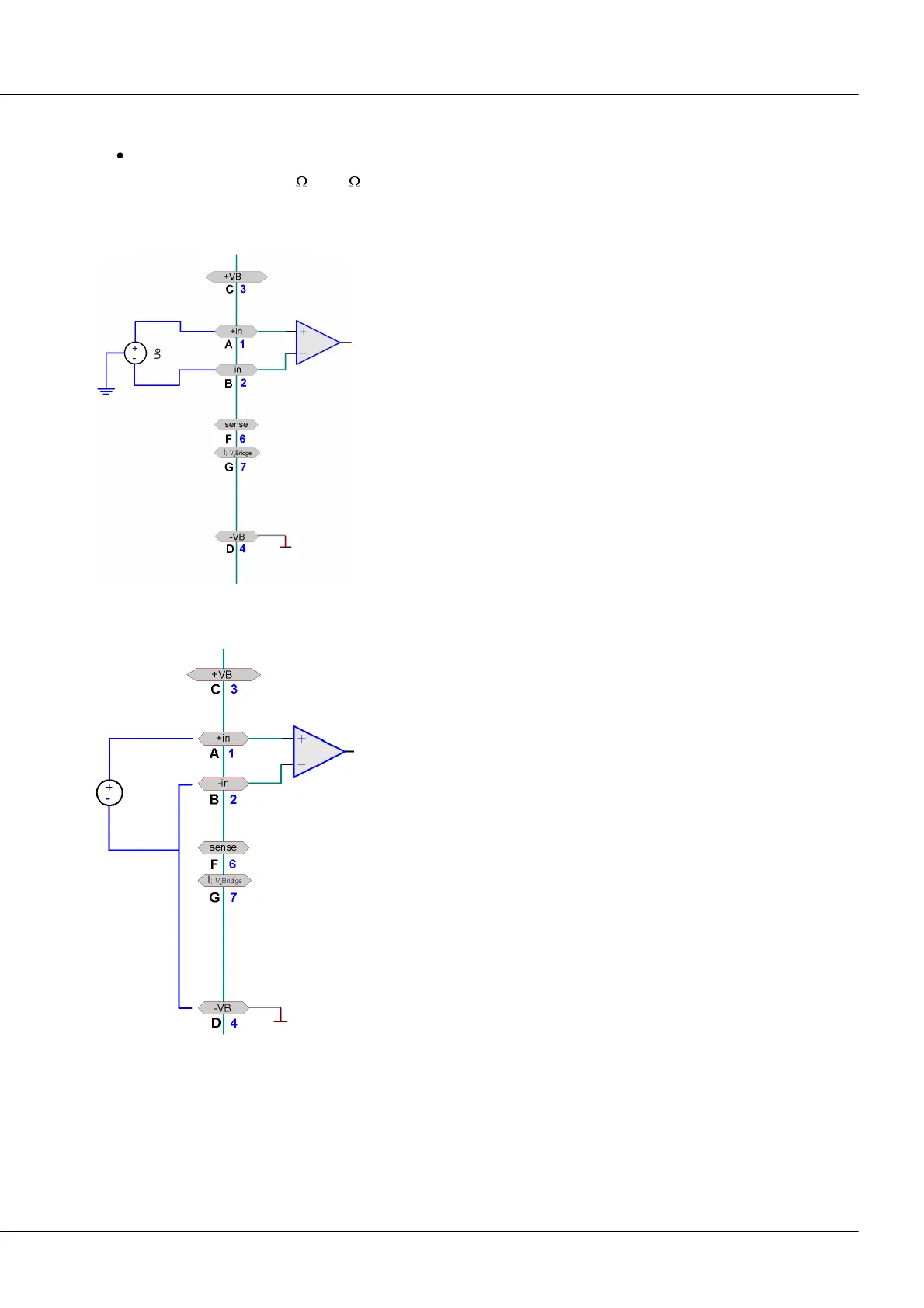
6.7.2.1 Voltage source with ground reference
The voltage source itself already has a connection to the device’s
ground. The potential difference between the voltage source and
the device ground must be fixed.
Example: The device is grounded. Thus, the input -VB (D) is also at
ground potential. If the voltage source itself is also grounded, it's
referenced to the device ground. It doesn't matter if the ground
potential at the voltage source is slightly different from that of the
device itself. But the maximum allowed common mode voltage
must not be exceeded.
Important: In this case, the negative signal input -in (B) may not be
connected with the device ground -VB (D). Connecting them would
cause a ground loop through which interference could be coupled
in.
In this case, a genuine differential (but not isolated!) measurement
is carried out.
6.7.2.2 Voltage source without ground reference
The voltage source itself is not referenced to the device ground
but is instead isolated from it. In this case, a ground reference
must be established. One way to do this is to ground the voltage
source itself. Then it is possible to proceed as for "Voltage source
with ground reference". Here, too, the measurement is
differential. It is also possible to make a connection between the
negative signal input and the device ground, in other words to
connect -in(B) and -VB(D).
Example: An ungrounded voltage source is measured, for instance
a battery whose contacts have no connection to ground. The
module is grounded.
Important: If -in(B) and -VB(D) are connected, care must be taken
that the potential difference between the signal source and the
device doesn't cause a significant compensation current. If the
source's potential can't be adjusted (because it has a fixed,
overlooked reference), there is a danger of damaging or destroying
the amplifier. If -in(B) and D are connected, then in practice a
single-ended measurement is performed. This is no problem if
there was no ground reference beforehand.


 To Next Page