136 Virtual Channels
imc CANSAS Users Manual - Doc. Version 1.9 - 05.12.2014© 2014 imc Meßsysteme GmbH
4.7 Special module-specific characteristics
4.7.1 Acquisition modules
Depending on the module type, acquisition modules process either analog or digital input data. The
isolation and bridge amplifier modules, for example, take analog input data, and the digital acquisition
module DI16 takes digital data. The imc CANSAS module then sends the incoming data to the CAN-bus,
either directly or after prior processing. Such prior processing is accomplished with the help of virtual
channels; for instance, such a channel can contain the results of low-pass filtering applied to physical
input data. After data processing, only the results are then transmitted by CAN-bus.
The raw data always consist of the physical or digital input signals, which can then be subjected to any
desired processing. All channels assigned to a message are then transmitted by CAN-bus.
In order for data to be ready for transmission via CAN-bus, the bits or bytes to be transmitted must be
assigned to specific channels. To do this, use the Drag & Drop technique to position the Module Tree
entries of channels in messages. Virtual channels as well as physical inputs can be positioned in the
messages. In the message mapping dialog, a message's bit and Byte assignments, the number and order
of bits, the numerical format of the channel data being transmitted and the scaling factor and offset are
all indicated.
4.7.1.1 ISO8, C8, INC4 and C12
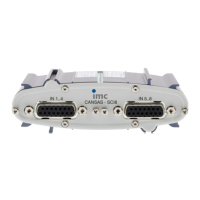
Isolation module ISO8, differential amplifier modules C8 and C12 and
incremental encoder module INC4
Up to 12 physical inputs are available depending on module type.
Sample application: A low-pass filter is to be applied to a physical input channel's signal and the results
are to be transmitted by CAN-bus. To do this, a virtual channel must be created and positioned in a CAN-
message (via Drag & Drop). In the settings dialog for this virtual channel, a low-pass filter function can be
selected and its parameters set.


 To Next Page