404 Properties of the Modules
imc CANSAS Users Manual - Doc. Version 1.9 - 05.12.2014© 2014 imc Meßsysteme GmbH
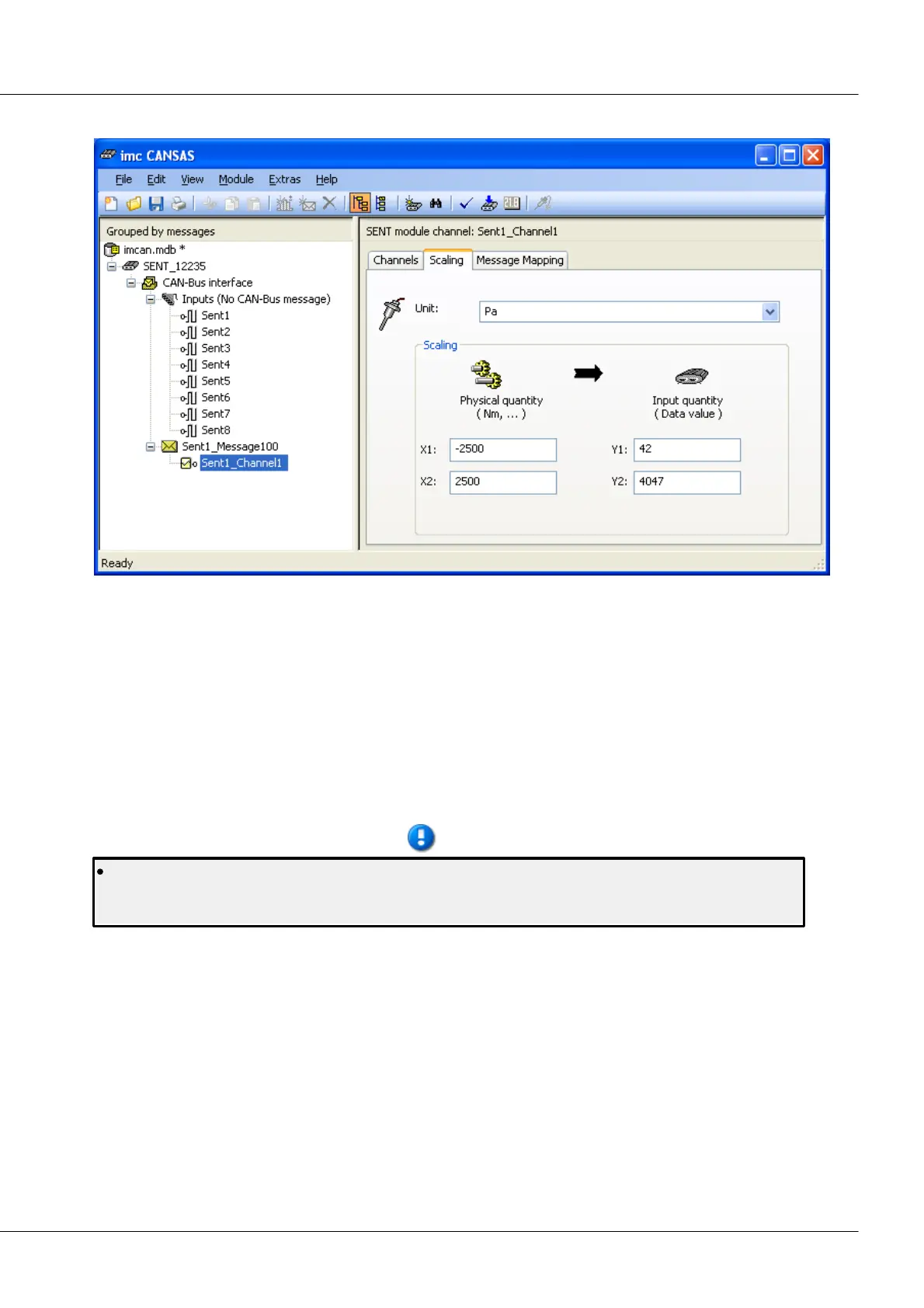
The following picture shows the scaling in the imc CANSAS GUI:
6.19.3 Format the CAN messages
For each SENT input, there is a CAN message containing all FAST channels. 1..4 FAST-channels can be
configured. The FAST channels are obtained from the SENT message’s 6 data nibbles. The CAN message is
as large as all the extracted channels strung together. If, for instance, two channels (one with 12 bits, one
with 8 bits) are extracted from the SENT message, then the CAN message is 20 = 8 + 12 bit long. The CAN
message is sent immediately after arrival and verification of the SENT message. The CAN message’s clock
rate is derived from the clock rate at which the SENT messages are received. If the Status channel is
activated, it is also appended to the CAN message with a width of 9 bits. The order of the channels in the
CAN messages is always set automatically.
The CAN message contains not simply a consecutive string of the 6 data nibbles, because a nibble
order of LSN first produces a bit sequence which the typical CAN-Bus decoders are not able to
evaluate.
For each SENT input, there is a CAN message containing the content of the Serial Protocol (SLOW
channels). This CAN message is only generated if a Serial Protocol has been parameterized. The message
structure is fixed. Initially the SLOW-channel’s message-ID is positioned in the CAN message with a
constant width of 16 bits. This channel’s name, for instance, is Sent1_SerialControl for the 1st input. This
channel is followed by the content of the SLOW channel, which is either 8, 12, or 16 bits wide, depending
on the Serial Protocol’s configuration. The CAN message is sent once a complete Serial Protocol data
package has been constructed and verified. For this purpose, it is necessary for the CRC of the individual
SENT messages to have been transmitted correctly, as well as that a sufficiently long series of SENT
messages was transmitted, and also that the CRC via a serial communication media was transmitted
correctly. This channel’s name, for instance, is Sent1_SerialData for the 1
st
input.


 To Next Page