Measurement modes 213
imc CANSAS Users Manual - Doc. Version 1.9 - 05.12.2014© 2014 imc Meßsysteme GmbH
5.2 Sampling rates: Scanner concept
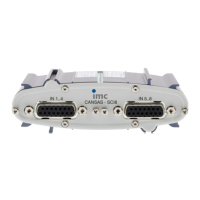
The following is a discussion of data acquisition with multiplexers and the limitations associated with it.
This will include a contrast of conventional scanners (e.g. C12) to systems working in the so-called Burst
mode (e.g. SCI8, SC16).
Conventional scanner systems work at a fixed sampling rate, namely the highest rate at which switching
between channels takes place (fast scanning). If the sampling rate actually set is less than the maximum
possible data rate, then an average of multiple samples taken at the high sampling rate is computed
(filtering).
The maximum sampling rate is substantially determined by the scanner's transients, i.e., the switching
times and the transients of pre-amps, of analog (and any digital) filters, and of ADCs.
Since the system's bandwidth must be quite high for the transients to subside within the interval
corresponding to the "aggregate sampling rate", while on the other hand the channel-sampling rate is
lower by at least the factor n=channel count, the conditions for the Sampling Theorem will necessarily be
violated. Aliasing effects which cannot be filtered out will result.
This dilemma, characteristic of scanner systems, can be significantly mitigated at least in the case of a
flexibly configured, low-speed measurement (e.g. of temperature). For that purpose, the rigid sampling
scheme is adapted in accordance with block-measurement and –averaging ("Burst-mode"). Thus, flexible
adaptation of the scanner timing enables disturbance- and aliasing-free low-speed precision
measurement.
The Burst mode is based on making optimal use of the time spent while the signal experiences its
transients. Not only a single measurement of the selected channel is performed, but a block
measurement over a period of time at least equally long or a multiple of the time period. By this means,
the total cycle time is mostly used for data acquisition and no longer mainly by the cumulative transient
time.
The block measurement is performed by a high-speed analog/digital converter (ADC) having a data rate
which is a multiple of the max. aggregate sampling rate. An anti-aliasing filter adapted to this data rate
ensures aliasing-free acquisition within the block. This block is then digitally filtered and becomes a data
stream whose bandwidth is flawlessly limited and perfect for frequencies above the block filter's. This
data stream is in turn "re-sampled" at the actually intended channel sampling rate. While it is true that
this channel rate is lower than the block-averaging filter's bandwidth, and that anti-aliasing effects could
theoretically occur for that reason, the conditions are vastly less extreme than with “fast-scanning“: the
range of possible aliasing errors is now limited to between one-half of the channel sampling rate and the
block filter's cutoff frequency. This range has a frequency ratio of approx. 14 to 28 (depending on the
module type), and, with the sampling rate suitably selected, it lies below the critical frequency ranges
from 50 Hz on, in which the relevant interference is expected.
This procedure thus has the following advantages:
flexible configuration of low-speed precision measurements and high-speed measurements with
one and the same affordable scanner system
Optimal aliasing-free noise suppression of even 50 Hz interference in spite of a scanner amplifier's
relatively high bandwidth
Note the following constraints: The block averaging time is not channel-specific. It is based on the
smallest sampling rate set in the system. All channels used, including ones not outputted directly but
rather used to calculate virtual channels, are instrumental! The procedure thus provides only advantages
if all channels are set to one low-speed sampling rate which determines the noise suppression properties.


 To Next Page