214 Measurement Technique
imc CANSAS Users Manual - Doc. Version 1.9 - 05.12.2014© 2014 imc Meßsysteme GmbH
Note also that systems using a multiplexer also have a time offset between channels. This is
automatically corrected computationally, in fact by means of a filter having a transit time (delay) which
depends on the sampling rate. This additional delay is based on the highest-speed sampling rate set for
the module.
This (non-recursive) time-offset compensation filter additionally leads to a characteristic overtravel upon
jumps in the signal. However, this property is independent of the Burt-mode's characteristics.
A summary of applicable constraints:
The highest-speed sampling rate (of all used, including channels used to derive virtual channels)
determines the averaging interval and thus the noise suppression properties of all channels.
Additional signal transit time due to automatic time offset correction is determined by the highest
sampling rate.
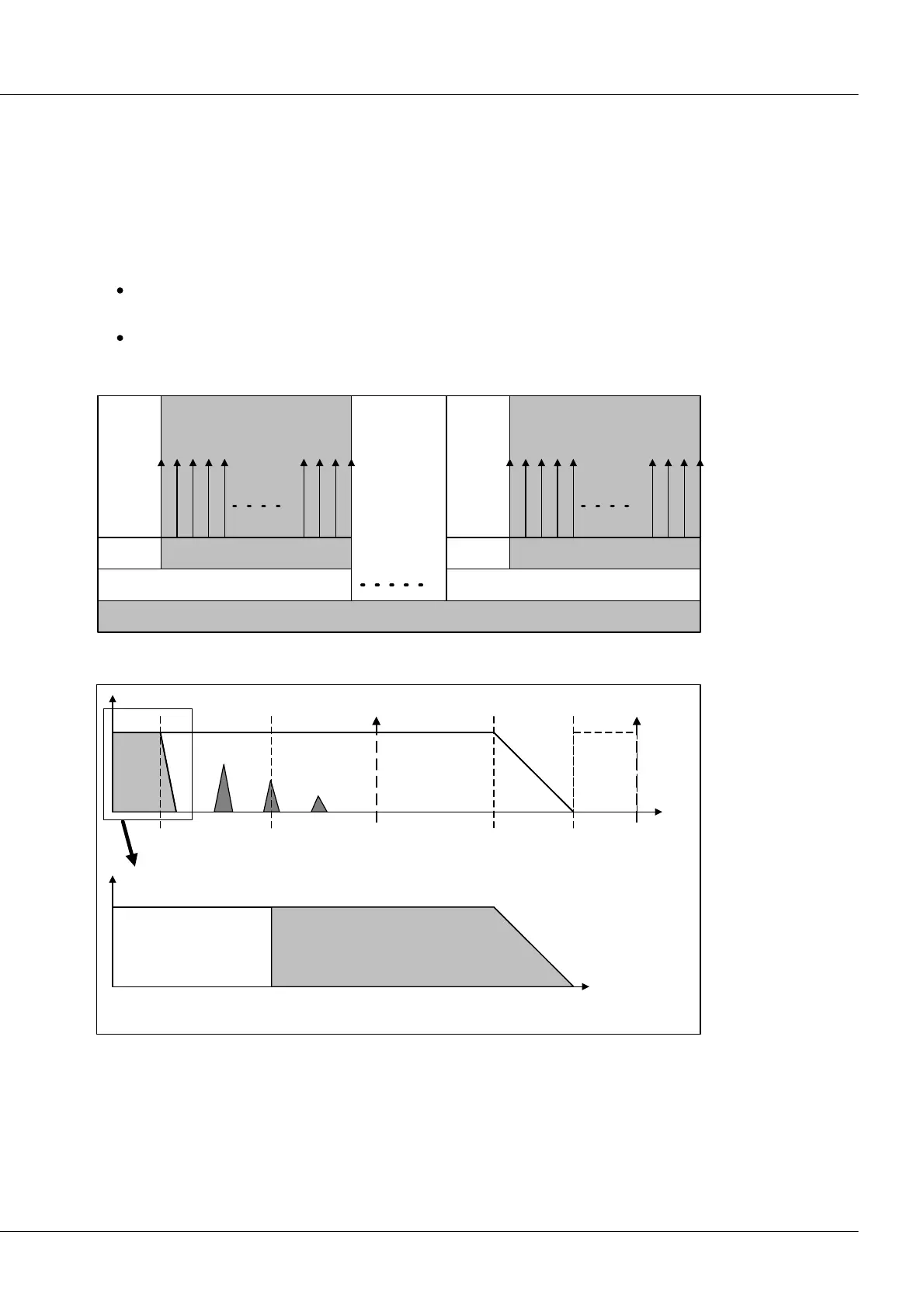
Scanner timing:
switch
250 µs
K1
acquire
single sample ... 50ms burst
K16
Channe l-Rate
: 5 ms / 200 Hz (single sample) ... 1 s / 1Hz (Burst 50 ms)
SC16
Burst me asurement
(40 kSps)
Burst me asurement
(40 kSps)
switch
250 µs
acquire
single sample ... 50ms burst
Filter concept: fast scanning vs. burst mode:
G
f
28 Hz
filter
(interpolation)
50 Hz
Nois e
8.6 kHz
AAF
40 kHz
sample
ADC
20 k Hz
Nyquis t
(ADC)
G
f
fast scanning: 200 Hz / channel
Aliasing-
free
band of
interest
effective user channel rate: 200 Hz
100 Hz
Nyquist
(
fas t s canning
)
200 Hz
fas t s canning
-> serious aliasing between
100 Hz .. 8.6 kHz


 To Next Page