386 Properties of the Modules
imc CANSAS Users Manual - Doc. Version 1.9 - 05.12.2014© 2014 imc Meßsysteme GmbH
6.18.10 Delay
With slower sampling times the filter will not always be calculated completely. Therefore delay times
may be similar with and without filtering.
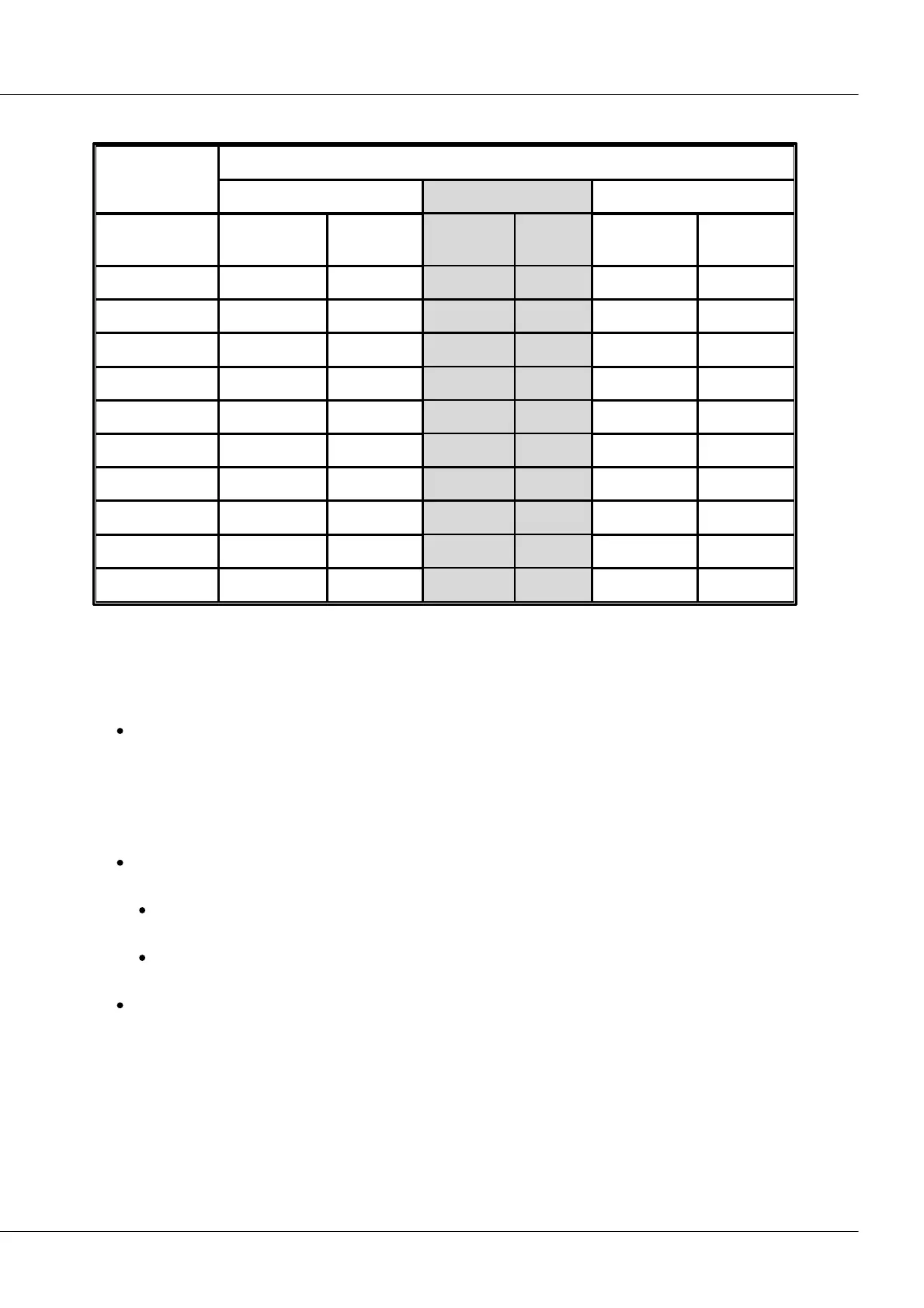
The table indicates typical delay times, for the respective most strongly delayed channels.
The SCxx modules possess certain particularities:
The highest sampling rates can cause longer delay times than slower sampling rates, depending on
the system. The cause is the multiplexer on which the module is based. This multiplexer doesn't
change channels at the highest clock rate. The reconstruction filter used also causes increased
delay. If the delay time is to be short, then you must select sampling rates with sufficiently short
delay. This may well be a slower sampling rate. In that case, the higher sampling rates produce finer
intermediate values, which however feature delayed processing.
With a SCxx module, if different sampling rates are used, the overall delay time results as per the
following rule:
For channels with the highest sampling rate used, the delay time is determined by this sampling
rate.
For channels with a slower sampling rate, the resulting delay time is that of the fastest sampling
time plus the sampling interval which is set.
With SCxx modules, the delay time depends on the channel. For instance, if Channels 1, 2, 3 and 4
are contained in a message, then Channel 1 was sampled first, then Channel 2 and finally Channel 4.
Thus the most current (the newest) measured value in the message comes from Channel 4.
Conversely, the measured value from Channel 1 is the most delayed one.


 To Next Page