The user interface 63
imc CANSAS Users Manual - Doc. Version 1.9 - 05.12.2014© 2014 imc Meßsysteme GmbH
3.2.4.3 CAN-Bus Interface
General bus connection settings are made in the dialog on this virtual index card.
Once switched on, a imc CANSAS-module sends messages according to its configuration and to the Baud
rate set for it. It also receives messages having the correct identifier for configuration messages (Master-
ID).
Only one PC having imc CANSAS configuration software, and no other CAN-node, should transmit on the
common CAN-Bus with the Master-ID.
If the imc CANSAS-module is started with a reset-plug connected, no messages which contain measured
data are sent. A Baud rate of 125kbit/s is used and messages with the Standard Identifier 2032 are
received.
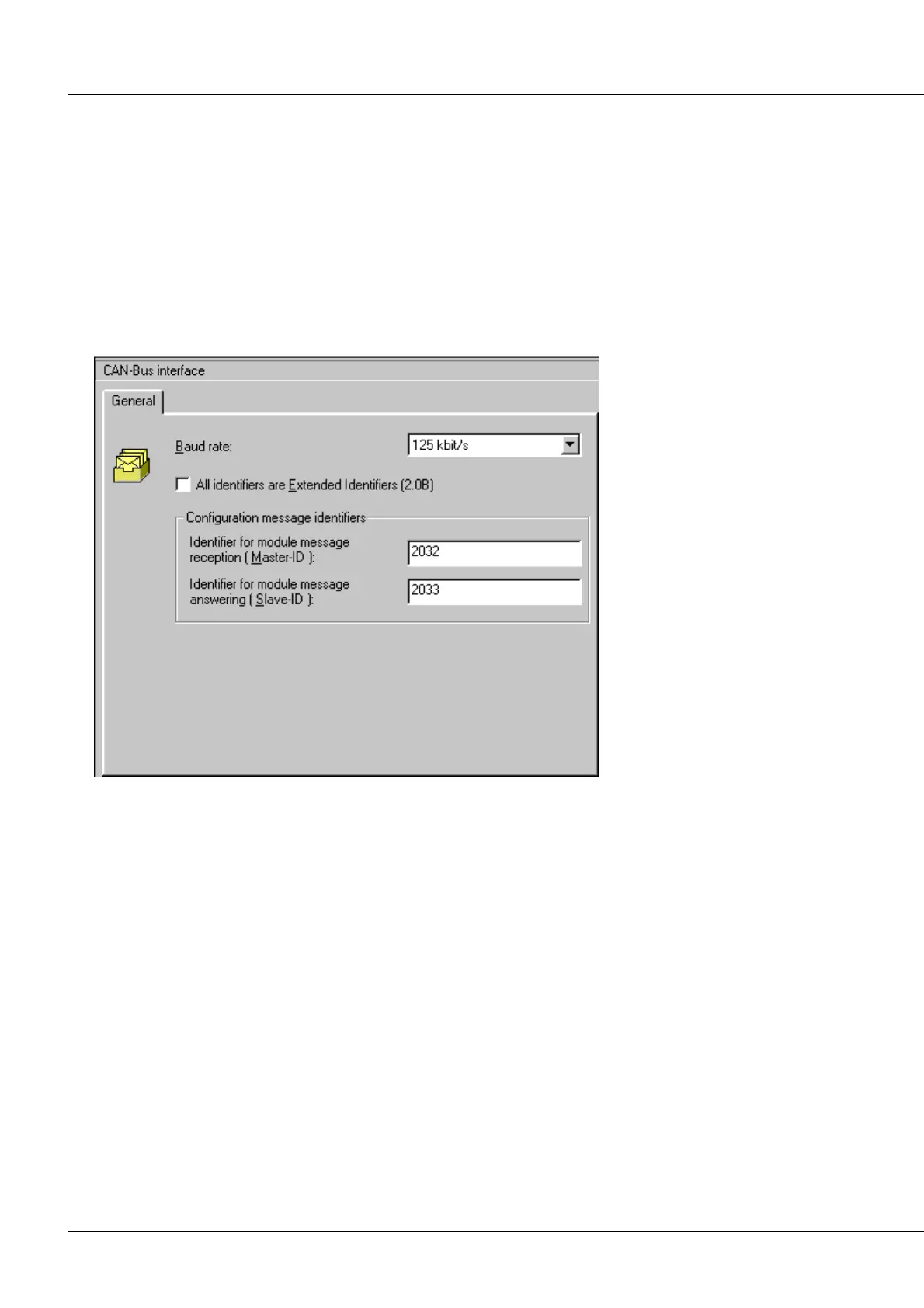
CAN-Bus interface Properties dialog
Baud rate: The Baud rate is the rate at which individual bits are serially transmitted. All CAN-Bus modules
must have the same clock rate. Baud rates from 20kbit/s to 1Mbit/s can be selected from the drop-down
list box. The default setting is 125kbit/s.
All identifiers are Extended identifiers ( 2.0 B ): All a module's identifiers, both those of the configuration
messages and those of the other messages, can be either Standard identifiers (2.0 A Standard) or
Extended identifiers (2.0 B Standard).
Extended identifiers are 29 bits long (ID's of 0 .. 536870912 are permitted), in contrast to a Standard
identifier, which is 11 bits long (ID's of 0 .. 2047 permitted). Extended identifiers can only be used if all
nodes of the common CAN-Bus are 2.0B supported or at least 2.0B passive.
Configuration message identifiers: These identifiers are for configuring the imc CANSAS-modules via the
CAN-Bus and normally can keep their default settings.
It can be useful to change an identifier if Extended identifiers are used, or if modules are to be configured
from multiple PC's linked to a common CAN-Bus. Each PC in a common CAN-Bus system should have a
unique pair of identifiers.


 To Next Page