202 Measurement Technique
imc CANSAS Users Manual - Doc. Version 1.9 - 05.12.2014© 2014 imc Meßsysteme GmbH
The time resolution corresponds to the value of an LSB (Least Significant Bit).
During sampling intervals when no time measurement was possible (because either a starting or stopping
edge was missing), the last valid return value continues to be returned until a time measurement is
completed. If there is no valid return value, zero is returned. If more than one time measurement is
completed during a single sampling interval (due to multiple starting and stopping edges), the last time
measured is returned.
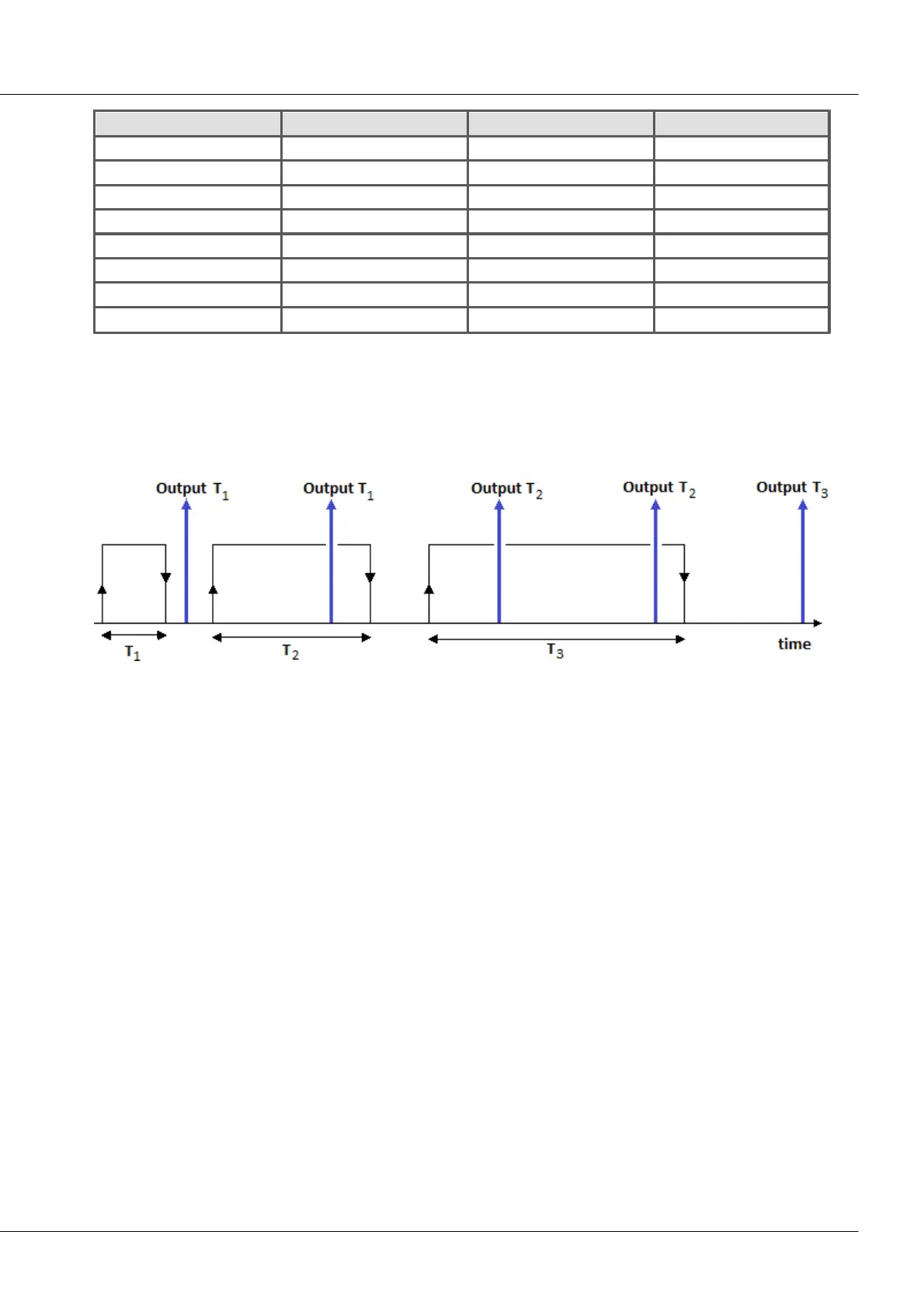
Above is illustrated a measured signal from which time readings are taken. Each reading starts at a
positive edge in the signal and is stopped at a negative edge. The "up" arrows indicate the times at which
the system returns a result. The returned values in this case are T1 –twice; T2 –twice; and T3.
5.1.3.3.2 Pulse Time
The point in time at which the edge is located within the sampling interval is determined. This
information is needed by some functions in imc Online FAMOS, e.g. for determining the course of the
RPMs from a pulse signal: OtrEncoderPulsesToRpm.
The measurement variable Pulse Time refers to phase-based data which is only relevant to special
applications (particularly order-tracking analysis). It is required for subsequent online calculations. It
represents the time between the last detected (asynchronous) pulse and the (synchronous) sampling
time at which the counter readings were sampled and evaluated. The unit associated with this variable is
called Code.


 To Next Page