IGN ignition angle measurement module 331
imc CANSAS Users Manual - Doc. Version 1.9 - 05.12.2014© 2014 imc Meßsysteme GmbH
Example:
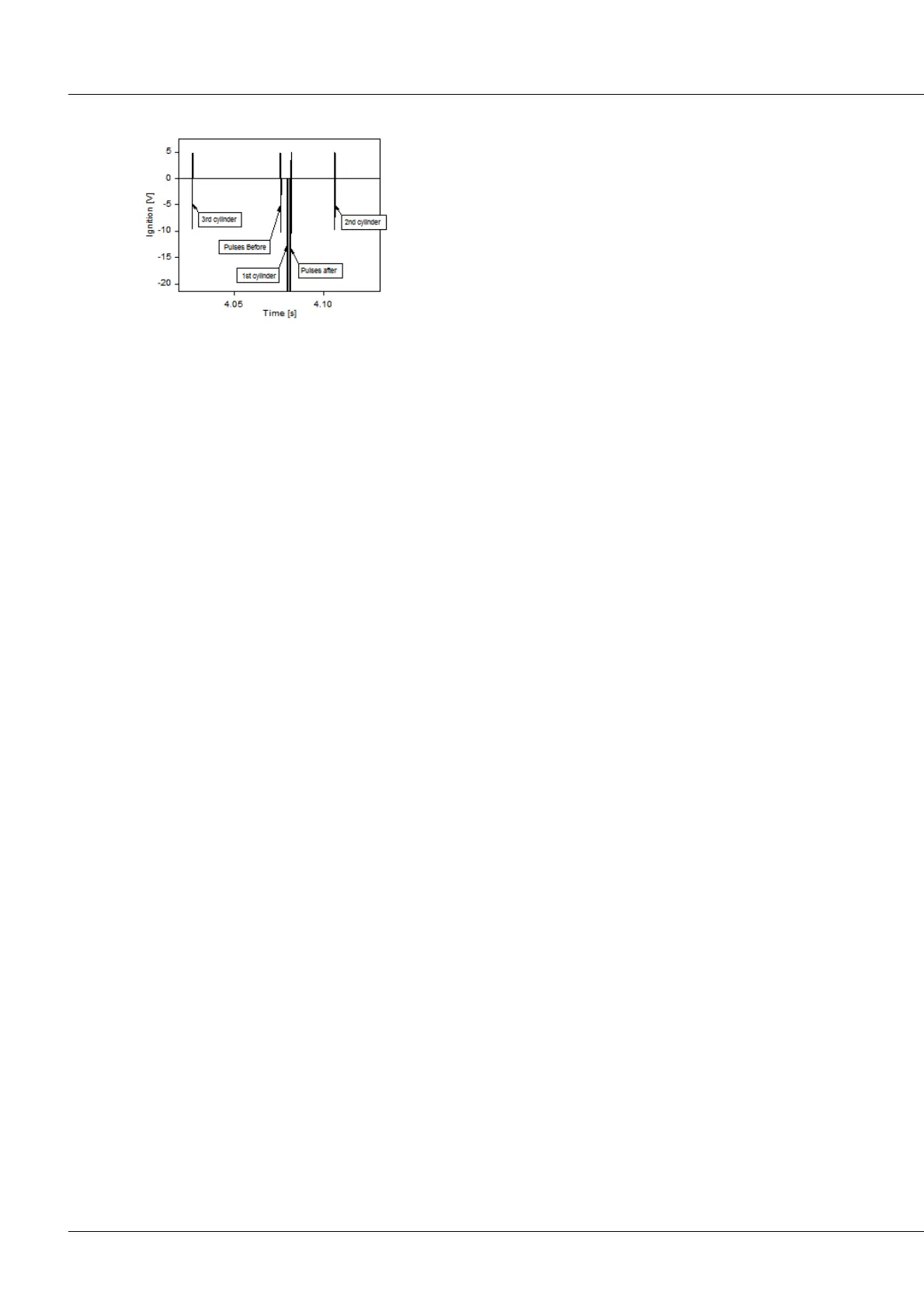
3-cylinder ignition signal
The ignition clamp sensor is connected in such a way that it
surrounds the 1st cylinder's ignition line. The other
cylinders' signals however are coupled in, as well as the
pulses before and after the actual ignition.
The conditioning must now be parameterized in such a way
that the 1st cylinder's pulse is captured in all cases.
It doesn't matter if the other cylinders' pulses are also captured. Since in this case 3 "Ignition pulses
per work cycle" was set, the device knows that the ignition pulses are 240 degrees apart. So, if for
instance the 2nd cylinder's ignition pulse is captured, then 240 degrees are subtracted from its angle.
The interference pulses directly after the ignition pulse ("pulses after") are no problem either. The imc
CANSAS-IGN hardware suppresses pulses which do not closely follow another one.
What is critical is suppression of pulses BEFORE the actual ignition pulse ("pulses before"). If the edge
detector recognizes these pulses as valid pulses, then this point in time is assumed to be the ignition
time, so that in consequence incorrect ignition angles are determined. By means of low-pass filtering
and a suitably large hysteresis, it is possible to compensate for these pulses before the ignition time.
One interesting possibility is offered by forming the absolute value plus subsequent low-pass filtering.
By this means, isolated fluctuations will lead to a tiny "hill", while a package of multiple fluctuations
results in a large "hill" where a threshold is easy to set.
It is worth being cautious about too much smoothing, which might cause the actual ignition pulse to
appear too weak, so that the "pulses after" dominate and are the only ones recognized. This, too,
would lead to the ignition time being determined incorrectly.
In any case, with such signals it is worth checking whether the sensor can be set to a better position.


 To Next Page