4.81
Date Code 20170927 Instruction Manual SEL-751 Relay
Protection and Logic Functions
Group Settings (SET Command)
High-Impedance Fault
Detection With Arc
Sense Technology
High-impedance faults (HIF) are short-circuit faults with fault currents smaller
than those a traditional overcurrent protective relay can detect. Almost all HIFs
involve the ground directly or indirectly. The main causes of HIFs are tree
branches touching a phase conductor; dirty or failing insulators that cause flash-
overs between a phase conductor and the ground; or downed conductors
touching the ground.
Staged downed-conductor fault tests in North America indicate that downed
conductor HIFs generate quite small fault currents. The HIF current of multi-
grounded systems depends highly on the surface types upon which a conduc-
tor falls, and the fault current varies from zero to less than 100 amperes.
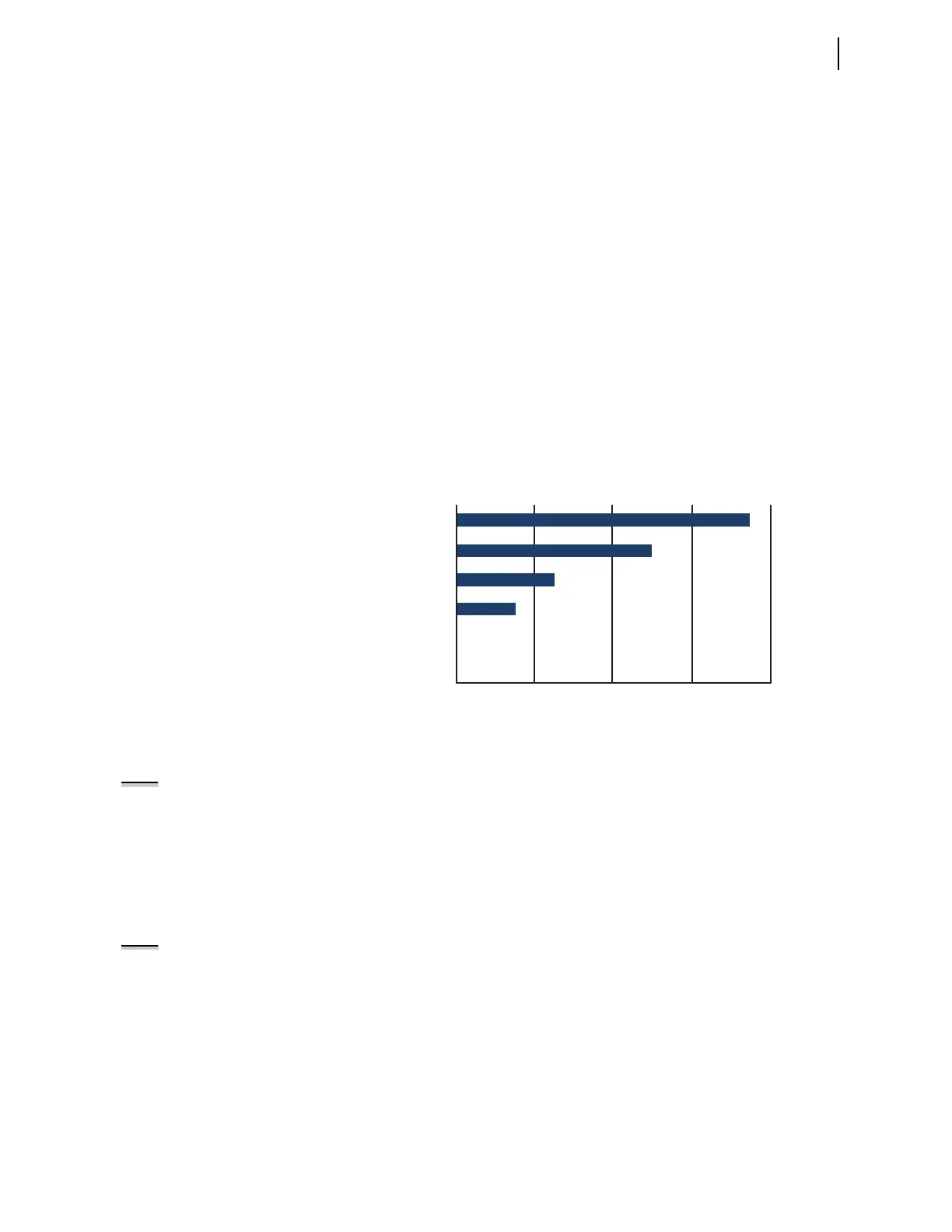
The probability of HIF detection is dependent on the type of surface involved
(asphalt, reinforced concrete, grass, etc.) and the moisture content of the sur-
face (dry/wet). Both of these factors affect the conductivity, as seen by the
fault current levels in Figure 4.55. While it is not possible to detect an HIF on
an asphalt surface, the probability of HIF detection increases for more conduc-
tive surfaces (e.g., wet grass). Low levels of fault current make it extremely
difficult to detect all HIFs while preventing the relay from causing nuisance
trips/alarms. Refer to the technical paper High-Impedance Fault Detection–
Field Tests and Dependability Analysis by Daqing Hou, available at
selinc.com, for more information.
Figure 4.55 High-Impedance Fault Current Levels Depend on Ground
Surface Type
High-impedance fault detection with Arc Sense technology (AST) is available
in select SEL-751 models. The part number indicates whether or not the relay
supports high-impedance fault detection.
HIF detection is based on the odd-harmonics and inter-harmonic components
present in the current signal. HIF detection requires the current to be at least
five percent of the nominal load current.
The HIF detection method shown in Figure 4.56 incorporates the following
key elements:
➤ An informative quantity that reveals HIF signatures as much as
possible without being affected by loads and other system
operation conditions.
➤ A running average of the quantity that provides a stable
prefault reference.
Reinforced
Concrete
Wet Grass
Dry Grass
Wet Sand
Dry Sand
Asphalt
020406080
Typical Fault Current (A) at 7200 V Line-to-Ground
NOTE: Detecting high-impedance
faults has challenged utilities and
researchers for years, especially in
situations where a fault occurs on
asphalt or dry sand or generates little
or virtually no fault current. As is
commonly known, not all HIFs are
detectable. Detecting HIFs potentially
reduces the risks associated with
these faults. The SEL HIF detection
method increases the likelihood that
an HIF is detected.
NOTE: High-impedance fault
detection using Arc Sense technology
is only applicable for solidly grounded
and low-impedance grounded
systems.


 To Next Page