4.175
Date Code 20170927 Instruction Manual SEL-751 Relay
Protection and Logic Functions
Global Settings (SET G Command)
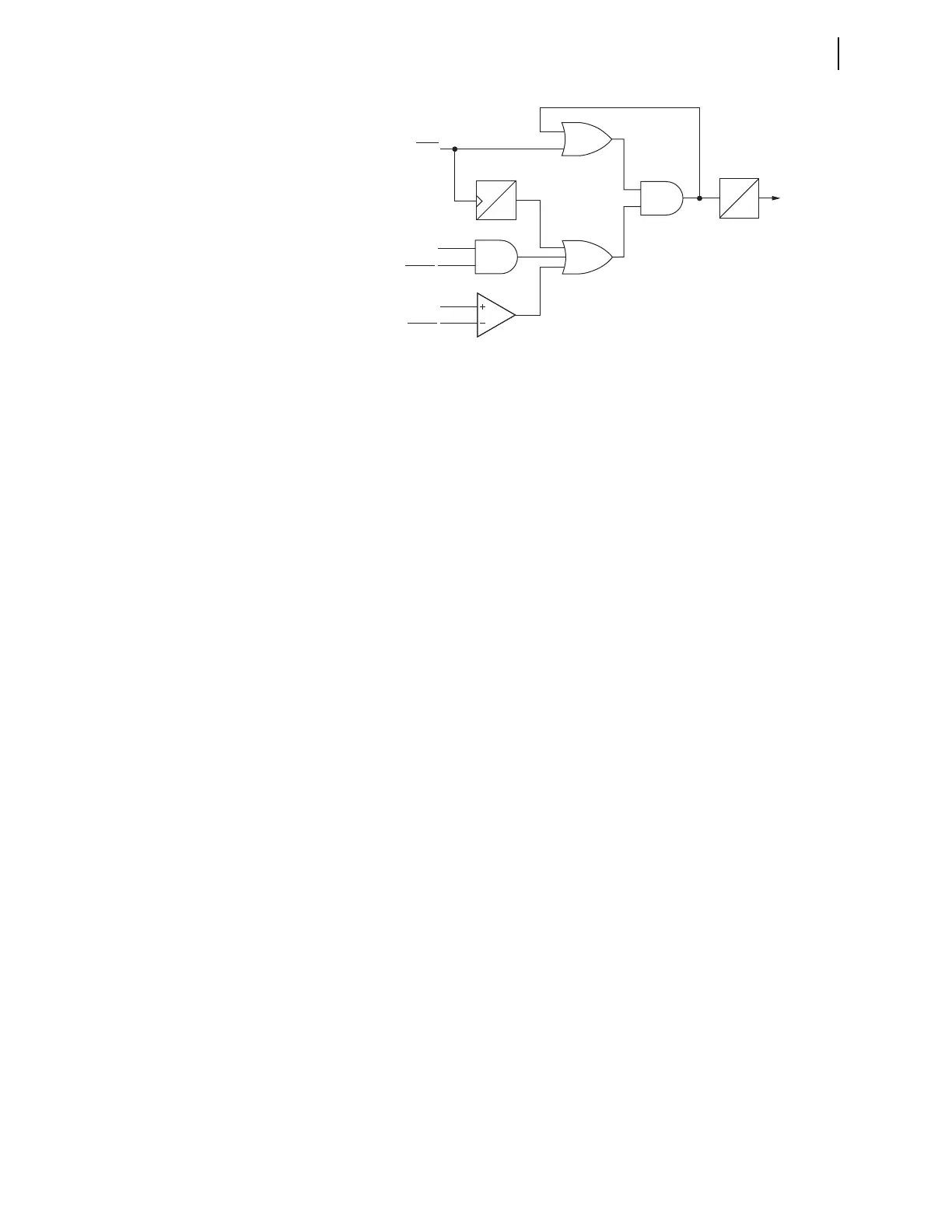
Figure 4.101 Breaker Failure Logic
Changing the BFI or the 52ABF, ATD, 50BFP settings can modify the default
breaker failure logic.
➤ Set BFI := R_TRIG TRIP AND NOT IN102 if input IN102 is
manual trip only and breaker failure initiation is not desired
when the tripping is caused by this input.
➤ Set 52ABF := Y if you want the breaker failure logic to bypass
the current detector when the breaker is closed.
➤ Aux timer (ATD) may be used to start the BFD timer in
sequential trip applications where the current detector may not
operate on initiation of the logic. If used, the ATD time must be
set lower than the BFD time setting for secure operation.
Arc-Flash Protection
The SEL-751 offers advanced arc-flash protection capability aimed at
minimizing the hazards associated with high energy arc (faults) in metal-
enclosed and metal-clad switchgear. The system supports as many as eight
fiber-optic light sensors capable of detecting the high energy arc-flash events
and tripping the breaker within milliseconds of the fault. Light sensors are
supervised with an instantaneous overcurrent element offering enhanced
security against false trips. Each of the eight sensors can be routed to multiple
tripping outputs by using SEL
OGIC control equations, offering ultimate
flexibility in creating multiple protection zones (breaker truck cabinet, bus, PT
cubicle, etc.).
SEL-751 arc-flash protection is exceptionally fast. Typical relay operating
times are in the order of 2–5 ms when equipped with the optional fast hybrid
(high-speed) output card. With standard, electromechanical outputs, tripping time
increases to 7–13 ms. Fault clearing time is typically longer, determined by the
breaker operating time, which often adds three to five cycles.
This system supports two distinct types of fiber-optic light sensors. The first
type is the omni-directional point sensor optimized for installation in individ-
ual switchgear compartments. The second sensor is the clear-jacketed fiber
loop sensor optimized for protection of long, distributed resources, such as the
switchgear bus compartment. Supervision of both types of sensors comes
from use of a loopback-based attenuation measurement method, and you can
use both sensors interchangeably on each of the eight light inputs. Refer to
Application Guide AG2011-01: Using the SEL-751 and SEL-751A for Arc-
Flash Detection for more details.
BFD
0
0
ATD
BFI
Current Detector
BFT
Max {Ia, Ib, Ic}
Aux Timer
52A
Relay
Word
Bit
52ABF = Y
Setting
50BFP
Setting


 To Next Page