D.7
Date Code 20170927 Instruction Manual SEL-751 Relay
DNP3 Communications
DNP3 in the SEL-751
While automatic unsolicited data transmission on power up is convenient, this
can cause problems if your DNP3 master is not prepared to start receiving data
immediately on power up. If the master does not acknowledge the unsolicited
data with an Application Confirm, the device resends the data until it is
acknowledged. On a large system, or in systems where the processing power
of the master is limited, you may have problems when several devices
simultaneously begin sending data and waiting for acknowledgment
messages.
The SEL-751 allows you to set the conditions for transmitting unsolicited
event data on a class-by-class basis. It also allows you to assign points to event
classes on a point-by-point basis (see DNP3 Documentation on page D.14).
You can prioritize data transmission with these event class features. For
example, you might place high-priority points in event class 1 and set it with
low thresholds (NUMEVEn and AGEEVEn settings) so that changes to these
points are sent to the master quickly. You may then place low priority data in
event class 2 with higher thresholds.
If the SEL-751 does not receive an Application Confirm in response to
unsolicited data, it waits for ETIMEOn seconds and then repeats the
unsolicited message. To prevent clogging of the network with unsolicited data
retries, the SEL-751 uses the URETRYn and UTIMEOn settings to increase
retry time when the number of retries set in URETRYn is exceeded. After
URETRYn has been exceeded, the SEL-751 pauses UTIMEOn seconds and
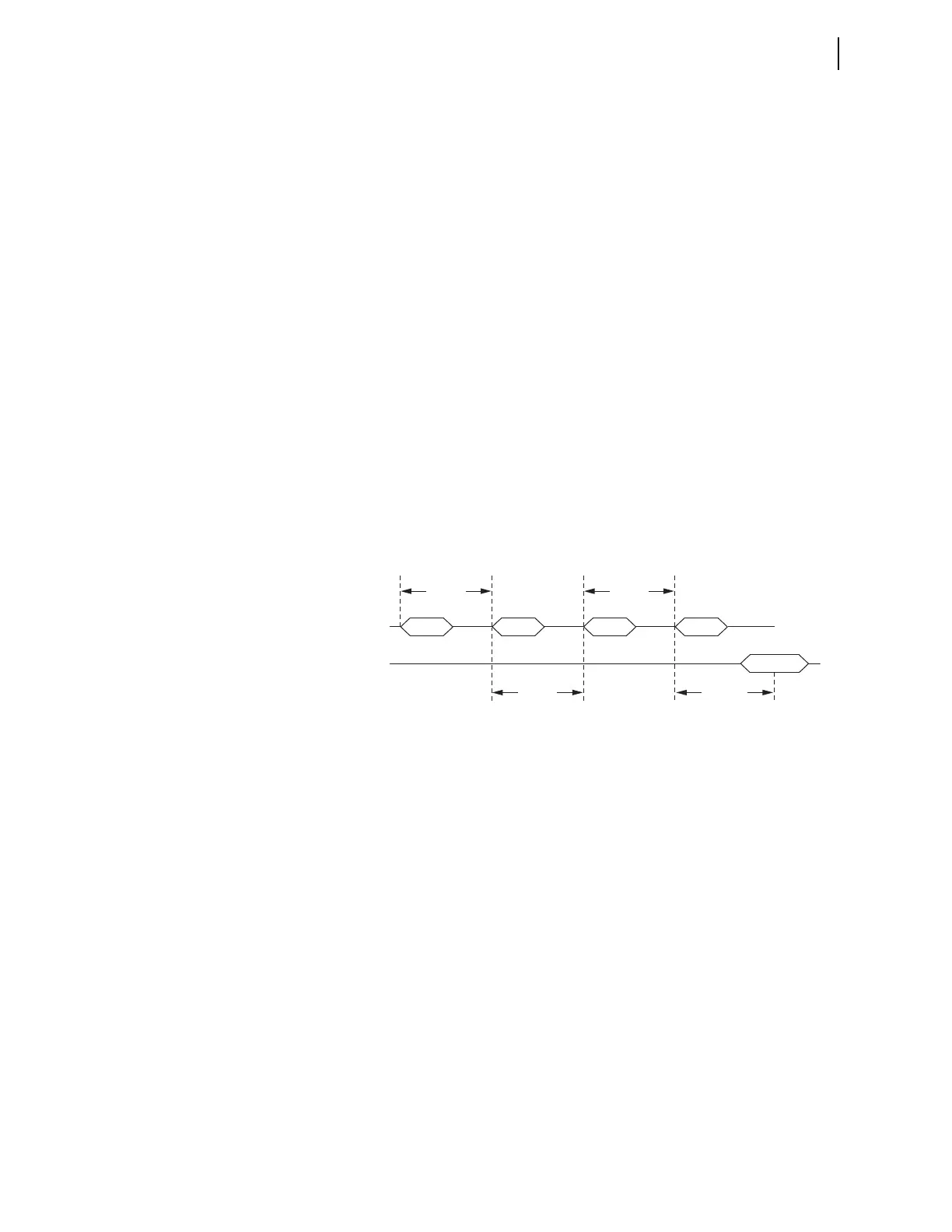
then transmits the unsolicited data again. Figure D.1 provides an example with
URETRYn =2.
Figure D.1 Application Confirmation Timing With URETRY n = 2
Collision Avoidance
If your application uses unsolicited reporting on a serial network, you must
select a half-duplex medium or a medium that includes carrier detection to
avoid data collisions. EIA-485 two-wire networks are half-duplex. EIA-485
four-wire networks do not provide carrier detection, while EIA-232 systems
can support carrier detection. DNP3 LAN/WAN uses features of the IP suite
for collision avoidance, so does not require these settings.
The SEL-751 uses Application Confirmation messages to guarantee delivery
of unsolicited event data before erasing the local event data buffer. Data
collisions are typically resolved when messages are repeated until confirmed.
The SEL-751 pauses for a random delay between the settings MAXDLY and
MINDLY when it detects a carrier through data on the receive line or the CTS
pin. For example, if you use the settings of 0.10 seconds for MAXDLY and
0.05 seconds for MINDLY, the SEL-751 inserts a random delay of 50 to 100
ms (milliseconds) between the end of carrier detection and the start of data
transmission (see Figure D.2).
RX DATA
(Event Data Confirmation)
TX DATA
ETIMEOn
Retry RetryRetry
Confirmation
UTIMEOn
UTIMEOn
ETIMEOn


 To Next Page