G.10
SEL-751 Relay Instruction Manual Date Code 20170927
IEC 60870-5-103 Communications
IEC 60870-5-103 in the SEL-751
The [INF, FUN] pair needs to either be entered together or not entered at all.
The SEL-751 does not accept only one member of the [INF, FUN] pair. Label,
INF, and FUN can all be manually entered. No other combinations are valid
with the SEL-751.
Binary Targets
The binary targets are Relay Word bits within the SEL-751 under row zero.
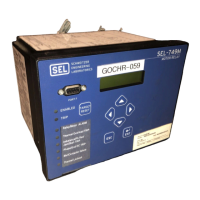
They also appear as LEDs on the front panel of the SEL-751. There are eight
binary targets in the SEL-751 namely, ENABLED, TRIP_LED, TLED_01,
TLED_02, TLED_03, TLED_04, TLED_05, and TLED_06. In the SEL-751,
binary targets are reported as ASDU type 2 (Time Tagged Message with
Relative Time) with COT type 1 (Spontaneous Events). The format of a binary
target point within the binary target map is “Label, [INF, FUN].” Label
represents any valid binary target point accepted by the SEL-751. The INF
parameter is an integer in the range of 0 to 255. Similarly, the FUN parameter
is an integer in the range of 0 to 255. Label can be entered by itself with the
SEL-751 choosing default parameters for INF and FUN. The default
parameter for INF is an available, unique value that is selected by the
SEL-751. The default parameter for FUN is 250.
The [INF, FUN] pair needs to either be entered together or not entered at all.
The SEL-751 does not accept only one member of the [INF, FUN] pair. Also,
Label, INF, and FUN can all be manually entered. No other combinations are
valid with the SEL-751.
Fault Analogs
The fault analogs are analog quantities in the SEL-751 used to describe faults
recognized by the relay, such as fault current or fault location. These
quantities are listed in Table G.11. In the SEL-751, fault analog quantities are
reported as ASDU type 4 (Time Tagged Measurands with Relative Time) with
COT type 1 (Spontaneous Events). The format of a fault analog point within
the fault analog map is “Label, [Scaling, [INF, FUN]].” Label represents any
valid fault analog point accepted by the SEL-751. Scaling is the scaling factor
applied to the point prior to being sent out of the relay via the protocol. Its
range is 0.000 to 99999.000. The INF parameter is an integer in the range of 0
to 255. Similarly, the FUN parameter is an integer in the range of 0 to 255.
Label can be entered by itself with the SEL-751 choosing default parameters
for Scaling, INF, and FUN. The Label and Scaling values can also be entered
together with the SEL-751 choosing default parameters for the INF and FUN.
The default parameter for INF is an available, unique value that is selected by
the SEL-751. The default parameter for FUN is 250. The default value for
Scaling is 1.
The [INF, FUN] pair needs to either be entered together or not entered at all.
The SEL-751 does not accept only one member of the [INF, FUN] pair. If the
[INF, FUN] pair has been entered, then Scaling must also be entered.
For a single Master/SEL-751 session, the SEL-751 stores as many as three
sets of event data into a buffer. If the buffer is full as a result of multiple events
with the poll cycle, any new event data is discarded. When the buffered data
have been reported (using the first-in first-out (FIFO) principle) to the Master,
those data are removed from the buffer to make room for the next event.
Table G.11 SEL-751 Analog Fault Quantities (Sheet 1 of 2)
Analog Fault Quantity Description
FLOC Location of the fault event
FIA A-phase current of the fault event
FIB B-phase current of the fault event


 To Next Page