F.10
SEL-751 Relay Instruction Manual Date Code 20170927
IEC 61850 Communications
IEC 61850 Operation
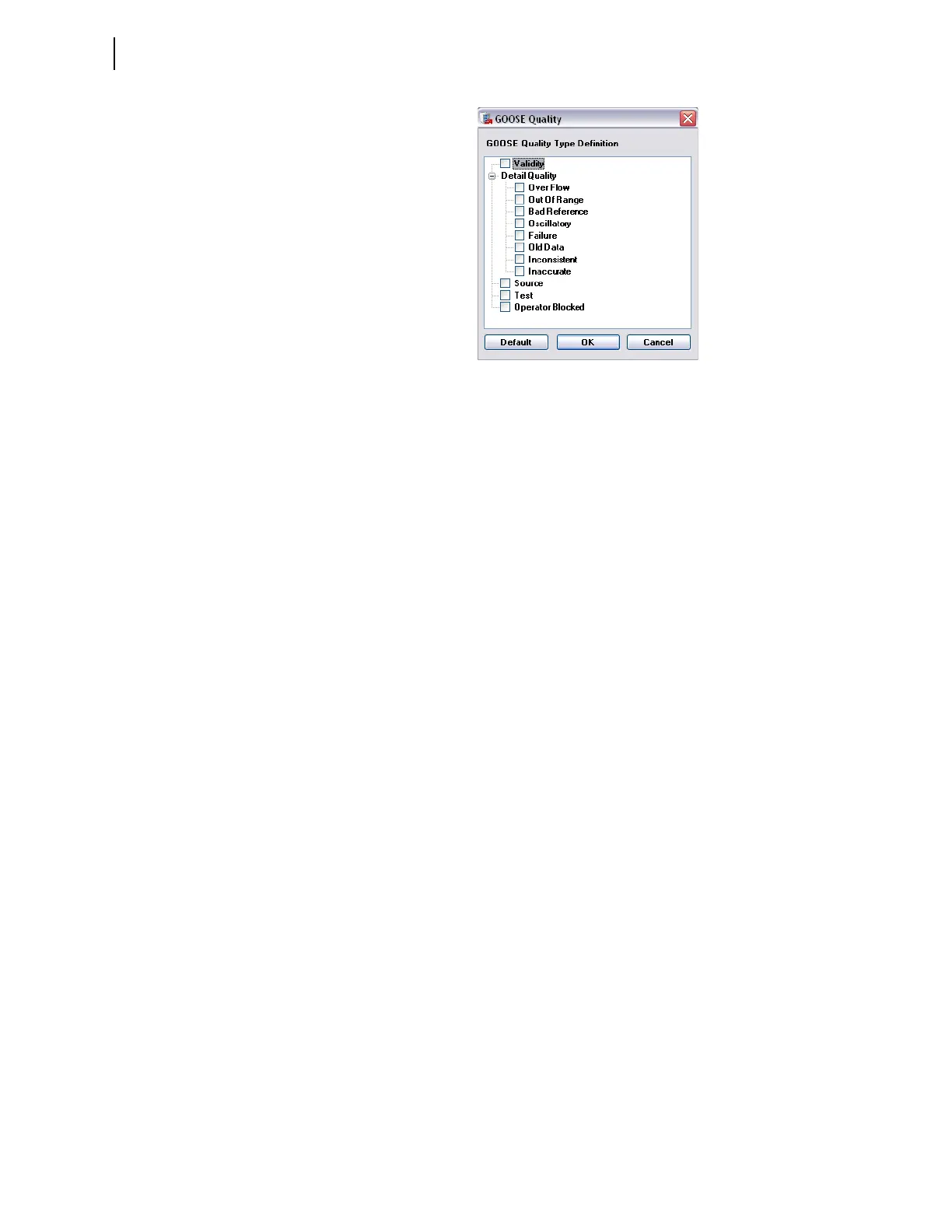
Figure F.3 GOOSE Quality
GOOSE Processing
SEL devices support GOOSE processing as defined by IEC 61850-7-1:2011(E),
IEC 61850-7-2:2010(E), and IEC 61850-8-1:2011(E) via the installed
Ethernet port. Outgoing GOOSE messages are processed within the following
constraints:
➤ You can define as many as eight outgoing GOOSE messages
consisting of any Data Attribute (DA) from any logical node.
You can map a single DA to one or more outgoing GOOSE, or one
or more times within the same outgoing GOOSE. You can also map
a single GOOSE dataset to multiple GOOSE control blocks.
➤ The relay transmits all configured GOOSE immediately upon
successful initialization. If a GOOSE message is not
retriggered; then, following the initial transmission, the relay
retransmits that GOOSE based on the minimum time and
maximum time configured for that GOOSE message. The first
transmission occurs immediately on triggering of an element
within the GOOSE dataset. The second transmission occurs
Min. Time later. The third transmission occurs Min. Time after
the second transmission. The fourth transmission occurs twice
Min. Time after the third transmission. All subsequent
transmissions occur at the Max Time interval. For example, a
message with a Min. Time of 4 ms and Max. Time of 1000 ms
is transmitted upon triggering, then retransmitted at intervals of
4 ms, 4 ms, 8 ms, and then at 1000 ms indefinitely or until
another change triggers a new GOOSE message (See IEC
61850-8-1, Sec. 18.1).
➤ GOOSE transmission is squelched (silenced) after a permanent
(latching) self-test failure.
➤ Each outgoing GOOSE includes communications parameters
(VLAN, Priority, and Multicast Address) and is transmitted
entirely in a single network frame.
➤ The SEL-751 maintains the configuration of outgoing GOOSE
through a power cycle and device reset.


 To Next Page