D.8
SEL-751 Relay Instruction Manual Date Code 20170927
DNP3 Communications
DNP3 in the SEL-751
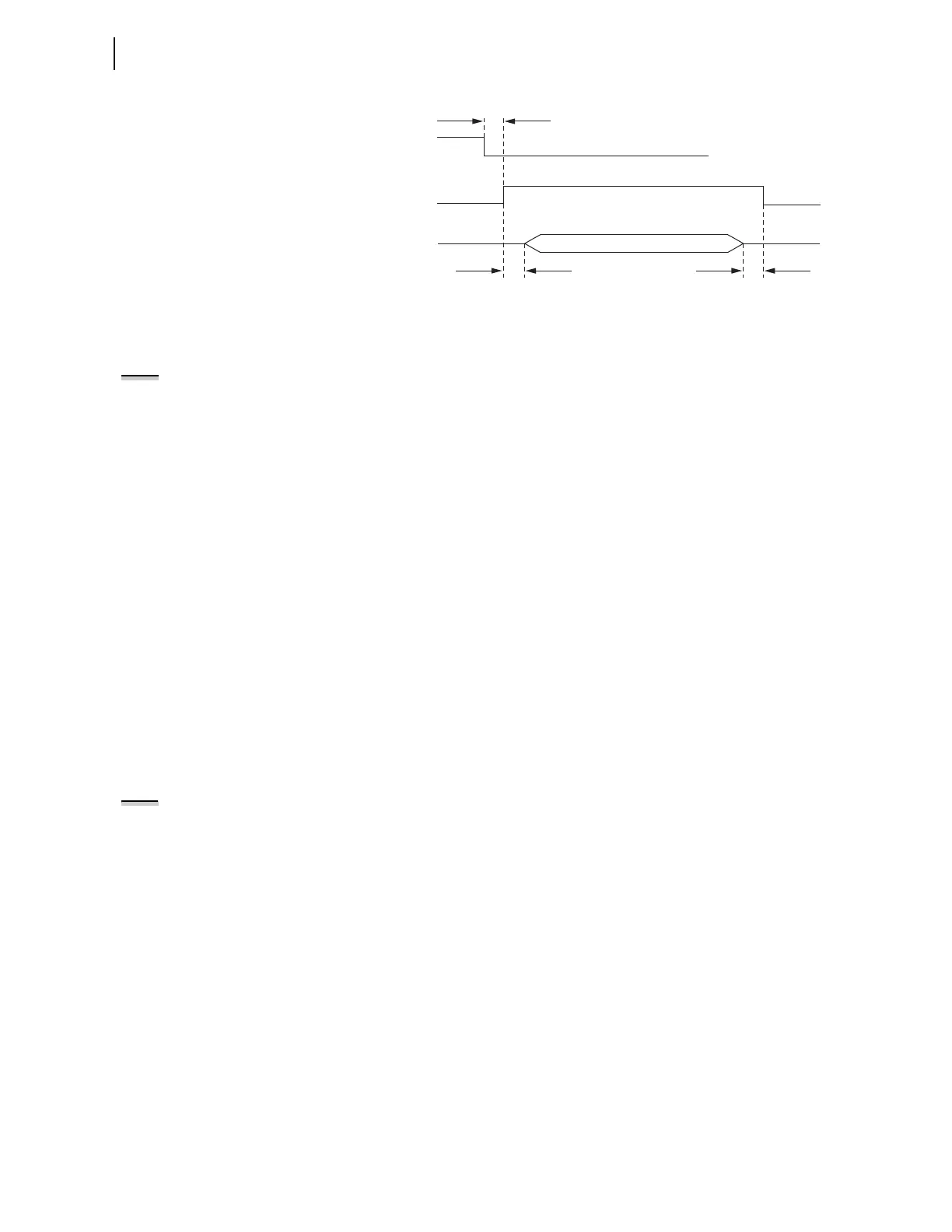
Figure D.2 Message Transmission Timing
Transmission Control
If you use a media transceiver (for example, EIA-232 to EIA-485) or a radio
system for your DNP3 network, you may need to adjust data transmission
properties. Use the PREDLY and POSTDLY settings to provide a delay
between RTS signal control and data transmission (see Figure D.2). For
example, an EIA-485 transceiver typically requires 10 to 20 ms to change
from receive to transmit. If you set the pre-delay to 30 ms, you avoid data loss
resulting from the data transmission beginning at the same time as the RTS signal
assertion.
Event Data
DNP3 event data objects contain change-of-state and time-stamp information
that the SEL-751 collects and stores in a buffer. Points assigned in the Binary
Input Map that are also assigned in the Sequential Events Recorder (SER)
settings carry the time stamp of actual occurrence. Binary input points not
assigned in the SER settings carry a time stamp based on the DNP map scan
time. This may be significantly delayed from when the original source
changed and should not be used for sequence-of-events determination. The
DNP map is scanned approximately once per second to generate events. You
can configure the SEL-751 to either report the data without a polling request
from the master (unsolicited data) or hold the data until the master requests it
with an event poll message.
With the event class settings ECLASSBn, ECLASSCn, and ECLASSAn, you
can set the event class for binary, counter, and analog inputs for session n. You
can use the classes as a simple priority system for collecting event data. The
SEL-751 does not treat data of different classes differently with respect to
message scanning, but it does allow the master to perform independent class polls.
NOTE: Most RTUs that act as
substation DNP3 masters perform an
event poll that collects event data of
all classes simultaneously. You must
confirm that the polling configuration
of your master allows independent
polling for each class before
implementing separate classes in the
SEL-751.
For event data collection you must also consider and enter appropriate settings
for dead band and scaling operation on analog points shown in Table D.7. You
can either:
➤ set and use default dead band and scaling according to data
type, or
➤ use a custom data map to select dead bands on a point-by-point
basis.
See DNP3 Documentation for a discussion of how to set scaling and dead-
band operation on a point-by-point basis. You can modify dead bands for
analog inputs at run-time by writing to Object 34.
The settings ANADBAn, ANADBVn, and ANADBMn control default dead-
band operation for each type of analog data. Because DNP3 Objects 30 and 32
use integer data, you must use scaling to send digits after the decimal point
and avoid rounding to a simple integer value.
Receipt of RX
DATA or CTS
Random Delay
MINDLY to MAXDLY
RTS
TX DATA
PREDLY
PSTDLY
NOTE: PREDLY and POSTDLY
settings are only available for EIA-232
and EIA-485 serial port sessions.


 To Next Page