4.182
SEL-751 Relay Instruction Manual Date Code 20170927
Protection and Logic Functions
Global Settings (SET G Command)
NOTE: The AIx0yNAM setting cannot
accept the following and issues the
Invalid Element message:
Analog Quantities
Duplicate Names
Other AI Names
Because the analog card is in Slot 3, type SET G AI301NAM <Enter> to go
directly to the setting for Slot 3, Input 1. Although the device accepts alphanu-
meric characters, the name AIx0yNAM setting must begin with an alpha char-
acter (A through Z) and not a number. The device displays the following
prompt:
AI301 TAG NAME (8 Characters) AI301NAM:= AI301?
Use the Instrument Tag Name to give the analog quantity a more descriptive
name. This tag name appears in reports (EVENT, METER, and SUMMARY)
instead of the default name of AI301. SEL
OGIC
control equations, Signal Pro-
files, and Fast Message Read use the default names. Use as many as eight
valid tag name characters to name the analog quantity. Valid tag names char-
acters are: 0–9, A–Z, and the underscore (_). For this example, we assign
TX_TEMP as the tag name.
Because this is a 4–20 mA transducer, enter I <Enter> (for current driven
device) at AI301TYP, the next prompt (enter V if this is a voltage-driven
device). The next two settings define the lower level (AI301L) and the upper
level (AI301H) of the transducer. In this example, the low level is 4 mA and
the high level is 20 mA.
AI301 TYPE (I,V) AI301TYP:= I ?
NOTE: Because the SEL-751 accepts
current values ranging from
–20.48 to 20.48 mA, be sure to enter
the correct range values.
The next three settings define the applicable engineering unit (AI301EU), the
lower level in engineering units (AI301EL) and the upper level in engineering
units (AI301EH). Engineering units refer to actual measured quantities, i.e., tem-
perature, pressure, etc. Use the 16 available characters to assign descriptive names
for engineering units. Because we measure temperature in this example, enter
“degrees C” (without quotation marks) as engineering units. Enter –50
<Enter> for the lower level and 150 <Enter> for the upper level.
With the levels defined, the next six settings provide two warning settings and
one alarm setting for low temperature values, as well as two warning settings
and one alarm setting for high temperature values. State the values in engi-
neering units, not the setting range of the transducer. Note the difference
between low warnings and alarm functions and high warnings and alarm func-
tions: low warnings and alarm functions assert when the measured value falls
below the setting; high warnings and alarm functions assert when the mea-
sured values exceed the setting.
In this example, we measure the oil temperature of a power transformer, and we
want the following three actions to take place at three different temperature values:
➤ At 65°C, start the cooling fans
➤ At 95°C, send an alarm
➤ At 105°C, trip the transformer
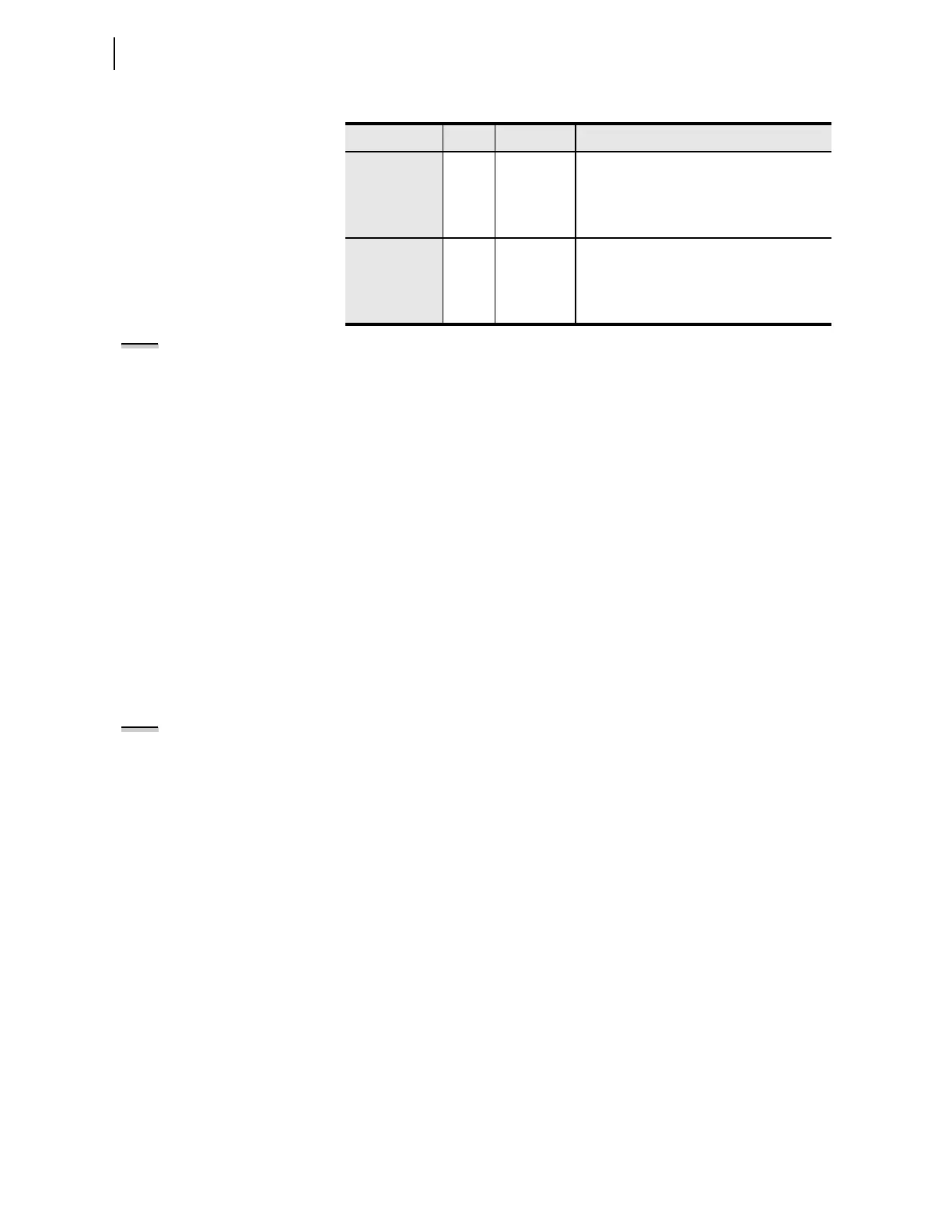
Low Warning/
Alarm
9
OFF Enter LOW WARNING 1 value
10
OFF Enter LOW WARNING 2 value
11
OFF Enter LOW ALARM value
High Warning/
Alarm
12
65 Enter HIGH WARNING 1 value
13
95 Enter HIGH WARNING 2 value
14
105 Enter HIGH ALARM value
Ta b l e 4 .76 S u m m a r y o f Step s (Sheet 2 of 2)
Step Activity Terse Description


 To Next Page