Virtex-5 FPGA User Guide www.xilinx.com 233
UG190 (v5.0) June 19, 2009
Virtex-5 FPGA SelectIO Primitives
Virtex-5 FPGA SelectIO Primitives
The Xilinx software library includes an extensive list of primitives to support a variety of
I/O standards available in the Virtex-5 FPGA I/O primitives. The following are five
generic primitive names representing most of the available single-ended I/O standards.
• IBUF (input buffer)
• IBUFG (clock input buffer)
• OBUF (output buffer)
• OBUFT (3-state output buffer)
• IOBUF (input/output buffer)
These six generic primitive names represent most of the available differential I/O
standards:
• IBUFDS (input buffer)
• IBUFGDS (clock input buffer)
• OBUFDS (output buffer)
• OBUFTDS (3-state output buffer)
• IOBUFDS (input/output buffer)
• IBUFDS_DIFF_OUT (input buffer)
IBUF and IBUFG
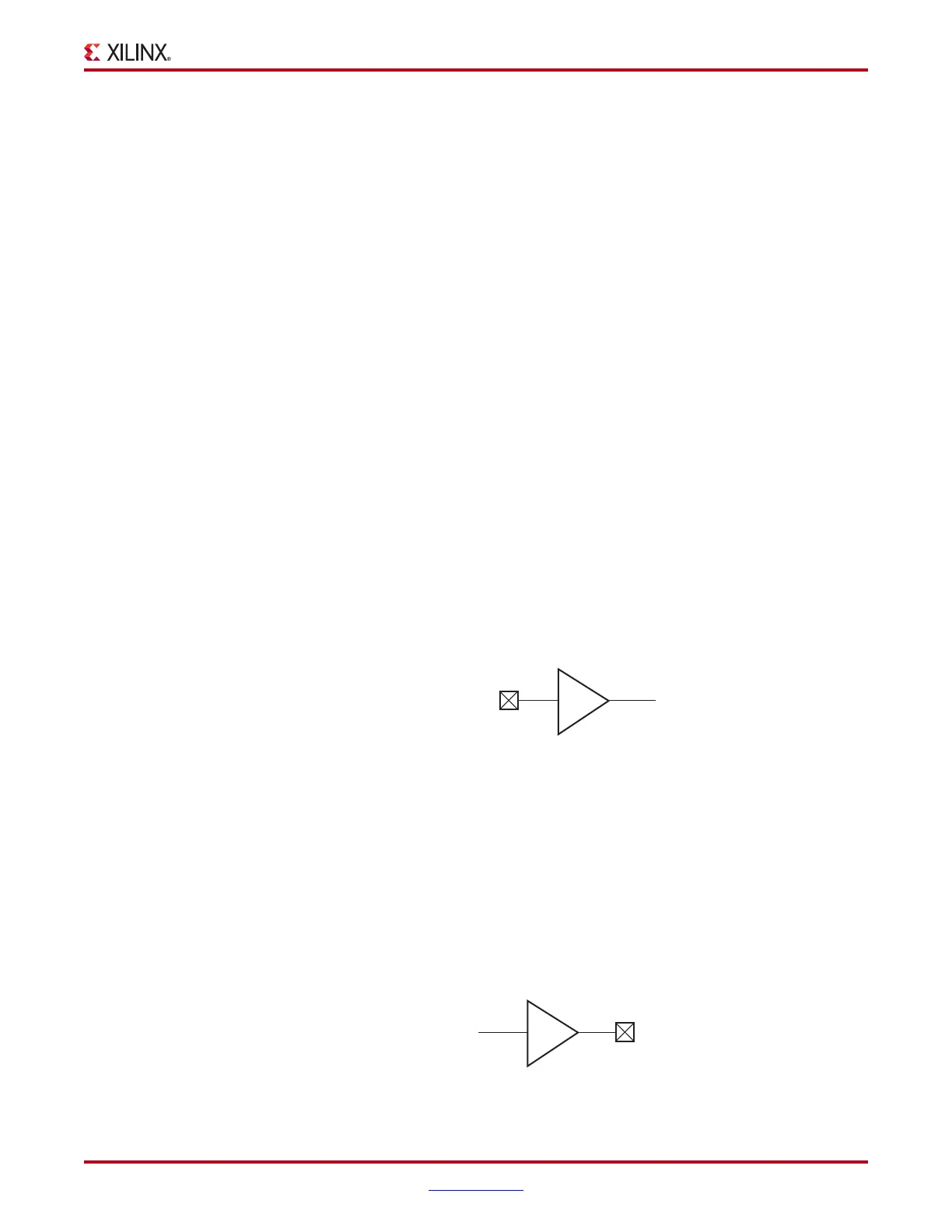
Signals used as inputs to Virtex-5 devices must use an input buffer (IBUF). The generic
Virtex-5 FPGA IBUF primitive is shown in Figure 6-18.
The IBUF and IBUFG primitives are the same. IBUFGs are used when an input buffer is
used as a clock input. In the Xilinx software tools, an IBUFG is automatically placed at
clock input sites.
OBUF
An output buffer (OBUF) must be used to drive signals from Virtex-5 devices to external
output pads. A generic Virtex-5 FPGA OBUF primitive is shown in Figure 6-19.
X-Ref Target - Figure 6-18
Figure 6-18: Input Buffer (IBUF/IBUFG) Primitives
ug190_6_16_022806
IBUF/IBUFG
O (Output)
into FPGA
I (Input)
From device pad
X-Ref Target - Figure 6-19
Figure 6-19: Output Buffer (OBUF) Primitive
ug190_6_17_022806
OBUF
O (Output)
to device pad
I (Input)
From FPGA



 To Next Page
 Loading...