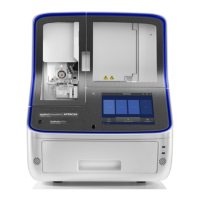
The SeqStudio™ Flex Series Genetic Analyzer is a fluorescence-based DNA analysis instrument that utilizes capillary electrophoresis technology. It is available in 8-capillary (Cat. No. A50369) and 24-capillary (Cat. No. A50370) models. The system includes the instrument itself, an 8- or 24-capillary array, POP™ polymer, reagents and consumables for various applications and system qualification, and integrated software for instrument control, data collection, quality control, basecalling, and sizecalling of samples.
Function Description:
The instrument performs DNA analysis by preparing capillaries with fresh polymer, electrokinetically injecting samples, washing capillary tips, and then applying a high electric field to separate fluorescently labeled DNA fragments. Smaller fragments migrate faster and reach the detector first. The capillaries are thermally controlled in an oven and detection cell to ensure optimal separation and DNA denaturation. Laser light excites the dyes attached to DNA, and the emitted fluorescent light is captured by instrument optics, spread by a transmission grating, and imaged onto a cooled CCD array. This process collects 20-color data per capillary, which is then converted into multi-dye data for the run. For sequencing, 4 dyes determine A, G, C, and T bases, while for fragment analysis, up to 6 dyes determine fragment sizes. The software generates electropherograms and primary analysis results, including basecalling and quality values for sequencing (AB1 format) and fragment sizing and quality values (FSA format).
Important Technical Specifications:
- Laser: Long-life, single-line 505 nm, solid-state laser with 20 mW output power and 1.4 mrad beam divergence.
- LED: Emitting natural white light with 30 Cd luminous intensity.
- Electrophoresis voltage: Up to 20 kV.
- Oven temperature: Active temperature control from 18°C–70°C.
- Instrument dimensions: Approximately 68 cm (27 inches) deep, 70 cm (28 inches) wide with doors closed (99 cm/39 inches with doors open), and 87 cm (35 inches) high.
- Weight: Approximately 115 kg (254 lbs). A bench rated for ~150 kg (331 lb) is recommended.
- Operating conditions: 15–30°C (59–86°F), 20–80% relative humidity (noncondensing). Room temperature should not fluctuate ±2°C during an instrument run.
- Storage conditions: –30 to +60°C (–22 to +140°F), 5–95% relative humidity.
- Electrical requirements: Dedicated line and ground, 1,000 VA/W max power dissipation, mains AC line voltage tolerance ±10%.
- RFID: Four identical wireless RFID read/write units (13.56 MHz, ~67 mW output power) track consumables (capillary array, anode/cathode buffer containers, polymer pouches) by reading lot numbers, serial numbers, expiration dates, and usage capacity. Effective range between RFID tag and internal read/write units varies by consumable (e.g., 8.8–9.6 mm for ABC tag, 18.4 mm for polymer pouch tag). Typical use range is 0.5 cm. Minimum separation distance from external RFID devices is 10 cm, and from other wireless technologies (WiFi, Bluetooth, Cellular) is 92 cm. Wireless security includes checksum, password access, and Base-64 encoding.
Usage Features:
- Integrated Touchscreen Software (v1.0): Provides a complete workflow from plate file setup to primary analysis results review.
- Intuitive Display: Shows sample quality, run notifications, and consumables status.
- Plate Capacity: Supports 4 plates with interactive loading during runs.
- Injection Prioritization: Allows users to prioritize injection order.
- Automated Barcode Workflow: Utilizes an internal barcode reader and optional external USB barcode reader for automated plate linking.
- Enhanced Accuracy: Spectral autocalibration is performed during every run.
- Libraries: Enables reuse of plate files, injection protocols, and other run elements.
- Learning Aids: Includes on-instrument tutorial videos, demonstration mode, step-by-step maintenance wizards, and Smart Help for technical support.
- Thermo Fisher™ Connect Integration (Optional):
- Voice Commands: Uses Amazon™ Alexa™ for Business for hands-free operation (e.g., linking plates, starting runs).
- Remote Plate File Creation: Create plate files from the cloud.
- Cloud Data Storage: Store data on the cloud.
- Remote Run Monitoring: Monitor runs from a remote computer or mobile device via the InstrumentConnect app.
- Automated Cloud Analysis: Integrates with Thermo Fisher Scientific sequencing and fragment analysis cloud apps (e.g., Quality Check, Variant Analysis, Next-generation Confirmation, Peak Scanner, Microsatellite Analysis).
- Security, Auditing, and E-signature (SAE) v2.1 Module (Optional): Controls user access, grants permissions, provides an audit trail, and supports electronic signatures for critical functions.
- Network Connection Options: Supports wired, wireless (802.11 b/g/n), and direct connections to a computer or network drive for data transfer and remote management.
Maintenance Features:
- Maintenance Schedule: Daily, monthly, and annual tasks are outlined, with software alerts for upcoming maintenance.
- Wizards: Step-by-step wizards guide users through complex procedures such as:
- Changing Capillary Array: Includes options to store or discard the old array.
- Changing Polymer Type: Allows switching polymer types, with optional capillary array changes.
- Replenishing Buffers: Guides installation of fresh anode and cathode buffer containers.
- Replenishing Polymer: Guides installation of new polymer pouches.
- Removing Bubbles: Clears bubbles from the fluid pathway (automatically performed during other wizards or manually if needed).
- Washing Pump and Channels: Primes the polymer pump with conditioning reagent and fills with fresh polymer.
- Shut Down Instrument: Prepares the instrument for storage (>2 weeks) by removing the capillary array and polymer, and installing conditioning reagent.
- Reactivate Instrument: Prepares the instrument for operation after storage.
- Spatial Calibration: Associates signals from each capillary to the CCD camera (automatically performed during capillary array changes or manually if needed).
- Cleaning: Instructions for cleaning instrument surfaces, anode buffer pin-valve assembly, drawer, buffer autosampler, drip tray, and capillary tips.
- Consumables Tracking: RFID tags on consumables track usage and expiration, with software warnings and options to prevent use beyond supported limits.
- Log File Export: Ability to export consumables install logs, usage logs, error logs, and firmware logs for troubleshooting and record-keeping.
- User Data Backup: Administrator-only function to back up instrument settings, library items, and run results.

 Need help?
 General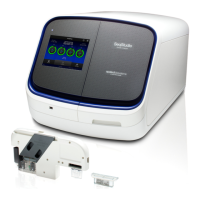


 To Next Page