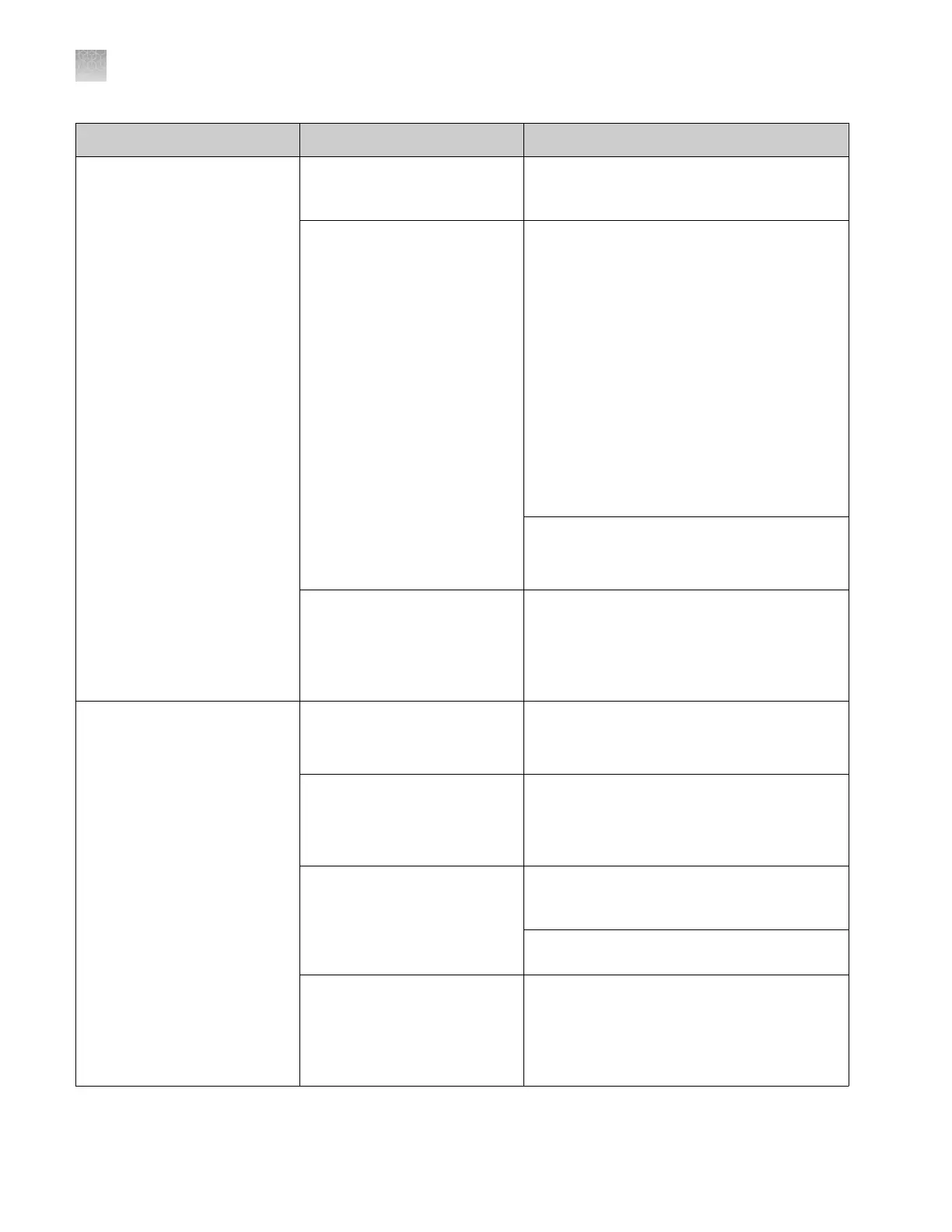
Observation Possible cause Recommended action
Poor resolution, low size
quality, or a low-quality
sequencing result is observed
Details: Results are color-
coded based on quality. For
more information, see “Sample
QC and quality alerts” on
page 172.
(continued)
Consumables are past on-
instrument and/ or product
expiration.
Install new, unexpired consumables.
The temperature and/or
humidity in the lab is too
high for optimal sample and
polymer stability.
Ensure that the conditions in the lab are
within the operating range for the instrument
(15–30°C and 20–80% relative humidity).
Sample stability can be lower near the high
end of the operating range of the instrument
for temperature and humidity.
The polymer has been verified for use for up
to 14 days on the instrument at the following
temperature ranges:
•
15–25°C—POP-4
™
and POP-7
™
•
15–30°C—POP-6
™
At higher temperatures, the limit is 7 days on
the instrument.
Use 20 µL of sample instead of 10 µL.
A lar
ger sample volume can reduce sample
breakdown under hot and humid conditions.
There was a sporadic data
quality failure.
Note: A sporadic data
quality failure can happen
occasionally.
Re-inject the sample.
No signal or a low signal is
det
ected
Note: Samples are stable
on the instrument for 16–24
hours. Determine if samples
will be stable if a re-injection
is recommended, then plan the
re-injection accordingly.
The sample volume was
insucient.
Use the recommended sample volume.
See “Sample preparation guidelines” on
page 73.
The sample concentration was
t
oo low.
Re-inject the samples with adjusted injection
conditions.
Injection time, voltage, or a combination of
these conditions can be adjusted.
There were bubbles in the
sample wells.
Centrifuge the sample plate or tubes to
r
emove the bubbles before loading onto the
instrument.
If the samples have been run, centrifuge the
plate or tubes, then set up a re-injection.
The sequencing reaction failed. Review the sequencing protocol, the template
quality, and the template quantity. Set up a
new plate and repeat the reaction.
See Troubleshooting Sanger sequencing data
User Bulletin (Pub. No. MAN0014435).
Appendix A Troubleshooting
Sample and data troubleshooting
A
514
SeqStudio
™
Flex Series Genetic Analyzer with Instrument Software v1.0 User Guide



 To Next Page