DocID13284 Rev 2 421/564
UM0404 CAN modules
messages and stores them (if they pass acceptance filtering) into a Receive Buffer.
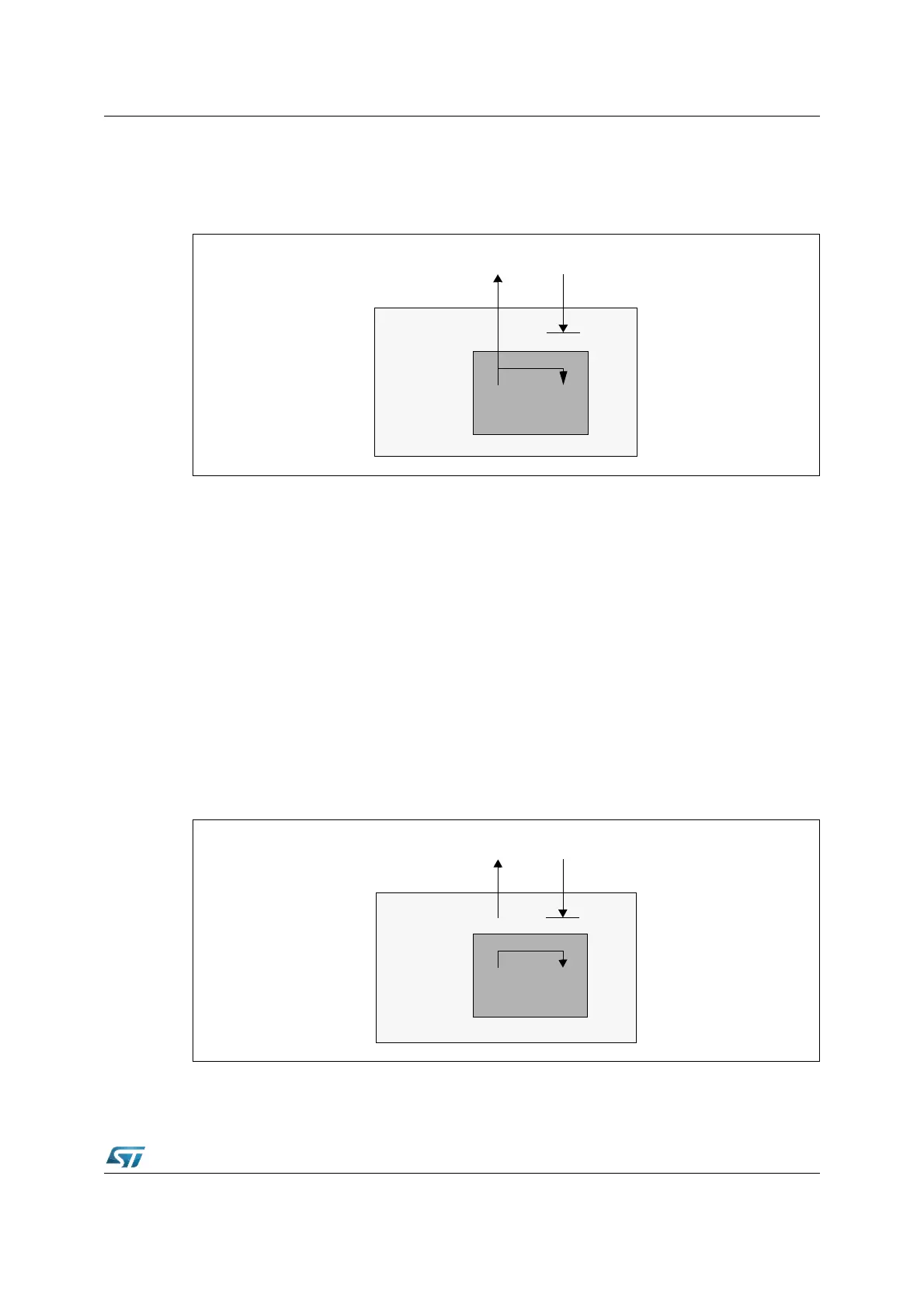
Figure 178 shows the connection of signals CAN_TxD and CAN_RxD to the CAN Core in
Loop Back Mode.
Figure 178. CAN core in loop back mode
This mode is provided for self-test functions. To be independent from external stimulation,
the CAN Core ignores acknowledge errors (recessive bit sampled in the acknowledge slot of a
data/remote frame) in Loop Back Mode. In this mode the CAN Core performs an internal
feedback from its Tx output to its Rx input. The actual value of the CAN_RxD input pin is
disregarded by the CAN Core. The transmitted messages can be monitored at the
CAN_TxD pin.
21.7.7 Loop back combined with silent mode
It is also possible to combine Loop Back Mode and Silent Mode by programming bits LBack
and Silent to one at the same time. This mode can be used for a “Hot Selftest”, meaning the
C-CAN can be tested without affecting a running CAN system connected to the pins
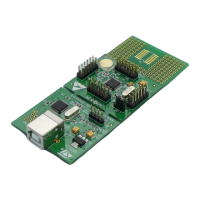
CAN_TxD and CAN_RxD. In this mode the CAN_RxD pin is disconnected from the CAN
Core and the CAN_TxD pin is held recessive. Figure 179 shows the connection of signals
CAN_TxD and CAN_RxD to the CAN Core in case of the combination of Loop Back Mode
with Silent Mode.
Figure 179. CAN core in loop back combined with silent mode
CAN_TxD CAN_RxD
Tx Rx
CAN Core
C-CAN
•
•
CAN_TxD CAN_RxD
Tx Rx
CAN Core
C-CAN
•
•
=1


 To Next Page