DocID13284 Rev 2 97/564
UM0404 Interrupt and trap functions
The ST10F276 provides a vectored interrupt system. In this system specific vector locations
in the memory space are reserved for the reset, trap, and interrupt service functions.
Whenever a request occurs, the CPU branches to the location that is associated with the
respective interrupt source.
This allows direct identification of the source that caused the request. The only exceptions
are the class B hardware traps, which all share the same interrupt vector.
The status flags in the Trap Flag Register (TFR) can then be used to determine which
exception caused the trap. For the special software TRAP instruction, the vector address is
specified by the operand field of the instruction, which is a seven bit trap number.
The reserved vector locations build a jump table in the low end of the ST10F276’s address
space (segment 0).
The jump table is made up of the appropriate jump instructions that transfer control to the
interrupt or trap service routines, which may be located anywhere within the address space.
The entries of the jump table are located at the lowest addresses in code segment 0 of the
address space. Each entry occupies 2 words, except for the reset vector and the hardware
trap vectors, which occupy 4 or 8 words.
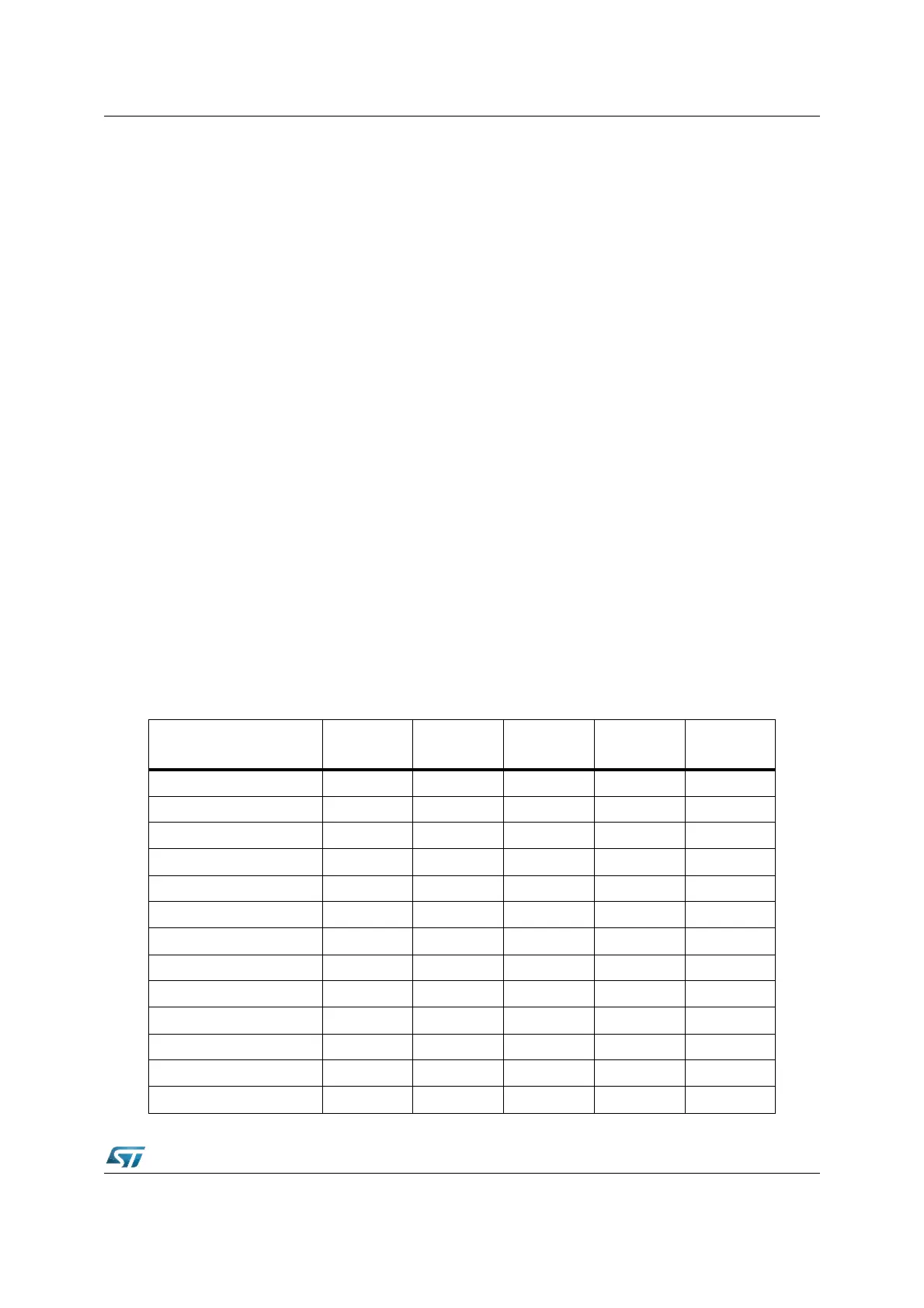
The Table 15 lists all sources that are capable of requesting interrupt or PEC service in the
ST10F276, the associated interrupt vectors, their locations and the associated trap
numbers. It also lists the mnemonics of the affected Interrupt Request flags and their
corresponding Interrupt Enable flags. The mnemonics are composed of a part that specifies
the respective source, followed by a part that specifies their function (IR = Interrupt Request
flag, IE = Interrupt Enable flag).
Each entry of the interrupt vector table provides room for two word instructions or one
double-word instruction. The respective vector location results from multiplying the trap
number by 4 (4 bytes per entry).
Table 15. Interrupt and PEC service request sources
Source of interrupt or
PEC service request
Request
flag
Enable
flag
Interrupt
vector
Vector
location
Trap
number
CAPCOM Register 0 CC0IR CC0IE CC0INT 00’0040h 10h
CAPCOM Register 1 CC1IR CC1IE CC1INT 00’0044h 11h
CAPCOM Register 2 CC2IR CC2IE CC2INT 00’0048h 12h
CAPCOM Register 3 CC3IR CC3IE CC3INT 00’004Ch 13h
CAPCOM Register 4 CC4IR CC4IE CC4INT 00’0050h 14h
CAPCOM Register 5 CC5IR CC5IE CC5INT 00’0054h 15h
CAPCOM Register 6 CC6IR CC6IE CC6INT 00’0058h 16h
CAPCOM Register 7 CC7IR CC7IE CC7INT 00’005Ch 17h
CAPCOM Register 8 CC8IR CC8IE CC8INT 00’0060h 18h
CAPCOM Register 9 CC9IR CC9IE CC9INT 00’0064h 19h
CAPCOM Register 10 CC10IR CC10IE CC10INT 00’0068h 1Ah
CAPCOM Register 11 CC11IR CC11IE CC11INT 00’006Ch 1Bh
CAPCOM Register 12 CC12IR CC12IE CC12INT 00’0070h 1Ch


 To Next Page