Scan Recipes - CMP Analysis KLA-Tencor P-16+ / P-6 User’s Guide
3-80 KLA-Tencor Confidential 0142530-000 AB
3/13/09
Arrays 3
For the purposes of this analysis, “array” is defined as an array of contacts or
vias (plugs). The contacts or vias are usually a metal like tungsten or copper
which typically have polish rates higher than that of the surrounding array
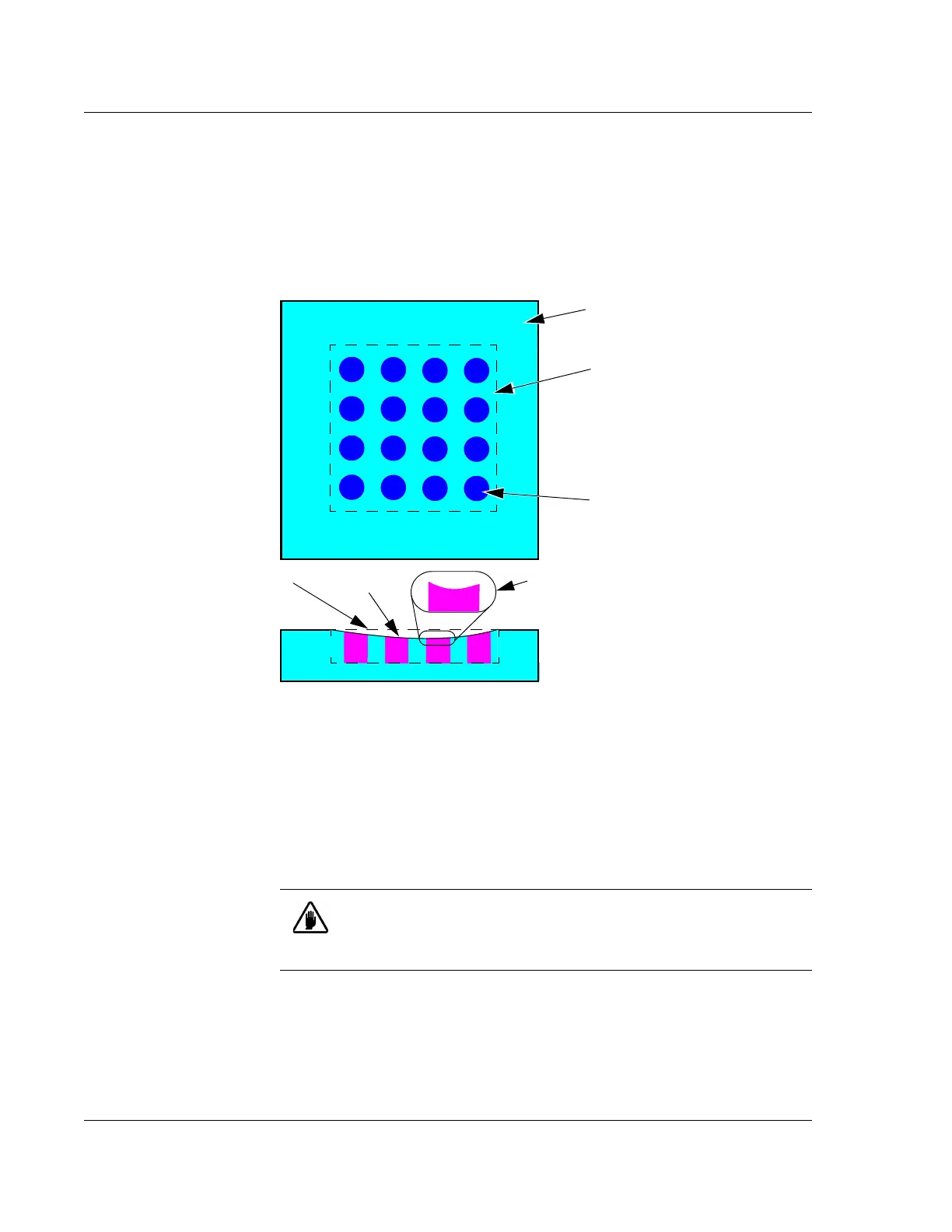
oxide. The basic composition of a sample array is illustrated in Figure 3.64.
Using the ARRAY Analysis Routine
3
This routine is designed to perform analysis on both 2D and 3D Profiler data.
The same set of input parameters are used for 2D and 3D data belonging to a
single recipe, e.g., 2D slices from a 3D data set. The routine is intended for
use with array profiles that have negligible recess and considerable
erosion. It can calculate both erosion and recession.
Analysis Process
The analysis is performed on Normal data as described in the following
sequence:
Figure 3.64 Sample Array
Field Oxide
Array oxide. Same
chemical structure but has
faster polish rates due to
presence of plugs.
Metal-filled contact or via
(plug). CMP polish rates are
typically higher than that of
array oxide.
Erosion RecessDashed line represents
surface with no erosion
CAUTION: The Array Analysis algorithm assumes that there will be a
flat profile at the beginning of the scan and at the end of the scan.
Therefore, the scan must start in the field oxide and end in the field
oxide so that the required flat regions border the scan target.


 To Next Page