UMN:CLI User Manual
V5808
292
8.3.2 RSTP Operation
STP or RSTP is configured on network where Loop can be created. However, RSTP is
more rapidly progressed than STP at the stage of reaching to the last topology. This
section describes how the RSTP more improved than STP works. It contains the below
sections.
• Port States
• BPDU Policy
• Rapid Network Convergence
• Compatibility with 802.1d
8.3.2.1 Port States
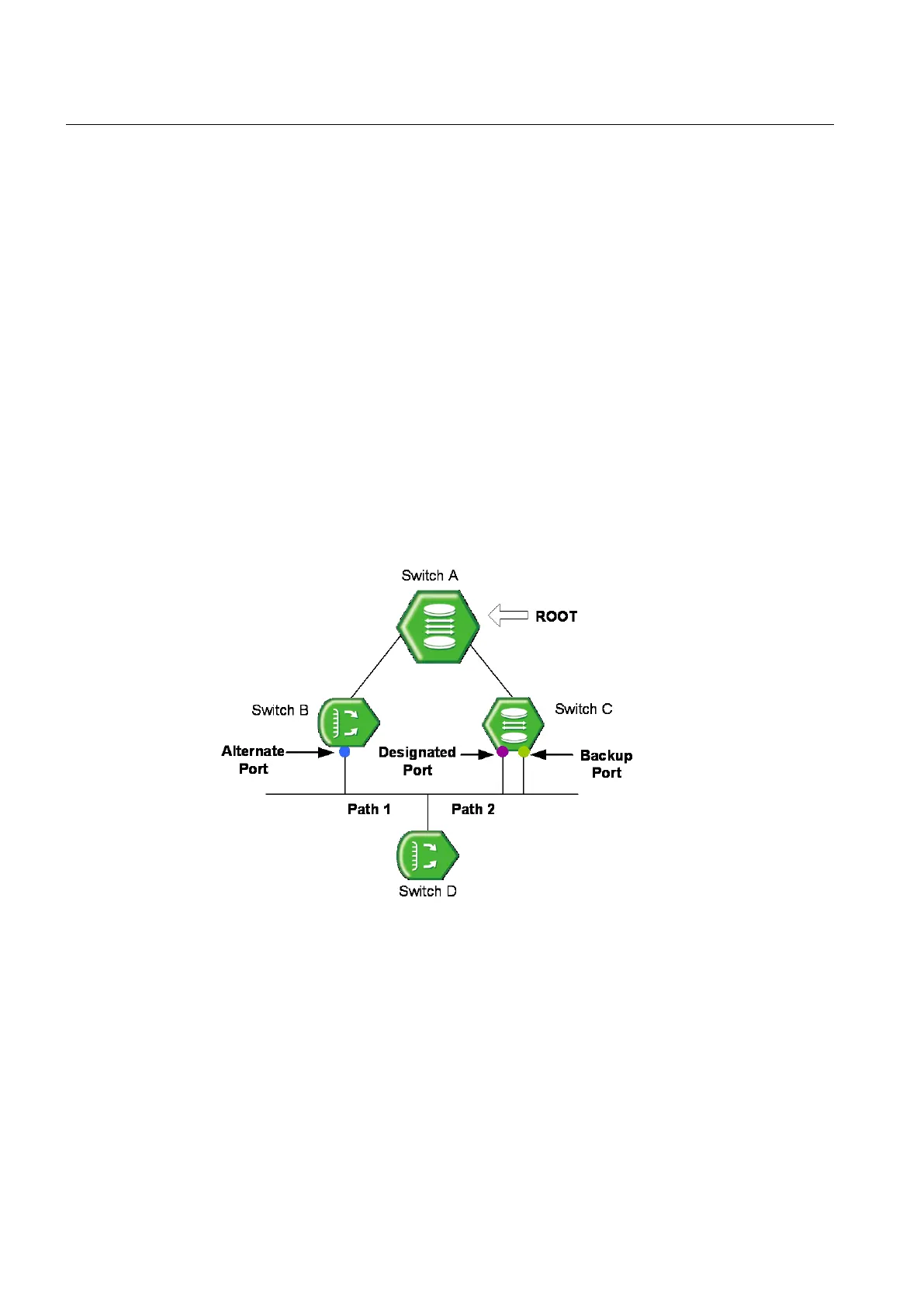
RSTP defines port states as discarding, learning, and forwarding. Blocking of 802.1d and
listening is combined into discarding. Same as STP, root port and designated port are
decided by port state. But a port in blocking state is divided into alternate port and backup
port. An alternate port means a port blocking BPDUs of priority of high numerical value
from other switches, and a backup port means a port blocking BPDUs of priority of high
numerical value from another port of same equipment.
Fig. 8.15 Alternate Port and Backup port
The difference of between alternate port and backup port is that an alternate port can
alternate the path of packet when there is a problem between Root switch and SWITCH
C but Backup port cannot provide stable connection in that case.
8.3.2.2 BPDU Policy
In 802.1d, only the root switch forwards BPDU following Hello-time. However in 802.1w,
not only root switch but also all the other switches forward BPDU following Hello-time. In
802w, BPDU is forwared more frequently than the interval of transmitting BPDU by the
root switch in 802.1d.


 To Next Page