UMN:CLI User Manual
V5808
612
11.6 Virtual Routing and Forwarding (VRF)
Virtual Routing and Forwarding (VRF) is a feature that enables multiple instances of
routing table within the single router at the same time. Since the routing tables are
independent, the private IP address can be used without the confliction. In general it is
utilized for VPN service to provide separate routing table for each customer’s network.
Virtual Private Networks (VPN) provides a secure way for customers to share the
bandwidth over a common backbone network. Each VPN requires its own routing table
called VRF table. Supporting multiple VRF tables allow a switch to support multiple VPNs,
where IP addresses can be overlapped among the VPNs. VRF forms virtual packet
forwarding/routing tables by associating one or more Layer 3 interfaces with a given VRF
table. Based on the input L3 interface, a VRF ID is obtained, which is used to access the
VRF table.
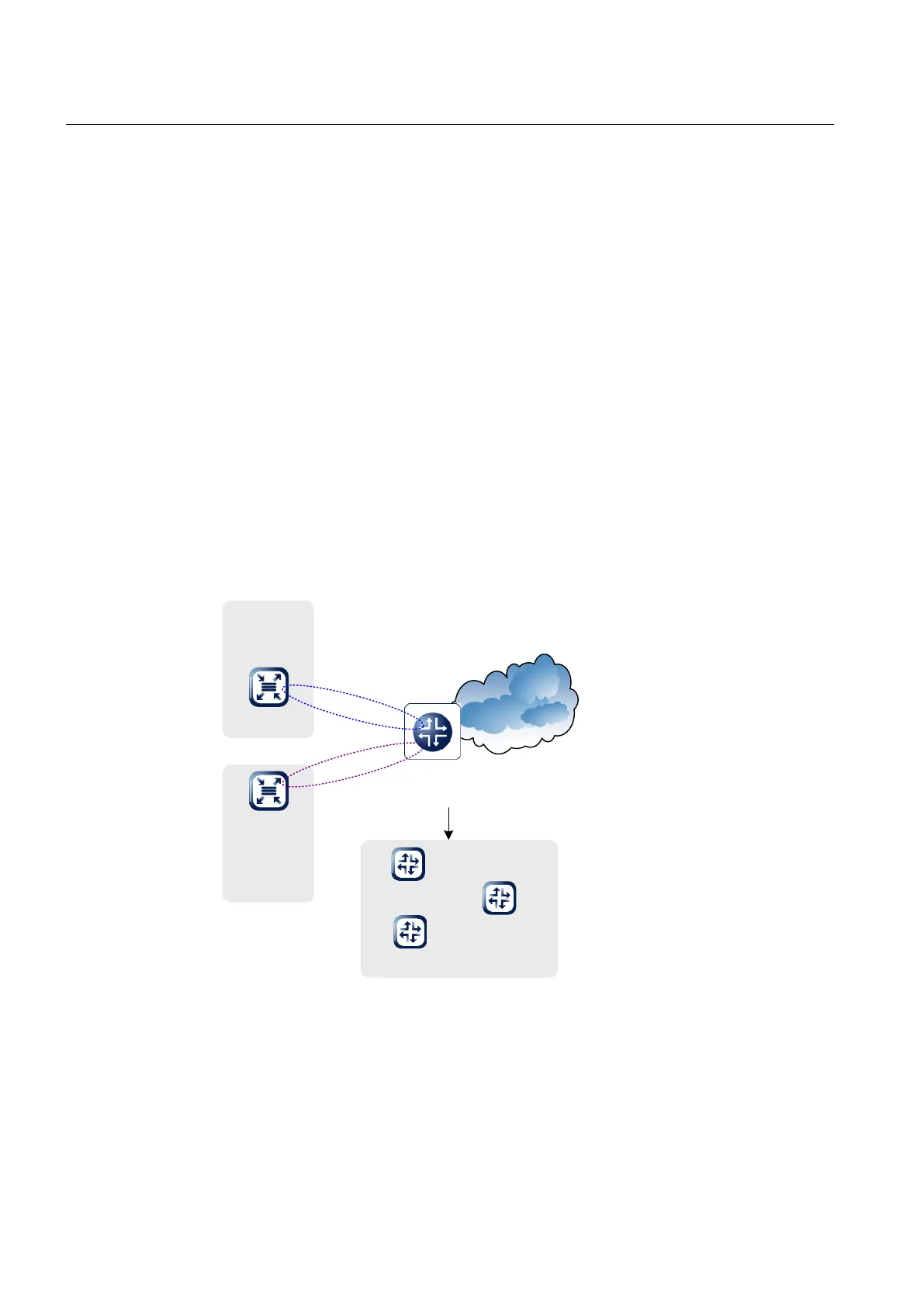
Provider Equipment (PE) routers maintain virtual routing tables which are per-site
forwarding tables. Every site to which the PE router is attached is associated with one of
these tables. A particular packet's IP destination address is looked up in a particular
virtual routing table only if that packet has arrived directly from a site that is associated
with that table. The PE router maintains a separate forwarding environment and a
separate forwarding table for each VPN in a PE-based VPN approach.
PSN
Provider
Equipment (PE)
Global IP
routing table
VRF routing table
for VPN A
VRF routing table
for VPN B
Customer
Equipment
VPN B
Site 1
Customer
Equipment
VPN A
Site 1
Fig. 11.1 Virtual Routing Concept
11.6.1 Creating a VRF Routing Table
VRF can be created and deleted like VLAN management. Once a VRF table is created, it
can be bound with L3 interfaces which are called as VRF interfaces. The incoming
packets from a VRF interface is forwarded based on the corresponding (bound) VRF
table. The static route can be added to or deleted from a VRF table, and routing protocols
can also run on it.


 To Next Page