UMN:CLI User Manual
V5808
362
Message types from client to server
- Solicit, Request, Confirm, Renew, Rebind, Release, Decline, Information-request
Message types from server to client
- Advertise, Replay, Reconfigure
Message type from relay to relay/server
- Relay-forward
Message type from relay/server to relay
- Relay-reply
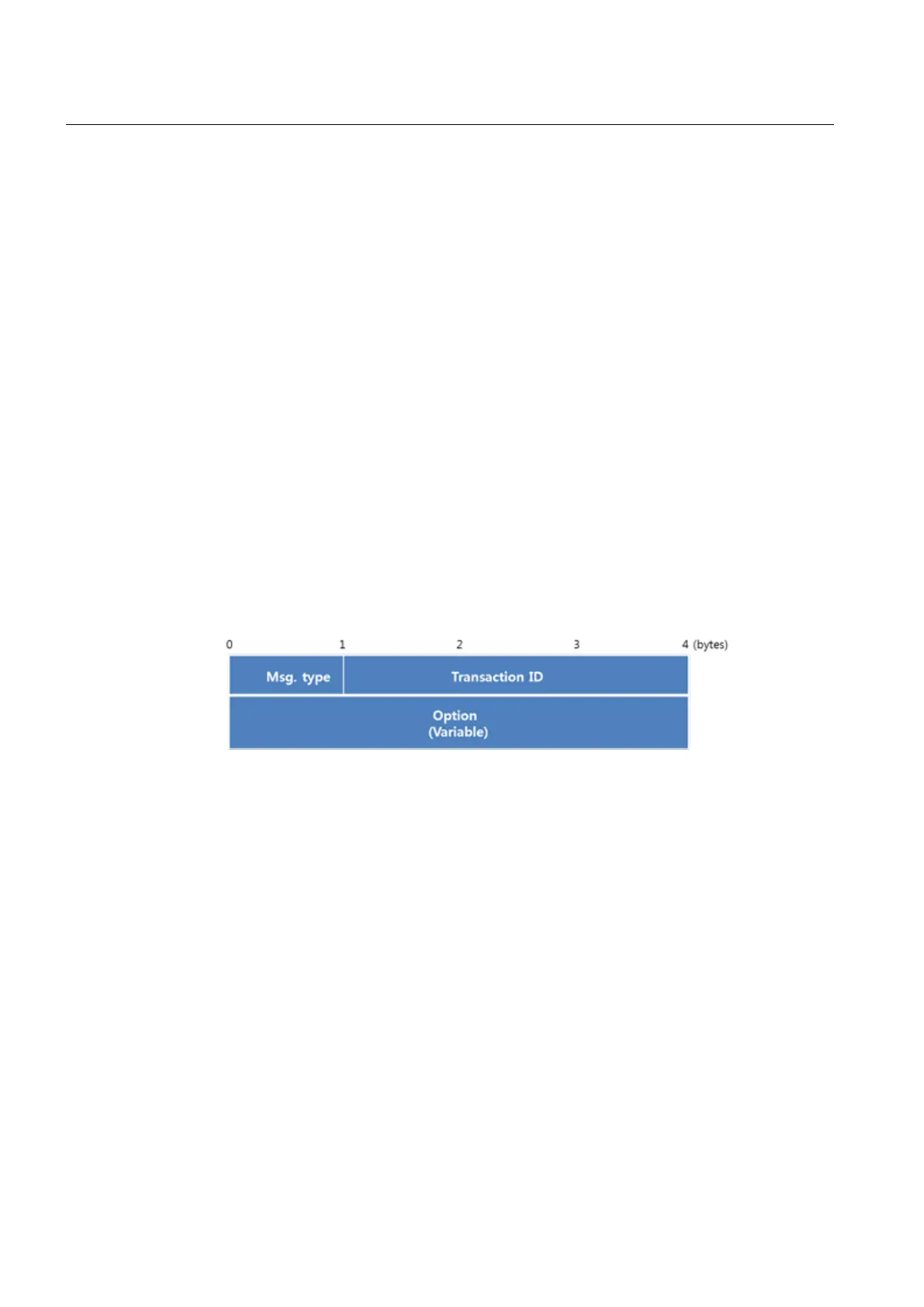
DHCPv6 Client-Server Message
DHCP servers communicate with DHCP clients by a series of DHCP messages. The Msg.
Type field (1-byte) indicates the type of DHCPv6 message. The Transaction ID field (3-
byte) is determined by a client and used to group the messages of a DHCPv6 message
exchange together. Following the Transaction-ID field, DHCPv6 options are used to
indicate client and server identification, addresses, and other configuration settings. For
the list of defined DHCPv6 options, see RFC 3315. DHCPv6 options are formatted with
the type-length-value (TLV) format.
The following figure shows the structure of DHCPv6 messages sent between client and
server.
Fig. 8.33 Basic DHCPv6 Message Format
DHCPv6 Relay agent-Server Message
DHCP relay agent is a node that acts as an intermediary to deliver DHCP messages
between clients and servers, and is on the same link as the client. If there is a relay agent
between the client and the server, the relay agent sends the server Relay-Forward
messages containing the encapsulated Solicit and Request messages from the client.
The server sends the relay agent Relay-Reply messages containing the encapsulated
Advertise and Reply messages for the client.
There is a separate message structure for the messages exchanged between relay
agents and servers to record additional information.


 To Next Page