UMN:CLI User Manual
V5808
452
and multicast traffic is sent via that distribution tree, the DR sends the prune message
with (*, G) state toward the RP to prune the existing shared tree to receive the traffic.
SPT is established based on the existing unicast routing table by performing the RPF
check. It has a different distribution tree for every multicast source, allowing the efficient
network traffic flows, but more resources are needed for each multicast routers to
maintain (S, G) states.
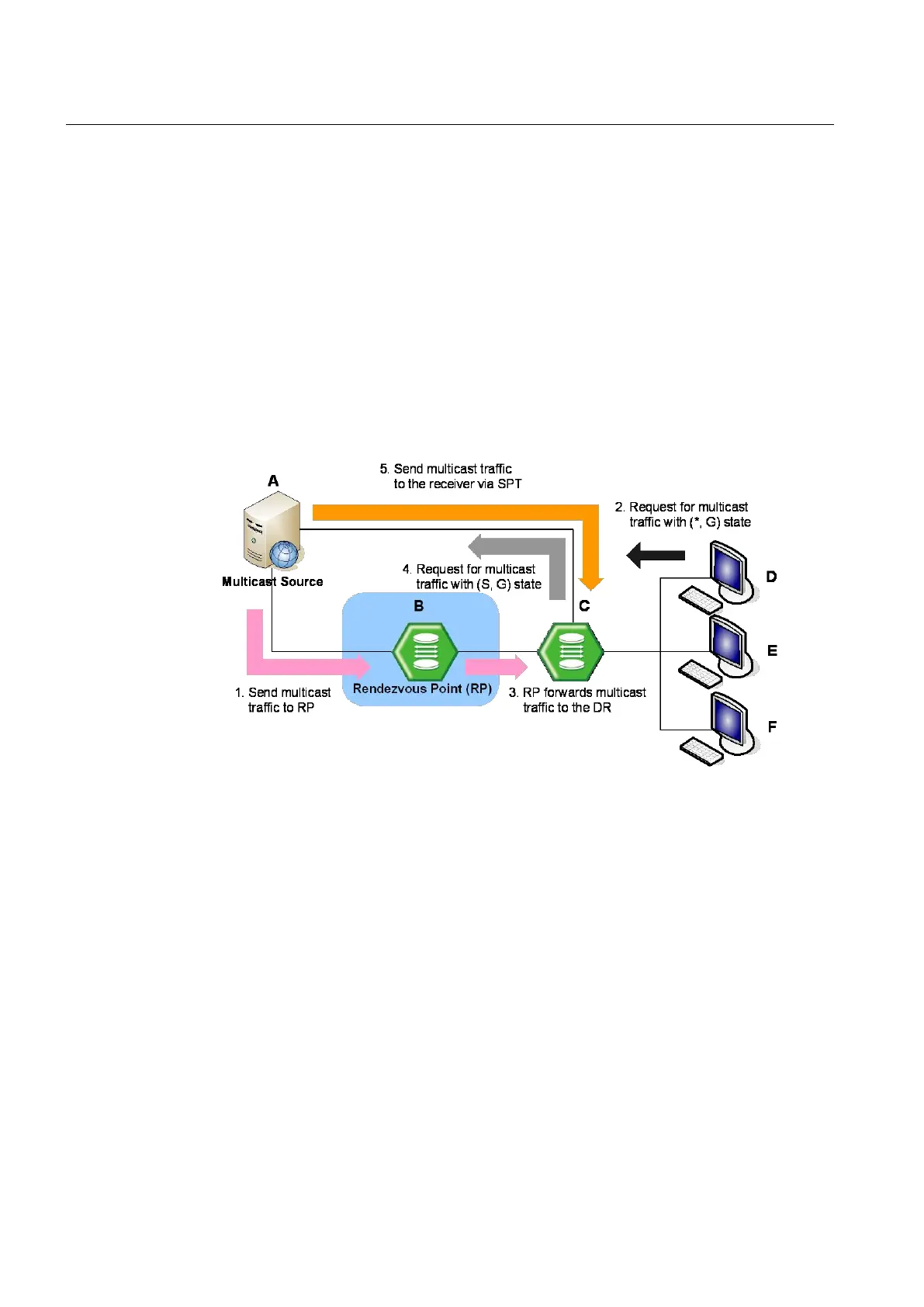
Fig. 9.7 shows an example of the SPT switchover. The multicast traffic from the source A
initially attempts to flow through the router B and C to the receiver D that indicates the
interest in the multicast group. Once the traffic arrives at the router C which is the DR, it
sends the join message with (S, G) state toward the source A to build the SPT between
the source and receiver. The source A then sends the multicast traffic to the receiver D
via the SPT by deleting unnecessary hops. Finally, the distribution tree (SPT) built by the
RPF check is A→C→D.
Fig. 9.7 Shortest Path Tree
PIM-SM Operation
When multicast receivers indicate their interests in certain multicast groups, the DR of the
receivers sends PIM join messages with (*, G) state toward the RP for those groups.
While the join messages flow hop-by-hop toward the RP, each PIM router along the path
adds the interface on which the join messages are received to the outgoing interface
(OIF) list with the join state, and sends the messages to the interface toward the RP.
If the RP has receivers interested in the group, the RP must receive the multicast traffic
from the source of that group via the SPT to deliver the traffic to those receiver. The DR of
the source encapsulates the multicast packets in the PIM register messages, and starts to
unicast them to the RP. On receipt of the register messages, the RP sends the join
message with (S, G) state toward the source to establish the SPT. When receiving the
multicast traffic via the established SPT, the RP forwards the traffic toward those
receivers.
Multicast traffic may be directly delivered from sources to receivers via the SPT using the
switchover mechanism. For more information, see Section 9.3.3.4.


 To Next Page